Few looks carry the glamour and confidence of the Jazz Age, and recreating a 1920s art deco bathroom lets you bring that bold, geometric elegance into a modern home without it feeling like a museum piece. Having restored and re-created period bathrooms in prewar buildings, I can tell you the style is surprisingly livable: it’s built on durable materials, high-contrast color, and clean symmetry that still photograph beautifully a century later.
Art Deco emerged in the mid-1920s as a celebration of machine-age optimism, luxury, and streamlined geometry. In the bathroom, that translated to glossy tile, black-and-white contrast, chrome fixtures, and repeating patterns like chevrons, sunbursts, and stepped forms. Here’s how to capture that look authentically, plus where to spend and where to save.
The Signature Elements of Art Deco Bathrooms
Before choosing materials, understand what actually defines the style. Nail these hallmarks and the room will read Deco even if you mix in modern conveniences:
- High-contrast color: Black and white as a base, punched with a saturated accent like jade green, dusty rose, canary yellow, or cobalt.
- Geometric pattern: Chevrons, zigzags, sunbursts, stepped ziggurat shapes, and repeating tile borders.
- Glossy, reflective surfaces: Polished tile, chrome, mirror, and lacquer.
- Symmetry and streamlining: Balanced, orderly layouts with strong horizontal lines.
- Luxe materials: Marble, brass, chrome, and black lacquer accents.
Authentic Tile Choices
Tile is the heart of a period bathroom, and the 1920s had a distinctive vocabulary. Small hexagonal floor tiles in white with a black border were nearly universal, often laid in a “flower” or accented pattern. On the walls, glossy white subway tile ran to a chair-rail height, capped with a decorative pencil-liner or a bold contrasting band.
For an authentic look, consider:
- 1-inch white hex floor tile with a black key or basketweave accent. Budget $8 to $15 per square foot installed.
- Glossy white subway wall tile to wainscot height with a black liner cap.
- Black-and-white checkerboard floor for a bolder statement.
- Colored field tile in jade, seafoam, or dusty rose for the accent zone.
Period bathrooms loved a strong tile border, a dark band, a geometric fret pattern, or a stylized floral repeat running around the room at chair-rail height. That single detail does more to sell the era than almost anything else.
Color Palettes That Say 1920s
Deco color was daring. Rather than the all-white bathrooms of a decade earlier, the 1920s embraced pastel and jewel tones set against black-and-white bones. Popular period combinations included:
- Black and white with jade or seafoam green accents, arguably the most iconic Deco bath palette.
- White with dusty rose or “flamingo” pink and black trim.
- Cream and canary yellow with black and chrome.
- White and cobalt or navy blue for a cooler, more masculine room.
Keep the accent color deliberate and contained, a tile band, the field around the tub, or the vanity, so it pops against the crisp black-and-white framework rather than overwhelming it.
Fixtures and Fittings
The 1920s introduced streamlined, chrome-plated fittings that still look sharp today. For faucets and hardware, polished chrome is the most period-correct choice, though brass and nickel also appeared in higher-end homes. Look for cross-handle or lever faucets with clean, geometric bases.
Signature fixtures include:
- A pedestal sink or console sink with slender chrome legs and a rectangular basin.
- A built-in or roll-top tub, often alcoved and tiled around, sometimes in a colored tub.
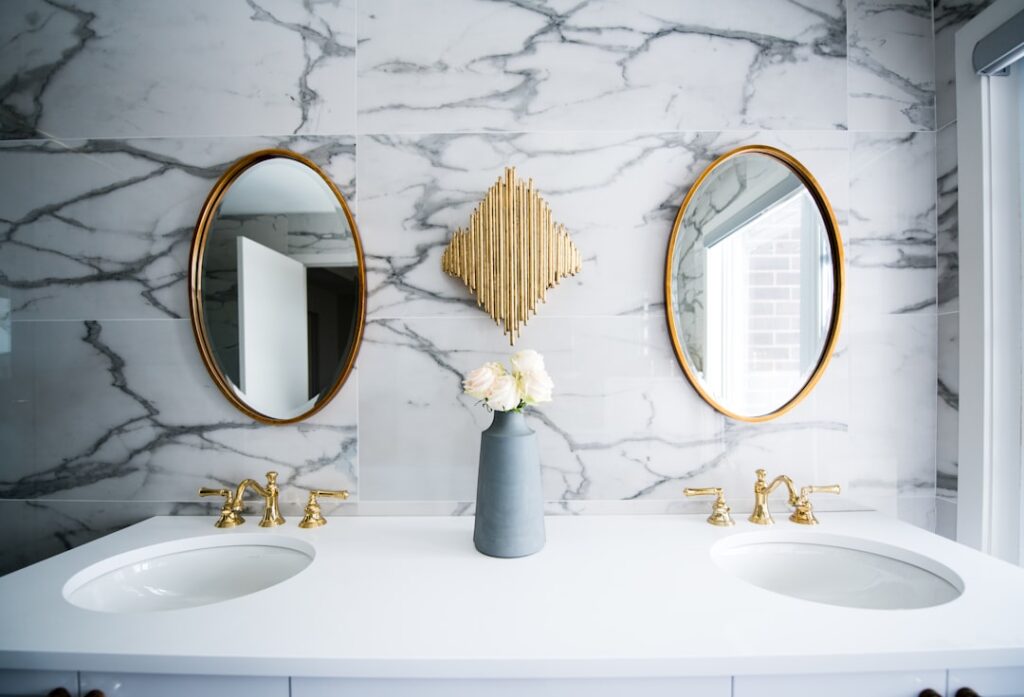
- A round or octagonal mirror with a stepped or sunburst frame.
- Sconces flanking the mirror with frosted glass shades and geometric metalwork.
Colored sanitaryware, a jade-green tub, a pale pink toilet and sink set, was a genuine 1920s and 30s luxury and is a fantastic authentic touch if you can source it, though it commands a premium at salvage yards.
Lighting and Mirrors
Deco lighting is all about geometry and frosted glass. Wall sconces with stepped chrome bodies and opal-glass shades flanking the mirror give the symmetrical, glamorous feel the era loved. A frosted flush-mount ceiling fixture with an etched sunburst or geometric motif finishes the look.
Mirrors were often round, octagonal, or arched, frequently with beveled edges or an etched border. A round mirror framed in a stepped chrome surround, lit by matching sconces, is an instantly recognizable Deco vignette.
Layout and Modern Updates
You don’t have to sacrifice comfort for authenticity. The trick is keeping the period look on the surfaces people see while hiding modern function. Use a low-profile modern toilet with clean lines that reads vintage. Conceal a modern thermostatic shower valve behind period-style cross-handle trim. Add discreet recessed lighting for task illumination while the sconces provide the character.
Ventilation, GFCI outlets, and heated floors can all be integrated invisibly. A radiant heat mat under that hex tile, about $8 to $12 per square foot, gives you a warm floor with no visual compromise, something the original 1920s homeowner would have envied.
What It Costs to Build
Budgets vary widely with material quality and whether you’re doing a full gut. Rough ranges for a standard 5-by-8 hall bath:
- Cosmetic Deco refresh (paint, mirror, sconces, hardware, accessories): $1,500 to $4,000.
- Mid-range renovation (new tile, pedestal sink, fixtures, lighting): $12,000 to $22,000.
- High-end period restoration (custom tile borders, colored sanitaryware, marble, brass): $25,000 to $45,000+.
Reproduction Deco tile and salvaged colored fixtures are where costs climb fastest, so decide early whether authenticity or budget leads the project.
Accessories and Finishing Touches
The details are what push a room from “vintage-ish” to convincingly Deco. Small accessories carry a surprising amount of the load, and they’re easy to swap without renovation. Look for a stepped or fan-shaped soap dish, chrome tumbler holders, and a geometric wastebasket. Towels in crisp white with a single bold stripe echo the era’s love of horizontal lines.
Window treatments matter too. A frosted or reeded glass window, or a simple etched geometric film, keeps light diffused and privacy intact while staying period-correct. For flooring transitions and thresholds, black marble or a black tile border frames the room and reinforces that high-contrast Deco discipline. Even the switch plates count, polished chrome or black Bakelite-style plates finish the walls the way the original builders would have.
Artwork should stay graphic and stylized. Framed vintage travel posters, Erté-style figure prints, or a simple sunburst mirror complete the vignette. Resist the urge to over-decorate; Art Deco’s power comes from restraint, symmetry, and a few strong statements rather than clutter.
Frequently Asked Questions
What colors define a 1920s art deco bathroom?
Black and white form the foundation, accented by a single bold color, most often jade green, dusty rose, canary yellow, or cobalt blue. The high-contrast combination of black, white, and one saturated jewel or pastel tone is the signature Deco palette.
What tile is most authentic for an Art Deco bathroom?
Small white hexagonal floor tile with a black accent and glossy white subway wall tile capped by a bold geometric border band are the most period-correct choices. Black-and-white checkerboard floors and colored field tiles in jade or pink are also authentic options.
Can I get the Art Deco look on a budget?
Yes. Focus your money on high-impact surfaces, a hex or checkerboard floor and a strong tile border, then save with reproduction chrome sconces, an off-the-shelf round mirror, and paint in period accent colors. A cosmetic refresh can capture the vibe for $1,500 to $4,000.
Are colored fixtures necessary for an authentic look?
Not necessary, but they’re one of the most convincing period details. Jade-green tubs and pink toilet-and-sink sets were genuine 1920s and 30s luxuries. If salvaged colored sanitaryware is out of budget, keep fixtures white and bring the color in through tile and paint instead.
A 1920s art deco bathroom rewards attention to a few key details: high-contrast tile, geometric borders, chrome fittings, and one confident accent color. Get those right and hide the modern mechanicals behind period-correct trim, and you’ll have a room with genuine Jazz Age glamour that still functions perfectly for daily life.