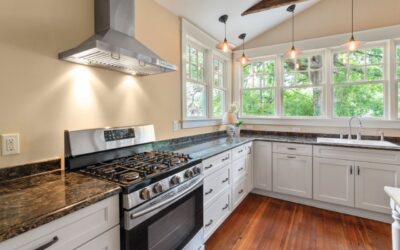
A 24 inch range hood is the natural partner for the compact ranges found in apartments, condos, cottages and small galley kitchens. The catch is that a hood exactly as wide as the cooktop often lets smoke and grease escape past the edges. Getting the width, fan power, mounting height and ducting right matters more in a small kitchen than a large one, because there is less air volume to dilute cooking fumes.
Part of our Kitchen Remodeling guide — explore the full guide →
The quick answer: pair a 24 inch range with a hood that is at least 24 inches wide, and go to 30 inches if the cabinet layout allows. For fan power, 200 to 300 CFM covers most electric 24 inch ranges, while gas models benefit from a bit more. Mount the hood at the height the manufacturer lists, usually in the 24 to 30 inch range above the cooking surface, and duct it to the outdoors whenever you can.
- Sizing a 24 Inch Range Hood to Your Cooktop
- How Much CFM Do You Need?
- Make-Up Air and Gas Ranges
- Under-Cabinet vs Wall and Insert Styles
- Mounting Height and Clearances
- Ducting Done Right
- Wiring and Installation Steps
- Troubleshooting
- Costs
- When to Call a Licensed Professional
- Frequently Asked Questions
Sizing a 24 Inch Range Hood to Your Cooktop
The general rule is that a hood should match the cooktop width or exceed it by about 3 inches on each side. A 24 inch range hood meets the minimum for a 24 inch range, and that is fine for everyday cooking on an electric coil or smooth top. A 27 or 30 inch hood captures more of the plume, which rises and spreads as it goes up.
Width is only half the equation. Depth matters too: the front edge of the hood should cover at least the front burners. Many compact under-cabinet models are 17 to 20 inches deep, which works for a standard 24 inch range whose cooktop is roughly 22 inches deep.
- 24 inch range, electric: 24 inch hood acceptable; 30 inch preferred if cabinets allow.
- 24 inch range, gas: 30 inch hood strongly preferred, since gas burners produce combustion byproducts as well as cooking fumes.
- Wall-mounted chimney style: Choose one at least as wide as the range and centered on it.
People shopping for a 24 inch hood fan or a 24 hood fan are usually looking at the same product; the fan is simply the part that moves the air.
How Much CFM Do You Need?
CFM (cubic feet per minute) measures how much air the blower moves. More is not always better in a small space, because a powerful fan in a tight apartment can pull air from wherever it can, including back down a water heater flue.
- Electric ranges: A common guideline is about 10 CFM per inch of cooktop width, so roughly 240 CFM for a 24 inch range.
- Gas ranges: Another common guideline is 100 CFM per 10,000 BTU of total burner output. Many compact gas ranges land between 250 and 400 CFM using this math.
- Noise: Look at sone ratings. Around 1 to 3 sones on low is comfortable for conversation.
Pick a hood with multiple speeds so you can use low for simmering and high for searing. The highest setting should rarely be needed if the hood is sized and ducted well.
Make-Up Air and Gas Ranges
Every cubic foot the hood pushes outside has to be replaced. In older, drafty homes that happens through gaps and cracks. In tight modern homes and apartments, a strong hood can depressurize the space, reducing its own performance and potentially backdrafting fuel-burning appliances such as furnaces, water heaters and fireplaces.
Many jurisdictions require a make-up air system once hood capacity passes a set threshold, commonly around 400 CFM. Confirm the threshold with your local building department, since it varies. Most 24 inch installations stay under that number, but it is worth checking before you buy a high-power insert.
If you cook with gas, remember the hood is also removing combustion byproducts, including carbon monoxide. Run the hood every time you use the burners or oven. Install carbon monoxide alarms on every level of the home and near sleeping areas, and test them monthly. Any work on gas lines or gas connections is for a licensed professional only; if you ever smell gas, leave the home and call the gas utility from outside.
Under-Cabinet vs Wall and Insert Styles
Under-cabinet hoods
This is the most common style for a 24 inch range. The hood fastens to the underside of a wall cabinet and ducts up through the cabinet or out the back wall. A 24 inch under cabinet range hood fits the standard 24 inch cabinet that usually sits above a compact range, which makes it the easiest retrofit.
Wall-mount chimney hoods
These mount directly to the wall with a decorative chimney cover running to the ceiling. They suit open shelving layouts but need a stud or blocking in the right spot to carry the weight.
Insert or liner hoods
An insert sits inside a custom wood or plaster surround. It offers the cleanest look, but the surround must be built to the insert’s exact dimensions.
Ducted vs ductless (recirculating)
A ducted hood sends air outdoors and is the better choice for smoke, moisture and combustion gases. A ductless or convertible hood filters air through charcoal and blows it back into the room. It traps some grease and odor but does nothing for heat, humidity or carbon monoxide. Use ductless only when ducting outdoors is not possible, and not as the only ventilation over a gas range if you can avoid it.
Mounting Height and Clearances
Mounting height is set by the manufacturer, and it can differ between electric and gas cooking. A common range is 24 to 30 inches above an electric cooktop and 27 to 30 inches above gas, but always use the numbers in the installation manual for your specific hood and range. The range manufacturer may also list a minimum clearance to combustible cabinets above.
Mounting too high reduces capture; too low creates a burn and fire risk and can overheat the hood’s electronics. If you are tall and tempted to raise the hood, step up to a wider or deeper model instead of pushing it past the maximum height.
Ducting Done Right
Duct the hood to the outdoors through a wall cap or roof cap with a backdraft damper. Never terminate the duct into an attic, crawl space, soffit cavity or wall cavity. Venting grease-laden, moist air into a hidden space leads to mold, rot, pests and a fire hazard.
- Use smooth rigid metal duct sized to the hood’s outlet, commonly 6 or 7 inch round or 3 1/4 by 10 inch rectangular on compact hoods.
- Keep runs short and minimize elbows; each elbow reduces effective airflow.
- Seal joints with foil tape rated for ducts, not cloth duct tape.
- Avoid flexible vinyl or foil accordion duct for kitchen exhaust.
Wiring and Installation Steps
Many compact hoods plug into a receptacle inside the cabinet above; others are hardwired to a junction box. Either way, turn off the breaker and confirm power is off with a non-contact voltage tester before you touch any wiring, and never work on a powered circuit. Adding a new circuit, junction box or receptacle is work for a licensed electrician.
- Read both the hood and range manuals for mounting height, clearances and electrical requirements.
- Turn off the breaker and verify power is off with a non-contact voltage tester.
- Remove the old hood with a helper supporting it while you disconnect the duct and wiring.
- Check that the duct path, wall cap and damper are intact, and that the duct leads outdoors.
- Mount the new hood to solid cabinet bottoms or wall blocking with the supplied hardware, with one person holding it level.
- Connect the duct and seal the joints with foil tape.
- Make the electrical connection per the manual, or plug into an existing receptacle if the hood is cord-connected.
- Restore power and test all fan speeds and lights.
Troubleshooting
- Smoke escapes the sides: The hood is too narrow, too high or running too low a speed. Try a higher setting first; if that fails, a wider hood is the fix.
- Weak airflow: Look for greasy filters, a stuck damper, crushed duct or too many elbows.
- Loud rattle: Tighten mounting screws and check the damper flap for debris or nests.
- Fan works but light does not: Replace the bulb or LED module per the manual with power off.
Costs
Basic 24 inch under-cabinet hoods run roughly $80 to $250, mid-range quieter models $250 to $600, and wall-mount or insert styles $400 to $1,200 or more. Professional installation for a like-for-like swap is often $150 to $400. Running new duct to an exterior wall or roof can add several hundred dollars, and more when framing or roofing work is involved.
When to Call a Licensed Professional
Hire a licensed electrician for new circuits or hardwired connections you are not comfortable with, a contractor for new wall or roof penetrations, and an HVAC pro for make-up air systems. Anything involving gas lines is for licensed gas professionals only. Permits may be required for new ducting, electrical work or make-up air, so check with your local building department.
Frequently Asked Questions
Can I put a 24 inch range hood over a 24 inch range?
Yes, it meets the minimum width. A 30 inch hood captures more smoke and is worth considering, especially over gas burners.
How high should a 24 inch hood be mounted?
Follow the manufacturer’s range, which is commonly 24 to 30 inches above the cooktop. Gas cooking often calls for the higher end.
Is a ductless hood okay for a small apartment?
It helps with grease and odor but does not remove heat, moisture or combustion gases, so ducting outdoors is better whenever possible.
Can I vent a range hood into the attic?
No. Always duct kitchen exhaust to the outdoors through a proper wall or roof cap with a damper.
Do I need make-up air for a small hood?
Most 24 inch hoods fall below common make-up air thresholds, but confirm the local limit with your building department.