
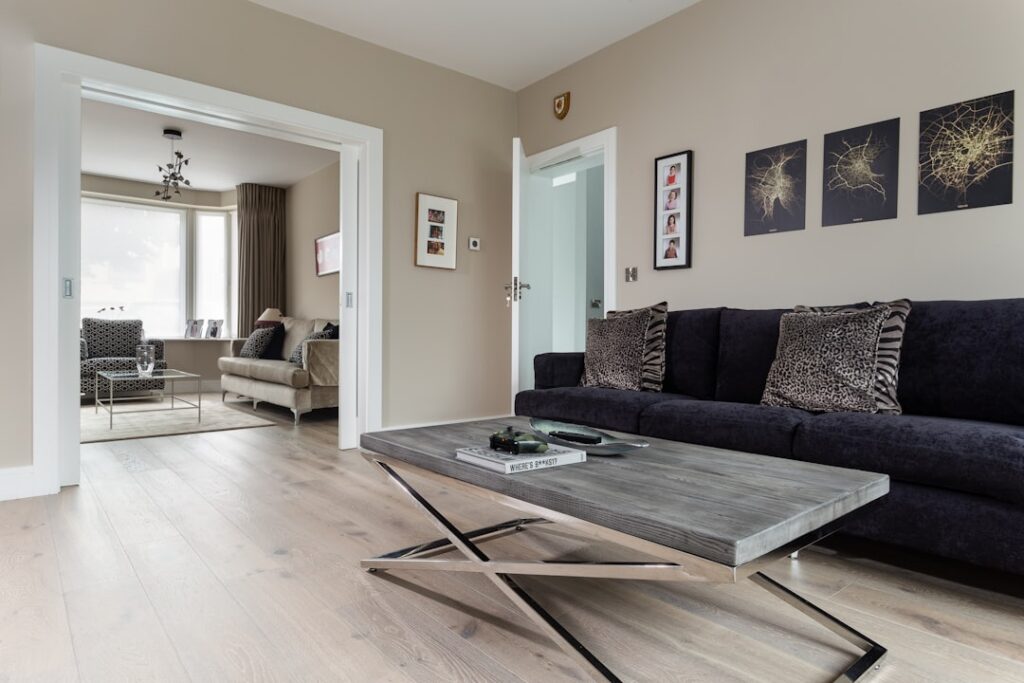
Walk the aisles of any home center and you will spot the bargain end of the laminate market dominated by thin boards, and 5mm laminate flooring sits right at the entry point. It is the floor of choice for tight budgets, rental upgrades, and quick refreshes where spending big does not make sense. At roughly half the thickness of premium 10mm or 12mm laminate, it brings real savings, but those savings come with trade-offs in sound, feel, and durability that you should understand before you buy.
What 5mm Laminate Actually Is
Laminate thickness refers to the total height of the plank, including the high-density fiberboard (HDF) core, the printed decor layer, and the clear melamine wear layer on top. A 5mm board has a thinner core than the 8mm, 10mm, and 12mm options that fill the mid and premium tiers.
That thinner core is the heart of every pro and con. It uses less material, so it costs less and weighs less, but it also flexes more, transmits more sound, and is less forgiving of imperfect subfloors. The wear layer, rated by an AC durability scale, can still be decent on a 5mm board, but the structure underneath it is inherently lighter-duty.
Why People Choose 5mm
For the right situation, thin laminate is a smart, economical pick. Its appeal is straightforward.
- Lowest cost: 5mm laminate is among the cheapest hard-surface flooring you can buy, often under $1 per square foot.
- Renter and flip friendly: Ideal when you want a fresh look without investing in a floor you may not keep.
- Easy DIY install: Lightweight click-lock planks are simple to handle and cut.
- Low profile: The thin build fits under doors and against existing thresholds with minimal transition issues.
- Quick refresh: Fast to install and replace, perfect for temporary or low-stakes spaces.
5mm vs 8mm-12mm: The Real Differences
Thickness changes the experience underfoot in ways that matter day to day. Here is how thin compares to thicker laminate.
- Sound: Thin laminate sounds hollower and louder underfoot; thicker cores and a good underlayment dampen that clack significantly.
- Feel and rigidity: 5mm boards flex more and can feel less solid; 10mm to 12mm feels closer to real hardwood.
- Subfloor tolerance: Thicker laminate bridges minor subfloor bumps better; thin laminate telegraphs imperfections and can develop clicks.
- Joint strength: Thicker planks have deeper, sturdier click joints that resist separating over time.
- Durability and lifespan: A premium thick board generally lasts longer in heavy traffic; thin laminate suits lighter use.
None of this makes 5mm bad, it makes it situational. Matching the thickness to the room’s traffic and your budget is the whole game.
The Honest Drawbacks
Thin laminate’s compromises are real. The hollow, clacky sound is the most common complaint, and while a quality underlayment helps, it never fully matches a thick board. The thinner core also makes the floor more sensitive to an uneven subfloor; bumps and dips can cause flexing, clicking, and even joint failure over time.
Durability is the other limit. The lighter structure and often thinner wear layer mean 5mm laminate is best for bedrooms, closets, low-traffic rentals, and light-use rooms rather than busy kitchens, hallways, or homes with big dogs. Like nearly all laminate, it is also not waterproof; standing water can swell the HDF core, and thin cores have less material to resist damage. For high-moisture areas, vinyl plank is the better choice.
Where 5mm Laminate Makes Sense
Pick the floor for the room. 5mm laminate shines in specific, lower-demand settings.
- Rental units and flips: Affordable, presentable, and easy to replace.
- Bedrooms and home offices: Light foot traffic suits the thinner build.
- Closets and small rooms: Low wear and small footprints make thin laminate a sensible economy.
- Temporary spaces: Short-term needs where longevity is not the priority.
Buying Guide: What to Check
Even within budget laminate, some products are far better than others. Prioritize these specs.
- AC rating: Look for at least AC3 for residential use; AC1 to AC2 is too light for most living spaces.
- Attached or separate underlayment: An attached pad, or a quality separate underlayment, reduces the hollow sound thin laminate is prone to.
- Joint quality: A precise, tight click-lock system resists gapping; inspect a sample plank.
- Water-resistance claims: Some 5mm laminates offer surface water resistance; useful, but still not a substitute for waterproof vinyl in wet areas.
- Decor and texture: Embossed textures and realistic prints make budget laminate look far more convincing.
Expect 5mm laminate to run roughly $0.70 to $1.50 per square foot, plus underlayment if not attached. Buy 7 to 10 percent extra for cuts and waste.
Installation and Care Tips
Subfloor prep matters more, not less, with thin laminate. Level the subfloor carefully, since 5mm boards reveal bumps, and use a good underlayment to add quiet and a slight cushion. Acclimate the planks, leave the recommended expansion gap at walls, and stagger joints for strength.
For care, sweep regularly, clean with a barely-damp microfiber mop and a laminate-safe cleaner, and wipe spills immediately to protect the HDF core. Use felt pads and entry mats to limit scratching and grit. Installed in the right room with a good underlayment, 5mm laminate delivers a clean, affordable floor that punches above its price, as long as you respect its limits.
5mm Laminate vs Vinyl Plank
Shoppers at the budget end often weigh thin laminate against entry-level vinyl plank, and the deciding factor is usually moisture. Vinyl plank is fully waterproof and a better choice for kitchens, bathrooms, laundry rooms, and basements, while laminate’s HDF core can swell if water sits on it.
- Water resistance: Vinyl wins decisively; laminate is vulnerable to standing water.
- Feel and sound: Thin vinyl can feel and sound a bit softer; thin laminate can be clacky without good underlayment.
- Look: Quality laminate often has crisper, more realistic wood texture at the budget level.
- Scratch resistance: Laminate’s hard melamine surface resists surface scratches well.
- Cost: Both are inexpensive; compare per-square-foot prices and warranties directly.
For dry bedrooms and living areas on a tight budget, 5mm laminate is a fine pick. For anywhere water is likely, choose vinyl instead.
Getting the Most From Thin Laminate
A few smart moves stretch the value and lifespan of a budget floor. The single biggest upgrade is a quality underlayment, ideally one with a moisture barrier and sound-dampening, which directly counters the hollow feel and noise that thin laminate is prone to. Spend a little here and the floor feels notably more solid.
Beyond that, careful subfloor prep, tight installation, and disciplined maintenance do the rest. Level the subfloor, avoid wet-mopping, address spills fast, and keep heavy grit off the surface with entry mats. Treat a 5mm floor as the light-duty product it is, place it in low-traffic dry rooms, and it will serve a rental, flip, or starter home well for years without pretending to be premium hardwood.
Prefer to explore on your own?
See how new flooring looks in your actual room in seconds — free, no signup.
Try the free Floor Studio →

