Here is the truth that flooring salespeople do not always lead with: real wood laminate is something of a contradiction in terms. Laminate flooring is not real wood at all. It is a high-resolution photograph of wood pressed onto a dense fiberboard core and sealed under a clear wear layer. That does not make it a bad floor. It just means you should understand exactly what you are buying before you compare it to genuine hardwood or engineered wood.
This guide breaks down what laminate really is, how it stacks up against floors that contain actual wood, and how to decide which one belongs in your home.
What Laminate Flooring Actually Is
Laminate is a synthetic product built in layers. The bottom is a moisture-resistant backing. Above that sits the core, usually high-density fiberboard (HDF) made from compressed wood fibers and resin. The fibers come from wood, but the plank itself behaves nothing like a solid board. On top of the core is the design layer, which is a printed image of oak, hickory, walnut, or whatever species you chose. The very top is a transparent aluminum-oxide wear layer that resists scratches and fading.
So when a product is marketed as wood laminate, the “wood” is a picture. Modern printing and embossing are impressive enough that the grain often lines up with the texture you feel underfoot, which fools most guests. But there is no sandable, refinishable lumber anywhere in the plank.
Laminate vs. Engineered Wood: The Key Difference
This is where most confusion lives. Engineered wood and laminate look similar at the store, but they are fundamentally different products.
- Engineered wood has a real hardwood veneer, typically 1/16 to 1/8 inch thick, bonded to a plywood or fiberboard base. You are walking on actual wood, and many engineered floors can be lightly sanded and refinished once.
- Laminate has no wood veneer. The surface is an image. You cannot sand or refinish it. When the wear layer fails, you replace the plank.
If a salesperson uses “real wood laminate” to describe an engineered product, that is loose marketing language. Ask one direct question: is there a genuine wood veneer on top, or is the surface a printed image? The answer tells you exactly which category you are in.
Why People Choose Laminate Anyway
Laminate earns its popularity honestly. The wear layer is genuinely tough, often more scratch-resistant than the soft finish on real hardwood, which makes it a favorite in homes with dogs, kids, and heavy foot traffic. Most planks click together over a foam underlayment as a floating floor, so a competent DIYer can install a room in a weekend without nails or glue.
Cost is the other draw. Laminate typically runs $1 to $5 per square foot for materials, with installed prices around $3 to $8. Solid and engineered hardwood usually start higher and climb fast for premium species. For a large area on a budget, laminate stretches your dollars further.
The Honest Drawbacks
No refinishing is the big one. A solid oak floor can be sanded several times across decades and look new again. Laminate cannot. Once the surface wears or chips, replacement is the only fix, and finding a matching plank years later can be tricky.
Water is the second weakness. Standard laminate uses an HDF core that swells if water seeps into the seams and sits there. Spills are fine if wiped promptly, but a dishwasher leak or a flooded bathroom can ruin a floor permanently. Waterproof and water-resistant laminates exist now, with tighter joints and treated cores, but read the warranty closely before trusting one in a kitchen or bath.
Underfoot, laminate can sound hollow and feel harder than wood unless you use a quality underlayment. It also does not add the resale appeal that buyers associate with genuine hardwood.
How to Spot Quality Laminate
Not all laminate is equal, and the spec sheet tells the story. Use these markers when comparing products.
- AC rating: This abrasion-class number runs from AC1 to AC5. For a busy household, look for AC3 or higher. AC4 and AC5 suit commercial-level traffic.
- Thickness: Planks range from about 7mm to 12mm. Thicker planks feel more solid and quiet, and they bridge minor subfloor imperfections better.
- Edge treatment: Beveled or “painted bevel” edges create realistic plank definition. Tighter locking systems also resist moisture at the seams.
- Warranty: A 25-year-plus residential wear warranty signals confidence. Check what voids it, especially around standing water.
Caring for a Laminate Floor
Maintenance is simple, which is part of the appeal. Sweep or vacuum with a hard-floor setting to lift grit that would otherwise scratch the wear layer. Damp-mop with a barely wet microfiber pad and a cleaner labeled for laminate. Never wet-mop, never use wax or oil soaps, and never let water pool. Felt pads under furniture legs and a doormat at every entry will do more to extend the life of the floor than any product you can buy.
Where Laminate Belongs in Your Home
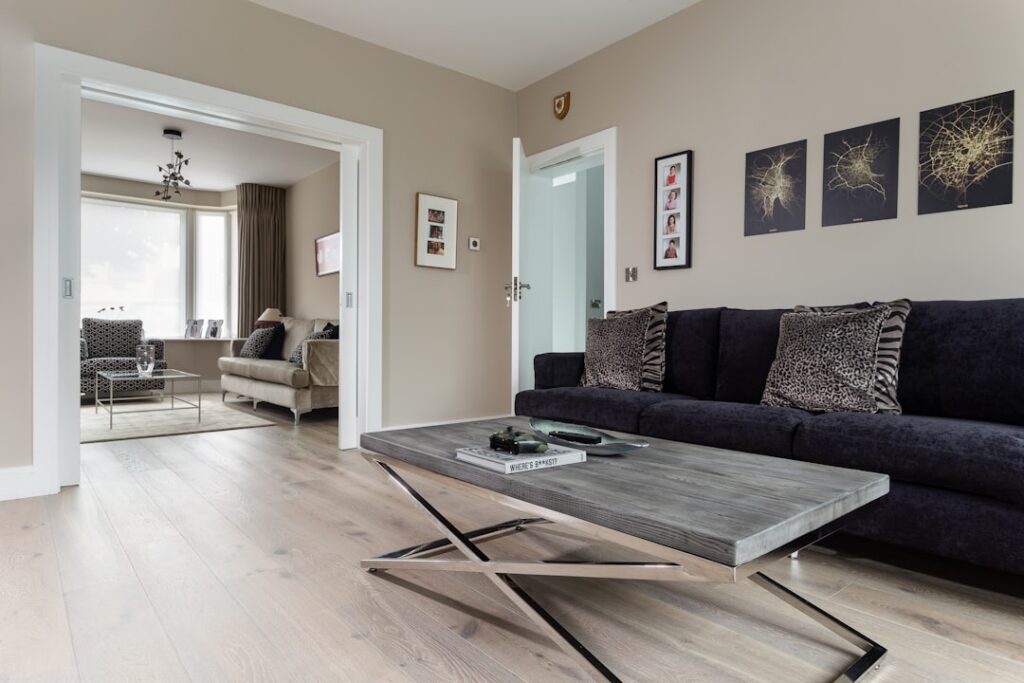
Laminate is a great fit in living rooms, bedrooms, hallways, and home offices, where traffic is steady but moisture is minimal. It performs especially well in homes with active dogs whose nails would scratch softer hardwood. Pair it with a quality underlayment to soften the sound and the feel underfoot, and it becomes a comfortable, hard-wearing surface for the busiest parts of the house.
Reconsider laminate in spaces prone to standing water unless you specifically buy a waterproof line. Full bathrooms, laundry rooms, and entryways from the outdoors all expose the seams to moisture that can wreck a standard HDF core. In those rooms, luxury vinyl plank or tile usually serves you better, since both shrug off water that would destroy ordinary laminate.
Installation Notes Worth Knowing
One reason laminate is a DIY favorite is the floating installation. The planks click edge to edge and rest over a thin foam pad rather than being nailed or glued to the subfloor. That means the whole floor expands and contracts as a single unit with changes in temperature and humidity, which is why you must leave a small expansion gap, usually about a quarter to a half inch, around the perimeter and under the baseboards.
Before installing, let the planks acclimate in the room for 48 hours so they reach the home’s humidity level. Make sure the subfloor is clean, dry, and flat, since dips and bumps will telegraph through and stress the locking joints over time. Skipping acclimation or the expansion gap is the most common cause of buckled or gapping laminate, so do not rush those steps.
So Should You Buy It?
Choose laminate when you want a convincing wood look, strong scratch resistance, and a friendly price, and when you accept that you cannot refinish it. Choose engineered or solid wood when you want a genuine wood surface, the option to refinish, and the resale cachet that comes with real lumber underfoot.
The smartest move is to stop thinking of real wood laminate as a wood floor and start judging it as what it is: a durable, photographic surface that imitates wood very well. Judged on those terms, it is often an excellent value. Judged as a substitute for hardwood, it will eventually disappoint. Match the product to your expectations and your budget, and you will be happy with the floor for years.
Prefer to explore on your own?
See how new flooring looks in your actual room in seconds — free, no signup.
Try the free Floor Studio →