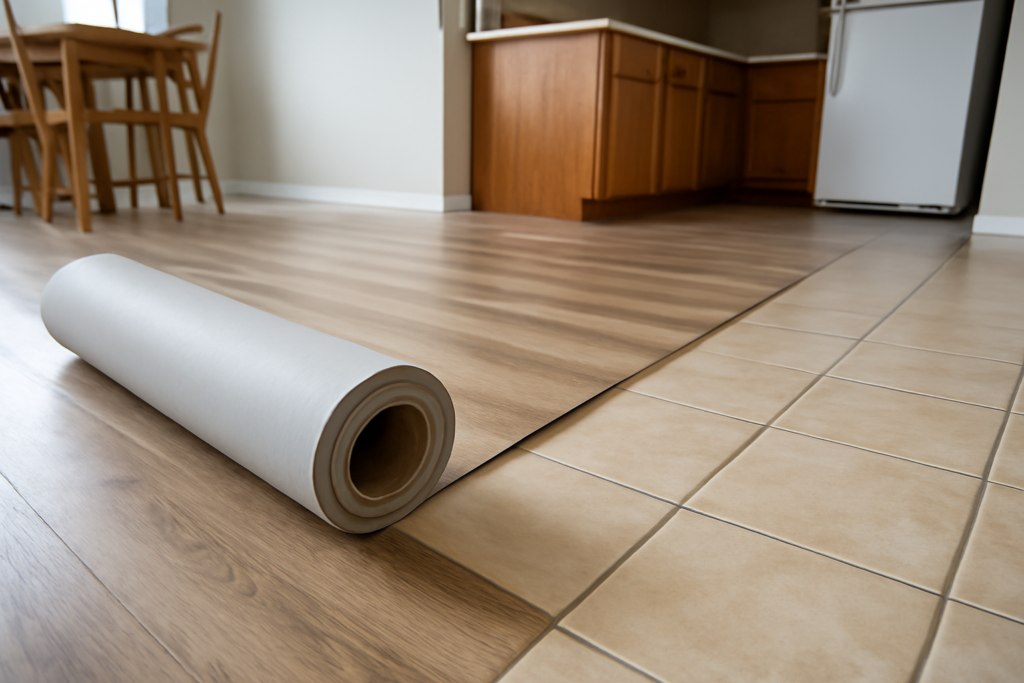
Most homeowners searching for “laminate roll flooring” are surprised to learn it’s not the same product as the click-lock laminate planks sold at Home Depot. Laminate roll flooring is a continuous, flexible sheet with a printed wood-look top layer fused to a felt or foam backing — sold in 6-12 ft wide rolls and used almost exclusively in RVs, manufactured homes, and budget rental rehabs. It’s not the high-pressure HDF laminate most people picture. Understanding the difference saves you from buying the wrong product or installing it in a setting where it will fail. Here’s a clear breakdown of what it is, what it’s good at, and where modern alternatives crush it.
- What Laminate Roll Flooring Actually Is
- Where Laminate Roll Flooring Actually Belongs
- Pros of Laminate Roll Flooring
- Cons That Push Most Buyers Elsewhere
- Pricing Breakdown
- Installation Methods
- Better Alternatives for Most Homeowners
- When to Pick Laminate Roll Flooring Anyway
- Frequently Asked Questions
What Laminate Roll Flooring Actually Is
True laminate (the kind sold as Pergo, Mohawk RevWood, or Quick-Step) uses a high-density fiberboard core under a printed decorative layer and a melamine wear surface. It comes in rigid planks and is installed as a click-lock floating floor.
Laminate roll flooring uses a thin printed paper or vinyl wear layer over a flexible felt, foam, or fiberglass backing. There’s no HDF core. The whole thing rolls up like sheet vinyl and gets glued or perimeter-fastened to the subfloor. Industry terminology often conflates this product with sheet vinyl, but manufacturers like Congoleum and IVC US still market certain felt-backed wood-look products under “laminate roll” branding aimed at RV and mobile home installers.
Where Laminate Roll Flooring Actually Belongs
Three settings make laminate roll flooring a sensible choice instead of a compromise.
- RVs and travel trailers: the flexibility tolerates frame movement that cracks rigid laminate. Lightweight backing keeps total weight down for towing
- Manufactured and mobile homes: often built with thinner, more flexible subfloors. Rolls bridge minor unevenness better than click-lock planks
- Temporary or budget rental flips: 6-12 ft rolls cover an entire room in one piece, eliminating seam labor and material cost
For permanent residential use in standard stick-built homes, rigid plank laminate or modern luxury vinyl plank delivers far better looks, sound, and durability at a similar price point.
Pros of Laminate Roll Flooring
Used in the right setting, this product has real advantages.
- Quick installation — a 12 ft x 16 ft room covers in one piece in 90 minutes or less
- No transition strips or end gaps required
- Cheap per square foot: $0.85-1.75 vs. $2-5 for click-lock laminate planks
- Tolerant of subfloor flex and minor unevenness
- Easy to mop and clean — fewer seams mean fewer dirt traps
- Soft underfoot when paired with foam-backed versions
Cons That Push Most Buyers Elsewhere
The reasons most homeowners skip this product are also worth listing honestly.
- Visual quality lags 10-15 years behind modern luxury vinyl plank
- Wear layer is thinner — typically 6-12 mil vs. 20+ mil on premium LVP
- Hard to repair — damage to one section often requires replacing the entire roll
- Indents under heavy furniture legs and rolling chair casters
- Lower resale value impact than rigid plank flooring
- Limited style and color selection compared to modern flooring categories
- Some products use formaldehyde-bearing adhesives — check for FloorScore or GreenGuard certification
Pricing Breakdown
Material costs typically fall in this range:
- Basic felt-backed roll laminate: $0.85-1.25 per sq ft
- Foam-backed cushioned roll: $1.25-1.75 per sq ft
- Premium fiberglass-backed roll: $1.75-2.50 per sq ft
- Adhesive (if not perimeter-installed): $40-70 per gallon, covers 250-300 sq ft
- Professional installation: $1.50-3.00 per sq ft labor
For a 200 sq ft room, expect total costs around $300-600 DIY or $600-1,000 with professional installation. The same room in mid-grade luxury vinyl plank runs $700-1,200 installed and lasts 2-3 times longer.
Installation Methods
Two main installation styles work for laminate roll flooring. Full-spread glue-down delivers the most stable result but is the messiest. Apply adhesive to the entire subfloor with a 1/16-inch v-notched trowel, lay the roll into the wet adhesive, and roll with a 100 lb floor roller to ensure full contact.
Perimeter installation uses double-sided tape or staples around the edges only and skips full glue. It’s faster and easier to remove later but tends to bubble or shift in high-traffic zones.
Always acclimate the roll in the room for 48 hours before installing. Subfloor must be flat to within 3/16 inch over 10 feet — bumps telegraph through the thin material immediately.
Better Alternatives for Most Homeowners
For permanent residential installations in standard homes, three modern alternatives outperform laminate roll flooring at similar prices.
Luxury Vinyl Plank (LVP)
$2-5 per sq ft. Click-lock installation, waterproof core, realistic wood looks, 20+ year wear layers. Brands like Coretec, LifeProof, and Mohawk Solidtech all sit in this range.
Rigid Click-Lock Laminate Plank
$1.50-4 per sq ft. Better visuals than roll laminate, real beveled edges, and AC4-rated wear surfaces. Pergo TimberCraft and Mohawk RevWood are reliable mid-range picks.
Sheet Vinyl with Wood Look
$0.75-2.50 per sq ft. Same roll-style installation as laminate roll flooring but with better print clarity, thicker wear layers, and more designs. Armstrong and Tarkett dominate this segment.
When to Pick Laminate Roll Flooring Anyway
If you’re refloor an RV, fifth wheel, or single-wide manufactured home, laminate roll flooring is genuinely the right product. The flexibility matches what the structure needs, and the price-per-foot is hard to beat.
For a quick rental flip where you’ll re-do the floor again in 5-7 years, it can also make sense. Just don’t expect it to look great in real estate photos or hold up under a dishwasher leak.
Frequently Asked Questions
Is laminate roll flooring waterproof?
The wear surface resists splashes, but seams and edges aren’t sealed. Water penetrating to the felt or foam backing causes warping and mildew within days. It’s water-resistant, not waterproof.
Can I install laminate roll flooring over existing flooring?
Over flat, hard surfaces like vinyl or sealed concrete, yes. Over carpet, tile with grout lines, or anything textured, no — the imperfections show through almost immediately.
How long does laminate roll flooring last?
5-10 years in light residential use, 3-5 years in rentals, 10-15 years in low-traffic RV applications. Premium LVP lasts 20-30 years for comparison.
Is roll laminate flooring the same as sheet vinyl?
Functionally close, but technically different. Sheet vinyl uses a PVC base; laminate roll flooring sometimes uses a felt or paper composite under the wear layer. Most homeowners would benefit from sheet vinyl over true laminate roll product.
Prefer to explore on your own?
See how new flooring looks in your actual room in seconds — free, no signup.
Try the free Floor Studio →