An aluminum window frame is the strongest, slimmest option in residential glazing — a 2-inch extrusion carries glass spans that would need 4 inches of vinyl — which is why every floor-to-ceiling modern window wall you have admired rides on aluminum. But the material has a split reputation: the aluminum window frame in a 1970s ranch is a cold, sweating energy sieve, while a 2025 thermally broken unit meets Energy Star in most climate zones. The difference is one engineering detail, and understanding it tells you whether to love, upgrade, or replace the aluminum windows you have.
- Why Builders Keep Choosing Aluminum
- The Thermal Break: The Detail That Changed Everything
- The Condensation Reality
- Maintenance That Actually Matters
- Common Repairs, Ranked by Difficulty
- Repainting an Aluminum Frame
- Aluminum vs. Vinyl vs. Wood at a Glance
- Should You Keep 1970s Unbroken Frames?
- Buying Advice If You Are Replacing Anyway
Why Builders Keep Choosing Aluminum
Strength-to-weight is the headline. Aluminum extrusions run 0.062 to 0.125 inch wall thickness and deliver roughly three times the rigidity of vinyl per inch of frame, so sightlines shrink dramatically — frame faces of 1-3/4 to 2-1/4 inches versus 3 to 4 inches for vinyl. That stiffness is what permits 8-foot sliders and 12-foot multi-slide doors without frames flexing. The material will not rot, warp, swell, or burn; it holds dark colors (black window frames, the dominant trend since about 2018, started as an aluminum finish) without the heat distortion that limits dark vinyl; and a factory anodized or 70 percent PVDF powder-coat finish (Kynar) carries 20-to-30-year warranties. Recyclability is real too — around 75 percent of all aluminum ever produced is still in circulation, and old frames have scrap value at roughly $0.40 to $0.70 per pound.
The Thermal Break: The Detail That Changed Everything
Raw aluminum conducts heat about 1,000 times faster than wood, so an unbroken frame is effectively a radiator fin connecting your living room to the weather. Old single-pane aluminum windows test around U-1.2 — worse than the glass alone. The fix, standard in quality residential lines since the 1980s, is the thermal break: a strip of polyamide (nylon) or poured-and-debridged polyurethane, typically 1/4 to 1 inch wide, structurally splitting the extrusion into an exterior half and an interior half with no metal path between them. A thermally broken frame with double low-e glass reaches U-0.28 to U-0.35; premium European-style systems with 34-to-44-millimeter polyamide breaks and triple glazing hit U-0.15 to U-0.20. Shopping shortcut: look at the frame edge for the visible dark plastic strip between metal sections, and ask for the NFRC label — if the whole-window U-factor is above 0.45, there is no meaningful break in it.
The Condensation Reality
Sweating frames are the complaint that fills my inbox every January, so here is the honest physics. Interior condensation forms when the frame’s room-side surface drops below the dew point of indoor air. On an unbroken aluminum frame in 20°F weather, that surface can sit at 35 to 40°F, and at 40 percent indoor humidity the dew point is about 45°F — so the frame streams water, puddles the sill, and grows mold along the drywall return. Thermally broken frames keep the interior surface 15 to 25°F warmer, which stops condensation in all but extreme cold snaps. If replacement is not in the budget, manage the symptom: hold winter humidity at 30 to 35 percent, run bath and kitchen fans religiously, keep blinds cracked so air washes the frame, and wipe sills daily in cold snaps. Interior storm panels over the whole opening also work, since they stop room air from reaching the cold metal at all. What never works is painting or caulking over the problem — it is temperature, not a leak.
Maintenance That Actually Matters
Aluminum asks for less than any other frame, but not zero:
- Wash frames twice a year with dish soap and water. In coastal salt air, quarterly — salt is the one environment that genuinely eats aluminum, pitting anodized finishes within a few years if left crusted.
- Clear the sill-track weep holes with a toothpick or compressed air each spring. Blocked weeps are behind most “leaking window” service calls I get on sliders.
- Lubricate rollers, tracks, and locks with dry PTFE or silicone spray annually. Never oil — it binds dust into paste.
- Wax exposed mill-finish or anodized surfaces with automotive paste wax every year or two to slow chalking.
- Inspect the exterior perimeter sealant joint; polyurethane caulk lasts 10 to 15 years, and the frame-to-cladding joint fails long before the frame does.
Common Repairs, Ranked by Difficulty
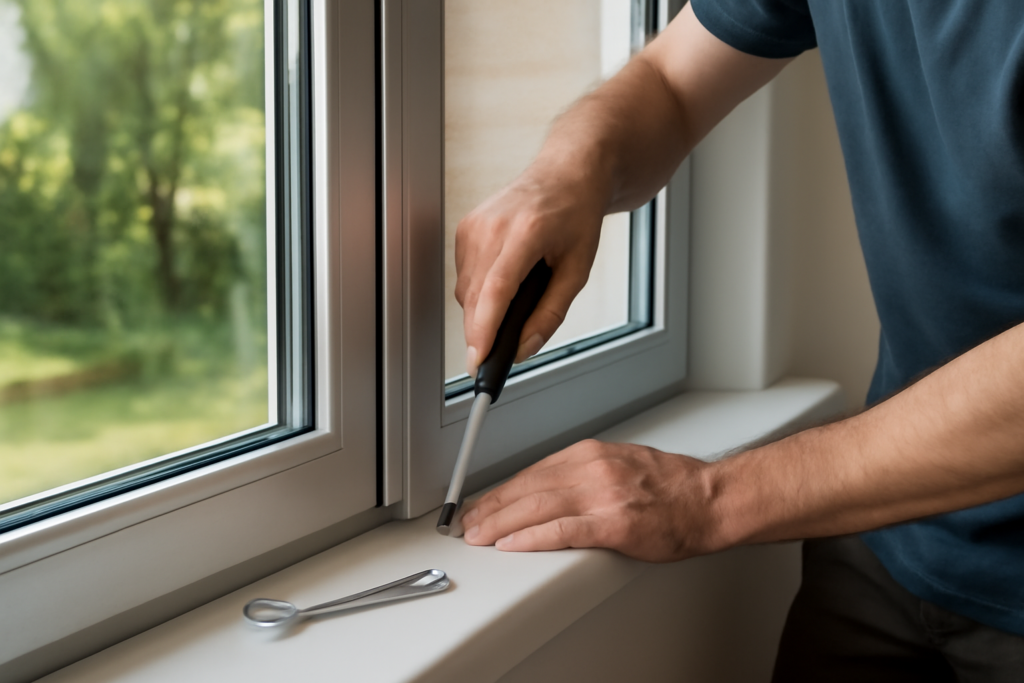
Nearly everything on an aluminum window unbolts, which makes it the most parts-repairable frame type in the business. Easy tier: replacing rollers on a dragging slider ($10 to $25 per pair; back out two screws, swap the tandem assembly), snapping in new corner keys on a racked storm sash, re-splining a screen ($15), and replacing sash locks. Middle tier: swapping worn glazing gaskets or vinyl bead — buy by the foot from Swisco, Prime-Line, or CR Laurence — and drilling out fixed rivets to replace a bent rail. Harder tier: fogged insulated glass units, where you measure the IGU thickness (commonly 1/2, 5/8, or 3/4 inch), order a replacement sealed unit for $60 to $180, and reset it in new glazing tape. Cosmetics respond to auto-body technique: Bondo in dents, 220-grit feathering, and a color-matched two-part enamel or aerosol PVDF touch-up. Structural corrosion — white powder blooming from inside a joint on coastal or pool-house windows — is the one condition I call terminal; once galvanic corrosion starts inside a sealed joint, replacement beats any repair.
Repainting an Aluminum Frame
Faded bronze anodizing from 1985 does not have to stay ugly. The refinish schedule that lasts: scrub with a Scotch-Brite pad and TSP substitute, sand glossy areas with 320 grit, wipe with solvent, spray a self-etching primer formulated for aluminum, then two coats of a urethane or acrylic bonding enamel — brushed Benjamin Moore Ultra Spec HP or rattle-can 2K aerosols both hold up. Mask the glass and gaskets, and keep paint out of the tracks or the sashes will stick shut. A whole house of frames is a long weekend and about $150 in materials, versus $15,000-plus for replacement — one of the best cosmetic returns in exterior work. Black over old bronze is the transformation clients photograph.
Aluminum vs. Vinyl vs. Wood at a Glance
- Cost installed, typical 3×5 double-hung or slider: builder aluminum $400 to $700; thermally broken architectural aluminum $800 to $1,600; vinyl $450 to $800; clad wood $900 to $1,800.
- Energy: vinyl and wood win by default; thermally broken aluminum ties them; unbroken aluminum loses badly.
- Lifespan: aluminum 40 to 50 years; vinyl 20 to 30 (UV embrittlement); wood 30-plus with paint discipline.
- Looks: aluminum owns thin-frame modern and true black; vinyl cannot do either convincingly.
- Repairability: aluminum first, wood second, vinyl a distant third — welded vinyl corners are not fixable.
Should You Keep 1970s Unbroken Frames?
Owners of original single-pane aluminum sliders face a genuine fork. Full replacement runs $500 to $900 per opening and fixes everything at once. The budget path keeps the frames and attacks the weak points: an exterior or interior storm panel adds the missing air gap and can cut the opening’s heat loss roughly in half for $100 to $250 per window, while new gaskets, rollers, and a careful re-caulk stop the drafts that annoy people daily. That combination gets a 1975 slider to maybe 70 percent of a new vinyl window’s performance for a quarter of the money. Where I draw the line is condensation-driven mold in bedrooms and any frame with corroded, non-sliding sashes — comfort and health problems that patches only mute. Landlords and flippers keep and upgrade; twenty-year owners in climate zones 5 and up almost always come out ahead replacing.
Buying Advice If You Are Replacing Anyway
Insist on a polyamide thermal break, not just “thermally improved” marketing language, and read the NFRC sticker: target U-0.30 or lower in heating climates, SHGC under 0.25 in cooling climates. Milgard Trinsic and Thermally Broken Aluminum, Western Window Systems, Fleetwood, and Ply Gem cover the residential spectrum from mid-market to luxury. Choose anodized (Class I, 0.7-mil) or 70 percent PVDF powder coat for the finish — cheap polyester powder chalks in five to eight years of southern sun. And in coastal zones, specify stainless hardware and an added corrosion-resistant pretreatment; the frame will handle the salt air only as well as its weakest fastener. Spec those details and an aluminum window frame is a 50-year component, which is longer than most people keep the house.