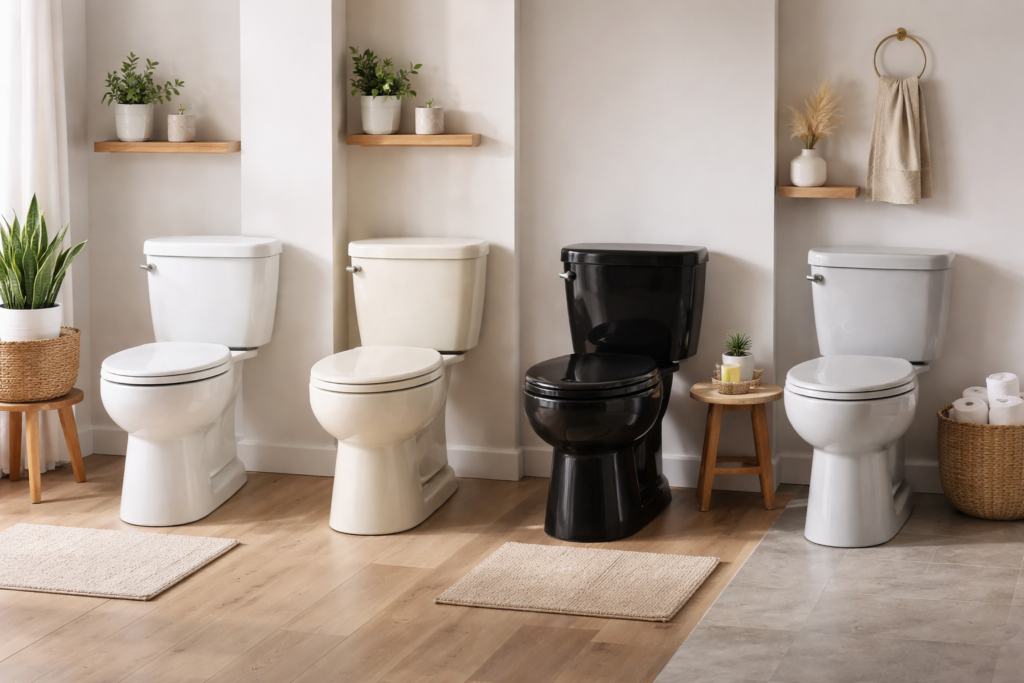
Shopping american standard toilet colors today is mostly a choice between white and two off-whites, with black on a short list of parts. The current lineup centers on White, Bone and Linen, and Black shows up on some Champion bowls and tanks. The pastel blues, pinks and grays many people remember from older bathrooms are no longer part of the regular range.
Part of our Bathroom Remodeling & Flooring guide — explore the full guide →
That matters most when you are replacing only a tank, lid or seat, or trying to match a sink and tub already in the room. A bone toilet next to a linen sink looks wrong even though both are “off-white,” so knowing exactly which color you have is the first job.
- American Standard Toilet Colors and Where to Find Them
- White, Bone and Linen: Telling Them Apart
- Black Toilets: What Is Available
- What Happened to Blue, Pink and Gray?
- Matching a Toilet Seat
- Tools and Materials for Swapping a Toilet or Tank
- Troubleshooting Color Problems
- Planning a Bathroom Around the Color
- General Cost Ranges
- When to Call a Pro
- Frequently Asked Questions
Most models are white only. If you want bone, linen or black, choose your model from the lines that offer it, then match the seat, which is often sold separately and in fewer colors than the bowl.
American Standard Toilet Colors and Where to Find Them
The table sums up what the manufacturer’s current toilet catalog shows, plus the older colors people still search for. Model availability changes often, and many listings are marked out of stock or discontinued, so confirm the color on the specific model number before ordering.
| Color | Look | Lines that offer it (current catalog) |
|---|---|---|
| White | Bright, neutral white | Every line, and the only color for most VorMax and many Champion models |
| Bone | Warm off-white with a slight creamy, yellow lean | Champion PRO and Champion 4 models, Estate and Townsend VorMax, several seats |
| Linen | Light, soft off-white, a little cooler than bone | Same groups as Bone: Champion PRO, Champion 4, Estate and Townsend VorMax |
| Black | Deep glossy black | A few Champion 4 bowls and tanks and Champion PRO 12-inch rough tanks |
| Biscuit | Warm beige off-white | Listed on a Champion 4 MAX replacement tank lid; not a mainstream bowl color |
| Gray / silver | Light gray | Not shown in the current catalog; older fixtures only |
| Blue, pink and other pastels | Mid-century bathroom colors | Discontinued; found only as salvage or old stock |
On many model numbers the color is the last block of digits. On older Colony and Cadet listings, for example, .020 usually means White, .021 Bone and .222 Linen. Check the label inside the tank or under the lid before you rely on that pattern, and confirm with the product page for your exact model.
White, Bone and Linen: Telling Them Apart
White is the default for a reason. It matches nearly any tile, it is the easiest to replace parts for, and it is the color stocked most widely. If you are building or fully remodeling, white keeps your options open.
Bone and linen are where people get stuck. Bone is the warmer of the two, with a creamy lean that pairs with beige tile, almond appliances and warm wood vanities. Linen is lighter and softer; next to bright white it reads off-white, but next to bone it can look almost gray. Descriptions vary between sources, so the only reliable test is to hold a physical sample, a seat or a lid, against your existing fixtures in your own bathroom light.
How to identify the color you already have
- Lift the tank lid and look for a stamped or printed model number and date inside the tank wall.
- Look up that model and note the color suffix on the listing.
- If the stamp is worn, compare the toilet next to a white sheet of paper in daylight. Bone shows a yellow-cream cast; linen shows a pale, soft cast.
- Take the lid (it lifts off) to a showroom to compare against samples if you still are not sure.
Black Toilets: What Is Available
Black is the color most people search for after white. In the current catalog it appears on a few Champion 4 pieces, such as a right height bowl and certain tanks, and on Champion PRO 12-inch rough tanks. That means a black toilet usually comes together from a matching bowl and tank rather than one boxed set, and stock can be thin.
Before choosing black, think about upkeep. Hard-water minerals and soap residue show up as white streaks on dark glaze. If your water is hard, plan on a weekly wipe with a mild cleaner and a soft cloth, and consider a water softener. Black also needs a black seat, which you may have to source separately since many seats come only in white, bone and linen.
A matte black trip lever is a cheaper way to add the look. Levers come in finishes like polished chrome, brushed nickel, oil rubbed bronze and matte black, and you can swap one in a few minutes on a white toilet.
What Happened to Blue, Pink and Gray?
Colored fixtures were popular decades ago, and pastel blue, pink, green and other shades were sold as full bathroom suites. Those colors have been dropped from the regular line. Older catalogs also listed colors such as fawn beige and silver, but they do not appear in the current toilet catalog.
If you have a blue or pink toilet that needs a part, you have a few options:
- Repair, do not replace: flappers, fill valves, flush valves and bolts are internal and color does not matter.
- Salvage yards and old stock: matching tanks and lids sometimes turn up at architectural salvage shops.
- Keep the bowl, swap the seat: a white or bone seat can bridge a retro color if the rest of the room has neutral tile.
- Replace the suite: if the sink and tub are also colored, a full refresh in white or bone usually looks better than one mismatched new piece.
Matching a Toilet Seat
The seat is the easiest piece to get wrong. Many of the manufacturer’s slow-close seats come in White, Bone and Linen, while several telescoping and slow-close seats are white only. Check three things before you buy a toilet seat:
- Shape: round front or elongated. Measure from the center of the seat bolt holes to the front edge of the bowl: about 16.5 inches is round, about 18.5 inches is elongated.
- Color: match the bowl suffix, not just the name. Bone and linen seats do not swap well.
- Fit: some bowls with special rims or skirted designs need a specific seat. Check the bowl’s spec sheet.
Tools and Materials for Swapping a Toilet or Tank
- Adjustable wrench and a socket set
- Bucket, sponge and old towels
- New wax ring or wax-free seal, and new closet bolts
- Tank-to-bowl gasket kit if replacing only the tank
- Supply line (braided, correct length)
- Torpedo level and plastic shims
- Putty knife to remove the old wax
Basic steps to replace a toilet
- Shut off the water at the stop valve and flush to empty the tank. Sponge out the rest.
- Disconnect the supply line and remove the nuts at the floor bolts.
- Rock the toilet gently to break the wax seal, then lift it straight up with a helper; toilets often weigh 60 to 100 pounds.
- Scrape the old wax from the flange and check the flange for cracks.
- Set new bolts and a new seal, lower the bowl straight down, and tighten the nuts evenly by hand, then a quarter turn at a time. Overtightening cracks porcelain.
- Mount the tank, reconnect the supply, turn the water on and check for leaks at every joint.
If the flange is broken, the floor is soft, or the shutoff valve will not close, stop and call a licensed plumber. Those signs often point to a leak under the floor.
Troubleshooting Color Problems
New tank does not match the old bowl
Glaze shifts slightly over production runs and with age. Match the color suffix exactly and expect a slight difference if the bowl is decades old. Replacing both pieces is the only sure match.
Bone fixture looks yellow next to new tile
Bright white tile makes bone look dated. Warm tile, cream grout and warm bulbs (around 2700K) help it blend.
White streaks on a black toilet
That is mineral residue. Use a mild descaler made for porcelain, then rinse. Avoid abrasive powders, which dull the glaze.
Planning a Bathroom Around the Color
If you are choosing between American Standard toilet colors for a remodel, decide on the toilet color at the same time as the sink, tub and tile. White fixtures give you the widest choice of replacement parts, seats and matching sinks for decades. Bone and linen look intentional when the vanity top, tub and tile share the same warm or soft off-white, but they look like a mismatch when only one fixture is off-white. A black toilet works best as a deliberate accent with black faucets, a dark vanity or dark floor tile, and with light grout that frames it.
General Cost Ranges
A standard white two-piece toilet sits at the low end of the market. Bone and linen versions of the same model often cost a little more and can take longer to arrive. Black pieces are less common and tend to sit higher. Professional installation typically adds a modest labor charge, more if the flange or supply valve needs work. Seats range from inexpensive basic models to higher priced slow-close designs.
When to Call a Pro
Replacing a seat or trip lever is a simple DIY job. Swapping a full toilet is manageable for many homeowners, but call a licensed plumber if the shutoff valve leaks or will not turn, the flange is cracked or sits lower than the finished floor, the subfloor feels soft, or you are moving the toilet location. Moving drains usually needs a permit and must follow local plumbing code.
Frequently Asked Questions
What colors do American Standard toilets come in?
The current lineup focuses on White, Bone and Linen, with Black on a few Champion bowls and tanks. Most models are white only.
Does American Standard make a black toilet?
Yes, but only on a short list of Champion 4 and Champion PRO bowls and tanks. Check stock on the exact model number before planning around it.
Can I still buy an American Standard blue or pink toilet?
Not new. Pastel colors were discontinued long ago, so you would need salvage or old stock to match one.
Is bone or linen lighter?
Linen is generally the lighter, softer off-white, and bone is warmer and creamier. Compare physical samples to be sure.
Is there a gray American Standard toilet?
Gray does not appear in the current toilet catalog. Older silver or gray fixtures exist, but new ones are not a regular option.
How do I find my toilet color code?
Look for the model number stamped inside the tank, then check the last digits against the product listing for that model.