Most people never think about their water heater until a cold shower forces the issue. An AO Smith gas water heater is one of the most common units you will find in American basements and garages, partly because AO Smith also manufactures tanks sold under other names, including many of the models stocked at Lowe’s and independent plumbing suppliers. Knowing how these units are built, sized, and maintained saves you money whether you are replacing a failed tank tomorrow or planning ahead.
This guide walks through the model lineup, how to size the tank to your household, venting requirements, real installation costs, and the maintenance routine that pushes a heater past its warranty period.
- Understanding the Model Lineup
- Sizing the Tank to Your Household
- Venting Requirements
- Installation and Real Costs
- Setting the Temperature Safely
- Maintenance That Extends Tank Life
- Tank Versus Tankless Gas Options
- Troubleshooting Common Problems
- Efficiency and Operating Costs
- When to Repair Versus Replace
Understanding the Model Lineup
AO Smith organizes its gas tanks into tiers, and the names hint at the feature set. The Signature series sells through The Home Depot, while the ProLine and ProLine Master lines go through professional plumbing channels. Entry units use a standard atmospheric vent and a basic gas valve. Mid-tier tanks add a powered damper or better insulation. The top tanks are power-vent and power-direct-vent models that use a blower to push exhaust through PVC pipe.
You will also see condensing models rated above 90 percent efficiency. These extract extra heat from the exhaust, drop the flue temperature low enough for plastic venting, and produce acidic condensate that drains away. They cost more up front but cut fuel use noticeably in a high-demand home.
Sizing the Tank to Your Household
Buying the wrong size is the most expensive mistake homeowners make. Too small and you run out of hot water; too large and you pay to keep unused gallons hot. The number that matters more than raw capacity is First Hour Rating (FHR), the gallons of hot water the unit can deliver in a busy first hour.
- 1 to 2 people: a 40-gallon tank with roughly 60 to 70 FHR usually suffices.
- 3 to 4 people: step up to a 50-gallon tank around 80 to 90 FHR.
- 5 or more people: a 50-gallon high-recovery or a 75-gallon unit prevents morning shortfalls.
Gas heaters recover faster than electric because the burner heats water quickly, so a 50-gallon gas tank often outperforms a 65-gallon electric one for a large family. Count simultaneous demands too: a soaking tub, a rain shower, and a running dishwasher can each pull several gallons per minute.
Venting Requirements
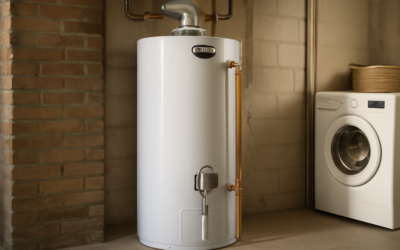
Venting is where installations go wrong and inspectors write red tags. An atmospheric-vent AO Smith gas water heater relies on natural draft up a metal flue, so it needs adequate combustion air and a properly sloped vent connector rising at least a quarter inch per foot. If your utility room is tight or sealed, that unit can backdraft carbon monoxide into the house.
Power-vent models solve the air problem with a blower and vent horizontally through PVC or CPVC, letting you place the tank far from a chimney. They need a nearby 120-volt outlet for the blower. Direct-vent units pull combustion air from outside through a concentric pipe, ideal for tightly built modern homes. Always confirm the vent material and diameter the manual specifies, because mismatched pipe is a common failure point.
Installation and Real Costs
A straightforward like-for-like replacement of a 40- or 50-gallon atmospheric tank typically runs $1,200 to $2,200 installed, with the tank itself accounting for $500 to $900 of that. Power-vent and condensing installations climb to $2,500 to $4,000 because they add electrical work, PVC venting, and a condensate drain.
Several code items drive cost. Most jurisdictions now require an expansion tank on the cold inlet, a $40 to $60 part plus labor, to absorb thermal expansion in a closed plumbing system. You also need a temperature and pressure relief valve piped to within 6 inches of the floor, a drip pan under tanks located above living space, and a sediment trap on the gas line. Skipping any of these fails inspection.
Setting the Temperature Safely
Out of the box, many tanks arrive set around 120°F, and that is the sweet spot for most homes. It scalds far more slowly than 140°F, which can cause a third-degree burn in seconds, yet it stays hot enough to discourage Legionella bacteria in the tank. If you have a dishwasher without its own booster heater or an immunocompromised household member, 130°F is a reasonable compromise. Turn the dial slowly and test the tap after a couple of hours.
Maintenance That Extends Tank Life
A gas tank should last 8 to 12 years, and simple upkeep pushes it toward the high end. Sediment is the main enemy, especially in hard-water regions where minerals settle on the tank bottom and insulate the burner, wasting gas and popping loudly as steam bubbles escape.
- Flush yearly: attach a hose to the drain valve, shut the cold inlet, and drain several gallons until the water runs clear.
- Test the T&P valve: lift the lever once a year; water should discharge and stop cleanly.
- Inspect the anode rod every 3 to 4 years: this sacrificial magnesium or aluminum rod corrodes so the steel tank does not. Replace it when the core wire shows.
- Check the venting and burner: look for soot, rust flakes, or a lazy yellow flame, which signals a combustion problem needing a pro.
Replacing a $30 anode rod at year four can add years to the tank, making it the single best-value maintenance task on the list.
Tank Versus Tankless Gas Options
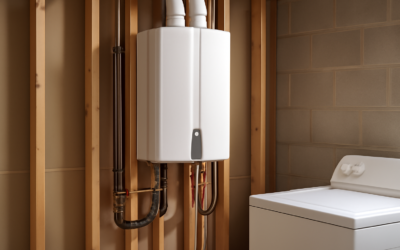
AO Smith builds both storage-tank and tankless gas heaters, and the choice shapes your whole hot-water experience. A storage tank keeps 40 to 75 gallons hot and ready, delivering high flow instantly but running out during marathon demand and losing a little standby heat around the clock. A tankless (on-demand) unit fires the burner only when you open a tap, heating water as it flows through, so it never runs out and wastes no standby energy.
Tankless gas heaters cost more up front, often $2,500 to $4,500 installed because they usually need a larger gas line and stainless venting, but they last longer, around 20 years versus 8 to 12 for a tank, and take up almost no floor space. The trade-off is flow limits: a single tankless unit is rated in gallons per minute, and running two showers plus a dishwasher can outstrip a mid-size model. For most families replacing a failed tank on a budget, a storage tank remains the simplest swap; for those building new or wanting endless hot water and long life, tankless earns its premium.
Troubleshooting Common Problems
Before assuming the worst, know the symptoms and their usual causes, because many gas water heater problems are cheap fixes. No hot water at all on a gas tank usually means the pilot light or igniter has failed, or the thermocouple is not sensing the flame and has shut off the gas valve as a safety measure. A thermocouple is a $15 part and a common repair.
- Not enough hot water: a tank too small for demand, a failed dip tube mixing cold into the outlet, or sediment stealing capacity.
- Rumbling or popping noises: sediment on the tank bottom trapping steam; flush the tank to fix it.
- Rotten-egg smell in the hot water: bacteria reacting with the anode rod; switch to a zinc-aluminum or powered anode.
- Water too hot or scalding: thermostat set too high, or a failed gas control valve stuck open.
- Water around the base: could be a leaking T&P valve or drain valve (fixable) or a rusted-through tank (replace).
Always rule out the cheap, common causes first. A pilot that will not stay lit points to the thermocouple long before it points to the whole heater, and sediment noise is solved with a garden hose, not a service call.
Efficiency and Operating Costs
A gas water heater’s efficiency is expressed by its Uniform Energy Factor (UEF); higher is better. Standard atmospheric-vent tanks land around 0.58 to 0.64 UEF, power-vent models a bit higher, and condensing units above 0.80. Over a 12-year life, the fuel savings from a high-efficiency unit can offset much of its higher purchase price, especially in a large household that uses a lot of hot water.
Natural gas is generally cheaper per delivered BTU than electricity in most US markets, which is a big reason gas heaters stay popular despite the venting requirements. Setting the thermostat to 120°F rather than 140°F, insulating the first few feet of hot-water pipe, and flushing sediment yearly all trim your operating cost further, keeping the burner working less to deliver the same comfortable shower.
When to Repair Versus Replace
Not every problem means a new tank. A failed thermocouple, gas control valve, or igniter is a fixable part, often under $200. But once you see water pooling under the tank, the inner steel shell has usually rusted through, and no repair reverses that. If your heater is past 10 years, leaking, and out of warranty, replacement is almost always the smarter spend.
Choosing and maintaining an AO Smith gas water heater comes down to matching capacity to real demand, following the venting rules to the letter, and flushing sediment before it robs your efficiency. Get those three right and you will barely think about hot water again, which is exactly how a water heater should behave.