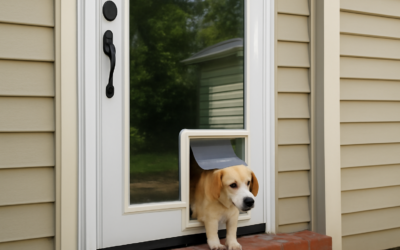
A plain flap door lets every dog, cat, raccoon and stray in the neighborhood push its way into your kitchen. An automatic dog door fixes that by staying locked until it detects your pet’s collar tag, then opening a solid panel just long enough for that animal to pass and closing again behind it. Some models slide a panel up or sideways, while others unlock a heavy insulated flap.
Part of our Windows & Doors guide — explore the full guide →
The payoff is better security, a tighter seal against drafts and control over when your dog can go outside. The trade-offs are cost, the need for power, and a little more maintenance than a simple flap. If you are choosing between models, the decisions come down to how the door is triggered, how it is powered, how big the opening needs to be and whether it goes in a door or a wall.
How an Automatic Dog Door Works
Most electronic pet doors read a small tag on the collar. As the dog approaches, a sensor in the frame detects the tag within a few feet and triggers a motor that lifts or slides a rigid panel. Once the dog clears the opening and a motion or proximity sensor confirms the path is empty, the panel closes and locks.
Trigger options vary:
- Collar tag: a passive or battery-powered key on the collar. Dog doors with collar activation are the most common type.
- Microchip reading: reads an implanted pet microchip, which is popular for a smart cat door since cats lose collars often.
- App or Wi-Fi: a smart dog door or wifi dog door adds scheduling, activity logs and remote lock and unlock from a phone.
- Remote control: a remote control dog door uses a handheld button for owners who want to open it manually.
Collar operated dog door models are simple and reliable. Smart pet door models add convenience, such as curfews that keep a dog inside at night or a log that shows how often an older dog is going out.
Powered Doors vs Passive Flaps
A passive flap costs less, needs no power and never fails because of a dead battery. It also offers almost no security and lets weather in around the edges. A powered pet door uses a rigid panel that locks shut, which blocks other animals and seals better. Flaps that simply unlock electronically sit in the middle: cheaper than a motorized panel but still selective about who gets through.
If your main concern is keeping wildlife out, choose a model with a solid locking panel and a selective trigger. If your dog is very large, elderly or nervous about pushing through a flap, a door that opens automatically removes that barrier entirely.
Power Needs and Electrical Safety
Electronic doors run on batteries, a plug-in adapter or both. Collar tags often use small coin cells, and the door itself may use a rechargeable pack or a low-voltage adapter that plugs into a standard outlet.
- Plug the adapter directly into a wall outlet, not an extension cord or power strip, and route the cord where pets cannot chew it.
- For an exterior or garage location, use a GFCI-protected outlet and keep the adapter and connections out of the weather.
- If there is no outlet near the door, have a licensed electrician add one. New outlets and circuits are not a DIY job.
- Before drilling near existing wiring, turn off the breaker and confirm power is off with a non-contact voltage tester. Never work on or test a live circuit.
Most doors run on low voltage once past the adapter, which keeps the door unit itself safe to handle. The line-voltage side is the outlet, and that stays with the electrician if anything needs to change.
Battery care
Replace or recharge batteries on the maker’s schedule, not when the door stops. Many units beep or show a light when the battery is low. Keep a spare collar battery on hand, check the collar tag monthly, and remove rechargeable packs from very hot or freezing locations if the manual recommends it. If a rechargeable pack swells, leaks or gets hot, stop using it and replace it.
Safety Sensors: Protecting Pets and Kids
A motorized panel has to know when something is in its way. Look for a model with a safety or obstruction sensor that stops and reverses the panel if a paw, tail or small hand is in the opening. Test it monthly by holding a soft object such as a rolled towel in the frame while the door closes; it should stop and reopen.
Teach children that the door is not a toy, and do not let small kids crawl through it. If toddlers could reach the opening, use the lock mode when they are playing nearby. Many doors also offer a mode that lets pets out but not back in, or in but not out, which is handy at night.
Sizing for Your Dog
Measure your dog standing. The flap or panel opening should be at least an inch or two taller than the height from the floor to the top of the shoulders, and a little wider than the widest part of the chest or hips. The step-over (the bottom edge of the opening) should be low enough for a comfortable stride, especially for short-legged, older or arthritic dogs.
Electronic dog door large models exist, but motorized panels have size limits, and the biggest units cost noticeably more. For giant breeds, check that the motor is rated for the panel size and that the opening still clears the dog’s back without crouching.
Installing in a Door vs a Wall
An automatic pet door can go in an exterior door, a wall, a sliding patio door panel or, with some models, a window. Each location has its own trade-offs.
- Exterior door: the easiest install for solid-core or hollow-core wood and many steel doors. Do not cut a fire-rated door, such as the door between an attached garage and the house, and avoid cutting glass or tempered panels.
- Wall: a good choice when the door is glass or you want to keep the main door intact. Check framing, avoid studs where possible and confirm there is no wiring, plumbing or duct in the bay before cutting. A tunnel kit seals the wall cavity.
- Sliding patio insert: a panel that fits into the track. No cutting, renter-friendly, but less secure unless you add a bar or lock.
For a door install, mark the opening at the right height, drill corner holes, cut with a jigsaw, then mount the frame with the supplied hardware and seal exterior edges. Wall installs need an extra step: locate studs, cut the opening, frame it if a stud is removed, and line the tunnel. Read the full instructions before cutting; the template supplied with the door is the best guide to the exact size.
Security Lockout and Training
Every good model has a manual lock or a solid cover for when you are away. Use it when traveling, and lock the door overnight if your area has wildlife. Smart models can schedule lock times automatically.
Training usually takes a few days. Prop the panel open at first and use treats to coax the dog through, then switch to automatic mode with the tag on the collar and let the dog learn that walking toward the door opens it. Stay nearby the first few times so the closing panel does not startle the dog.
Troubleshooting and Costs
- Door will not open: check the collar battery first, then the door battery or adapter, then whether the door is in a lock mode.
- Opens for the wrong animal: a neighbor’s pet may have a compatible tag, or a passive flap is being pushed. Switch to a selective trigger.
- Closes too soon: adjust the hold-open time or sensor range per the manual.
- Drafts: replace worn seals or weather strips and confirm the panel seats fully.
As a general range, electronic flaps cost less than a hundred to a couple hundred dollars, while motorized panel doors and the best pet door options with app control can run several hundred dollars or more. Professional installation adds labor, and wall installs cost more than door installs.
When to Call a Pro
Call a carpenter or handyman if the cut goes into a steel door, an exterior wall with unknown framing, or anywhere near a header. Call a licensed electrician for any new outlet or circuit. If the door is fire-rated or the wall contains plumbing or ductwork, choose a different location rather than cutting through it.
Frequently Asked Questions
Do automatic dog doors work during a power outage?
Many have battery backup or run fully on batteries. Plug-in only models may stay locked or unlocked, so check how yours behaves before relying on it.
Can other animals get through an electronic pet door?
A selective door with a rigid locking panel only opens for a registered tag or chip, which keeps out most strays and wildlife.
Will the door close on my dog?
Models with obstruction sensors stop and reopen when something is in the way. Test the sensor monthly with a soft object.
How long do collar batteries last?
Usually several months, depending on how often the dog uses the door. Check the tag monthly and keep a spare.
Can I put an automatic pet door in a wall?
Yes, with a wall kit and tunnel. Confirm the framing and check for wiring, plumbing and ducts before cutting.