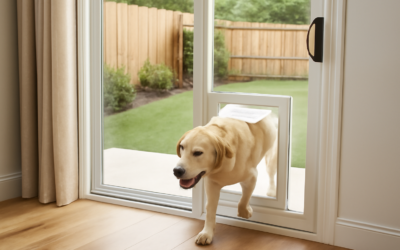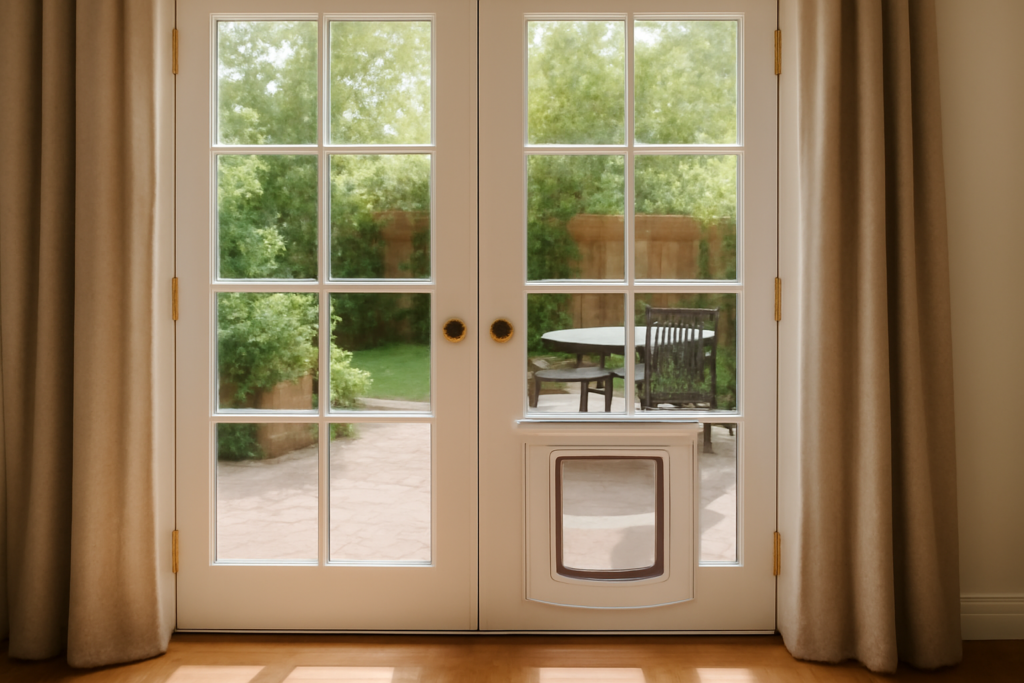
Letting a dog in and out through a pair of French doors twenty times a day wears on both the hinges and your patience. Adding a pet opening seems simple until you realize most French doors are nearly all glass, and tempered glass cannot be cut after it leaves the factory. Choosing french doors with dog door access means picking one of three routes: a door ordered with a built-in pet panel, a replacement glass unit with a flap installed, or a separate insert that sits beside the doors. Each has different costs, security trade-offs, and energy implications, and this guide walks through all of them so you can match the solution to your dog, your climate, and your door.
Part of our Windows & Doors guide — explore the full guide →
- Your Options for French Doors with Dog Door Access
- Factory-Built Pet Doors in New French Doors
- Replacing the Glass with a Pet Door Insert
- Sizing the Opening for Your Dog
- Security and Safety Considerations
- Energy Efficiency and Weather Sealing
- DIY or Professional Installation?
- Training Your Dog to Use the New Opening
- Alternatives When French Doors Are Not Ideal
- FAQs About French Doors with Dog Door Options
Your Options for French Doors with Dog Door Access
Because the glass in exterior French doors is tempered for safety, you have fewer choices than with a solid wood or steel slab door. Here is how the main options compare:
| Option | Typical Cost | Best For |
|---|---|---|
| New door with factory pet door | $1,800 – $5,500 installed | Replacing old doors anyway |
| Replacement glass with pet flap | $450 – $1,200 per panel | Keeping existing frames |
| Solid lower panel conversion | $600 – $1,500 | Wood doors with muntins |
| Wall-mounted pet door nearby | $300 – $1,400 installed | Preserving the doors entirely |
If your French doors are more than 15 years old, have failed seals (fogging between panes), or drafts around the astragal, replacing the whole unit with a pet-ready door usually delivers better value than retrofitting.
Factory-Built Pet Doors in New French Doors
Several major door manufacturers offer fiberglass and steel French doors with an integrated pet door built into the bottom of the active panel, or with a half-lite design that leaves a solid lower section. In the half-lite approach, the glass stops about halfway down and the lower 30 to 40 inches are a solid skin with foam core, which gives an installer room to cut in a standard pet door using the kit’s frame and tunnel.
The advantages are real. The pet opening is sealed within the door’s thermal envelope, the warranty stays intact, and the finished look is clean. Expect to pay $1,200 to $3,500 for the door unit alone, plus $500 to $1,800 for professional installation depending on whether the rough opening needs adjustment. Lead times for custom configurations typically run four to ten weeks.
Make sure the pet door goes in the active panel, the one that opens daily, only if you are comfortable with that panel being the main entry. Many owners prefer the pet door in the passive (fixed) panel so that the flap is never swinging along with the door itself.
Replacing the Glass with a Pet Door Insert
If you love your current doors, a glass shop can build a new insulated glass unit (IGU) with a round or rectangular hole pre-cut before tempering, then mount a glass-rated pet door through it. These in-glass pet doors are sold by several specialty brands in sizes from small (about 5 by 7 inches) to large (roughly 10 by 15 inches).
The process usually goes like this:
- Measure the glass itself, not the visible opening, including the portion hidden inside the glazing bead. Also record glass thickness, commonly 3/4 inch to 1 inch for dual-pane units.
- Choose the pet door model first, since the glass shop needs the cutout diameter and placement.
- Specify the height of the opening so the top of the flap sits about 2 inches above your dog’s shoulder.
- The shop fabricates, tempers, and seals the new IGU, typically in one to three weeks.
- The installer removes glazing beads, swaps the glass, and mounts the pet door.
This route works best on French doors with a single large pane per panel. Doors with true divided lites (many small panes) rarely have a single pane big enough for anything but a small dog. Simulated divided lites with grilles applied to the surface can often be worked around, though the grille pattern may need to be trimmed.
Sizing the Opening for Your Dog
A pet door that is too small becomes a door your dog refuses to use. One that is too large lets in drafts and potentially unwanted visitors. Measure your dog standing naturally:
- Width: measure across the widest part of the chest or shoulders and add 2 inches.
- Height: measure from the floor to the top of the shoulders (withers) and add 2 inches for the top of the flap.
- Step-over: the bottom of the flap should sit no higher than about one-third of the dog’s shoulder height. For older dogs or short-legged breeds like dachshunds and corgis, keep it as low as the door design allows.
With a large breed such as a Labrador or German Shepherd, you will typically need an opening around 10 by 16 inches or more. That size often rules out in-glass options on narrow French door panels, which pushes you toward a half-lite door or a wall-mounted unit.
Security and Safety Considerations
Any opening in an exterior door is a potential entry point. Most modern pet doors include a locking cover or slide-in panel, but the better solutions go further. Microchip-activated and collar-tag pet doors only unlock for registered animals, which keeps raccoons, opossums, and neighborhood cats out. Electronic in-glass models cost $250 to $700 before installation.
Place the flap on the panel farther from the lever handle when possible. Burglars occasionally reach through large pet doors to unlock deadbolts, so a double-cylinder lock (where local fire codes allow) or a keyed secondary lock on the active panel adds protection. Tempered glass remains safe even with a cutout, but only if the hole was made before tempering. Never attempt to drill tempered glass on site; it will shatter completely.
Energy Efficiency and Weather Sealing
A single flexible vinyl flap leaks noticeable air in winter. In climates with freezing temperatures, look for dual- or triple-flap designs with magnetic closures and weatherstripping, which reduce air infiltration significantly. Insulated in-glass pet doors use a thicker tunnel and a double-flap system to preserve some of the performance of your dual-pane glass.
Consider orientation too. A pet door facing the prevailing winter wind will push cold air into the room each time it swings. If your French doors face north or west in a cold climate, a wall-mounted pet door on a sheltered side of the house may be more comfortable. In hot, humid regions, the concern flips to keeping conditioned air in and insects out, so a flap with a tight magnetic seal matters more than insulation value.
DIY or Professional Installation?
Installing a pet door into a solid lower panel of a fiberglass or steel door is a manageable weekend job. You will need a jigsaw with a fine-tooth metal blade for steel skins, a drill, a straightedge, and exterior-grade silicone. Tape the cut lines with painter’s tape to prevent chipping, drill corner holes, then cut slowly. Seal exposed foam core edges before fastening the frame.
In-glass installations are different. Removing glazing beads without damaging vinyl or wood frames, handling a 60- to 90-pound insulated glass unit, and re-sealing it correctly is best left to a glazier. Most glass shops will handle fabrication and installation for a combined price, which also keeps the warranty on the new glass unit.
Before any work, check your door warranty and your HOA rules. Some manufacturers void coverage if the slab is cut, and some associations restrict visible modifications on front-facing doors.
Training Your Dog to Use the New Opening
Even the best-installed pet door is useless if your dog will not walk through it. Start by taping the flap fully open for the first few days so the opening feels like part of the doorway rather than an obstacle. Toss a treat through and praise every pass. Once your dog moves through confidently, lower the flap partway, then let it close completely. Most dogs adapt within a week, although anxious or older dogs may need two or three. Avoid pushing a dog through the flap, since one bad experience can set training back considerably. If you chose an electronic door, let your dog wear the collar key for a few days before activating the lock so the clicking sound is not a surprise.
Alternatives When French Doors Are Not Ideal
Sometimes the best answer is to leave the French doors alone. A wall-mounted pet door installed through a stud bay beside the doors keeps your glass intact and lets you pick a larger, better-insulated unit. Installation in wood framing typically costs $300 to $800, while cutting through brick or block runs $800 to $1,400. Another option for renters or temporary needs is a panel insert that fits in the track of an adjacent sliding door, though these do not work on hinged French doors.
FAQs About French Doors with Dog Door Options
Can you put a dog door in a glass French door?
Yes, but only by replacing the glass with a new tempered unit that has the hole cut before tempering. Existing tempered glass cannot be cut or drilled.
Which French door panel should have the pet door?
Many owners choose the fixed or less-used panel so the flap does not move with daily door traffic and sits away from the lockset for better security.
Do dog doors in French doors let in bugs?
Quality flaps with magnetic closures and brush seals limit insects. Adding a locking cover at night further reduces entry.