Buy a light fixture, solar kit or charger made for overseas markets and the wiring instructions will usually call for something like “2.5 mm2 cable,” while every spool at a US supply house is labeled in AWG. An AWG to mm2 conversion chart bridges that gap. American Wire Gauge (AWG) numbers run backward (smaller number, thicker wire), while metric sizes state the copper cross-section directly in square millimeters.
The quick answer: 14 AWG is about 2.08 mm2, 12 AWG is about 3.31 mm2 and 10 AWG is about 5.26 mm2. None of those land exactly on a standard metric size, so the safe rule is simple: when converting, always choose the equal or next larger wire, never the smaller one.
- AWG to mm2 Conversion Chart: 20 AWG to 6 AWG
- Large Conductors: 4 AWG to 4/0
- How the Conversion Works
- Fine Wire: 22 to 30 AWG
- Tools for Measuring Wire Size
- Using Metric Sizes With Imported Fixtures and EV Chargers
- Electrical Safety Basics
- Troubleshooting Common Sizing Mistakes
- Cost Considerations
- When to Call a Licensed Electrician
- Frequently Asked Questions
The tables that follow cover solid copper conductor sizes from 20 AWG up to 4/0, with diameters in millimeters and inches and the nearest standard IEC metric size at or above each gauge.
AWG to mm2 Conversion Chart: 20 AWG to 6 AWG
These are the gauges you meet in lamp cords, fixture wiring, branch circuits and most appliance connections. Diameters are for a solid round conductor; stranded wire of the same gauge has the same copper area but a slightly larger overall diameter.
| AWG | Diameter (mm) | Diameter (in) | Area (mm2) | Metric size at or above |
|---|---|---|---|---|
| 20 | 0.812 | 0.0320 | 0.518 | 0.75 mm2 |
| 18 | 1.024 | 0.0403 | 0.823 | 1.0 mm2 |
| 16 | 1.291 | 0.0508 | 1.309 | 1.5 mm2 |
| 14 | 1.628 | 0.0641 | 2.081 | 2.5 mm2 |
| 12 | 2.053 | 0.0808 | 3.309 | 4 mm2 |
| 10 | 2.588 | 0.1019 | 5.261 | 6 mm2 |
| 8 | 3.264 | 0.1285 | 8.366 | 10 mm2 |
| 6 | 4.115 | 0.1620 | 13.30 | 16 mm2 |
Notice that 20 AWG (0.518 mm2) is very close to the 0.5 mm2 metric size, but slightly larger. Following the equal-or-larger rule, 0.75 mm2 is the safe replacement when 20 AWG is specified. Going the other way, a 0.5 mm2 conductor is a reasonable stand-in only where the circuit was designed for 0.5 mm2 in the first place.
Large Conductors: 4 AWG to 4/0
Heavy feeders, service entrance conductors, battery banks, welders and large chargers use these sizes. Above 1 AWG, sizes are written as 1/0 (“one aught”), 2/0, 3/0 and 4/0, and they keep getting thicker.
| AWG | Diameter (mm) | Diameter (in) | Area (mm2) | Metric size at or above |
|---|---|---|---|---|
| 4 | 5.189 | 0.2043 | 21.15 | 25 mm2 |
| 3 | 5.827 | 0.2294 | 26.67 | 35 mm2 |
| 2 | 6.544 | 0.2576 | 33.63 | 35 mm2 |
| 1 | 7.348 | 0.2893 | 42.41 | 50 mm2 |
| 1/0 | 8.251 | 0.3249 | 53.48 | 70 mm2 |
| 2/0 | 9.266 | 0.3648 | 67.43 | 70 mm2 |
| 3/0 | 10.40 | 0.4096 | 85.03 | 95 mm2 |
| 4/0 | 11.68 | 0.4600 | 107.2 | 120 mm2 |
In large sizes, the gaps between metric steps are wide. A 1/0 AWG conductor (53.48 mm2) sits just above 50 mm2, so a direct metric equivalent jumps all the way to 70 mm2. That can affect lug sizes, conduit fill and cost, so plan terminations around the actual conductor you buy.
How the Conversion Works
Every value in an AWG to mm2 conversion chart comes from the same math. AWG is a logarithmic scale. Every 3 gauge steps roughly doubles or halves the cross-section, and every 6 steps roughly doubles or halves the diameter. The standard formulas are:
- Diameter (mm) = 0.127 x 92^((36 minus AWG) / 39)
- Area (mm2) = 0.7854 x diameter squared (that is, pi divided by 4, times the diameter squared)
For aught sizes, use 0 for 1/0, minus 1 for 2/0, minus 2 for 3/0 and minus 3 for 4/0 in the formula. To convert the other direction (metric to AWG), find the area in the table and pick the AWG whose area is equal to or larger than the metric size the equipment calls for.
A handy rule of thumb: 10 AWG is roughly 5 mm2, and each step of three gauges halves (thinner) or doubles (thicker) that area. 13 AWG is about 2.6 mm2, 7 AWG about 10.5 mm2.
Fine Wire: 22 to 30 AWG
Electronics, thermostat wire, doorbell wire, speaker leads and LED strip connections use much thinner wire. Approximate values for solid copper:
- 22 AWG: 0.644 mm (0.0253 in) diameter, 0.326 mm2
- 24 AWG: 0.511 mm (0.0201 in), 0.205 mm2
- 26 AWG: 0.405 mm (0.0159 in), 0.129 mm2
- 28 AWG: 0.321 mm (0.0126 in), 0.081 mm2
- 30 AWG: 0.255 mm (0.0100 in), 0.051 mm2
So the diameter of 30 AWG wire is about a quarter of a millimeter, roughly the thickness of a few sheets of paper. These sizes are for low-voltage, low-current signals only and should never carry line-voltage loads.
Tools for Measuring Wire Size
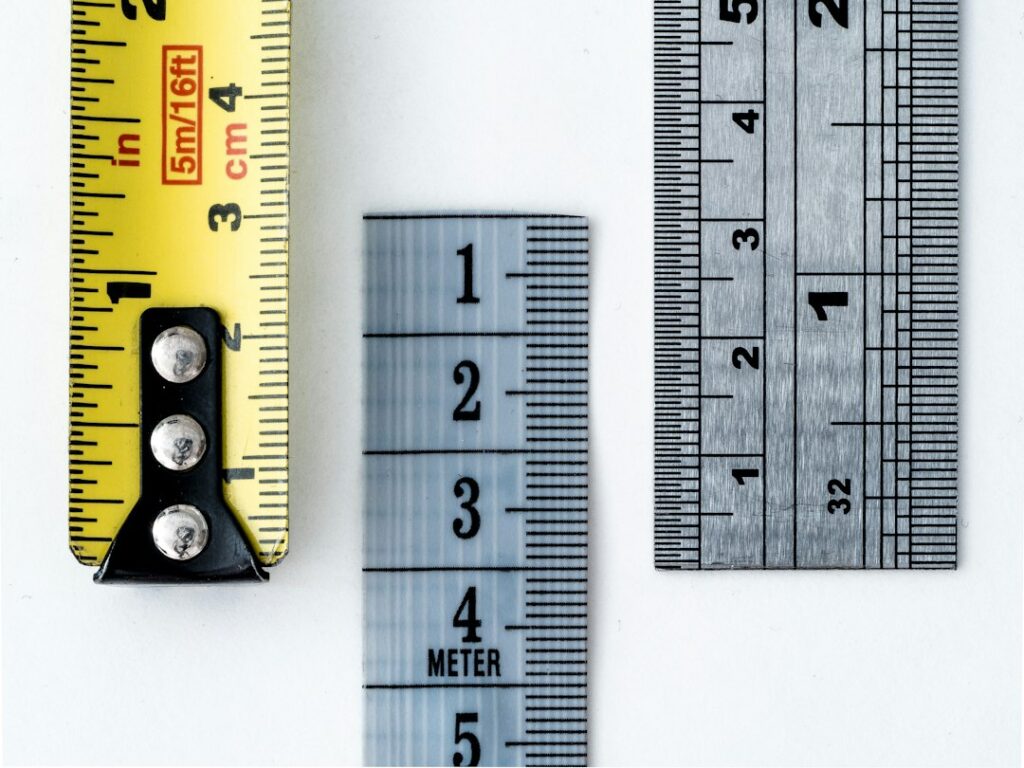
When a label is missing or worn, measure instead of guessing, then look the result up in the AWG to mm2 conversion chart.
- Wire gauge measuring tool: a round or rectangular plate with labeled slots. Slide the bare conductor into slots until it fits snugly without forcing.
- Digital or dial caliper: measure the bare conductor diameter and compare with the tables. For stranded wire, measure one strand and count strands, or rely on the jacket printing.
- Wire strippers with gauge markings: useful for a quick check on common building wire sizes.
- Jacket printing: most cable is printed with size, conductor material, insulation type and temperature rating every few feet.
Only measure wire that is disconnected or on a circuit that is turned off at the breaker and verified dead with a non-contact voltage tester.
Using Metric Sizes With Imported Fixtures and EV Chargers
Imported equipment often lists a metric minimum cable size. Converting that to AWG is only the first step.
- Read the manual’s minimum size and the circuit breaker rating it requires.
- Convert to the equal or larger AWG. For example, a 2.5 mm2 requirement converts to 12 AWG (3.31 mm2), not 14 AWG (2.08 mm2), because 14 AWG is smaller.
- Check US ampacity rules. Allowable current depends on insulation temperature rating, terminal ratings, installation method, bundling, ambient temperature and run length. A cross-section match does not guarantee code compliance.
- Allow for voltage drop. Long runs to garages, sheds or driveway chargers may need a size or two larger.
- Confirm the equipment is listed for US use. Fixtures, chargers and power supplies should carry a recognized safety listing (such as UL or ETL) and be rated for the 120 V or 240 V supply they will connect to.
EV chargers are continuous loads, so circuit and conductor sizing follows specific rules. That work belongs to a licensed electrician, along with the permit and inspection it requires.
Electrical Safety Basics
Converting a wire size on paper is safe. Working on the wiring is where the risk is. Keep these rules in mind:
- Turn off the breaker for the circuit and confirm the power is off with a non-contact voltage tester before touching any conductor.
- Never measure or test conductors on a live circuit. Resistance or continuity checks are done only with the power off.
- Understand the difference between low-voltage (doorbells, thermostats, landscape lighting secondaries, LED strips) and line-voltage (120 V or 240 V household circuits). Fine-gauge wire belongs only on low-voltage, low-current circuits.
- Kitchen, bathroom, garage and outdoor outlets need GFCI protection.
- Plug large appliances and heaters directly into a wall outlet, not an extension cord or power strip.
- Never replace a wire with a smaller one. Undersized conductors overheat and are a fire risk.
Troubleshooting Common Sizing Mistakes
Choosing the “nearest” size instead of the next larger: 2.5 mm2 is closer to 14 AWG than to 12 AWG on a list, but 14 AWG is smaller. Always round up in copper area.
Confusing diameter with area: metric sizes describe cross-sectional area in mm2, not diameter in mm. A 1.5 mm2 wire is about 1.38 mm in diameter.
Mixing aluminum and copper: aluminum conductors need a larger size than copper for the same load and require terminals rated for aluminum.
Terminal won’t accept the wire: upsized conductors may not fit small terminals on imported devices. Use listed connectors or pigtails rated for both sizes rather than trimming strands.
Cost Considerations
Copper wire prices move with the metals market, so expect general ranges rather than fixed prices. Moving up one gauge typically adds a noticeable but modest amount per foot on short runs, and much more on long runs of heavy feeder cable. Hiring a licensed electrician for a new circuit commonly runs a few hundred dollars for a simple run, and more for subpanels, long feeders or EV charger circuits with permits.
When to Call a Licensed Electrician
Replacing a like-for-like fixture on an existing circuit is a common DIY job where permitted. New circuits, new outlets, subpanels, service upgrades, EV charger installations and any wiring where you are unsure of the correct size belong to a licensed electrician. They will size the conductors to current code, pull permits and arrange inspection, which protects both your home and your insurance coverage.
Frequently Asked Questions
What is 14 AWG in mm2?
14 AWG is about 2.08 mm2. If equipment calls for 2.5 mm2, use 12 AWG, which is about 3.31 mm2, since 14 AWG is smaller.
What AWG is 2.5 mm2 wire?
2.5 mm2 falls between 14 AWG (2.08 mm2) and 12 AWG (3.31 mm2). Use 12 AWG to meet or exceed the metric requirement.
What is the diameter of 30 AWG wire?
Solid 30 AWG copper is about 0.255 mm (0.010 in) in diameter, with a cross-section of about 0.051 mm2.
How many mm2 is 4/0 AWG?
4/0 AWG is about 107.2 mm2, with a solid diameter of roughly 11.68 mm. The next standard metric size at or above it is 120 mm2.
Is mm2 the same as wire diameter?
No. Square millimeters describe cross-sectional area. To get the diameter of a round conductor, divide the area by 0.7854 and take the square root.
Can I convert millimeters to gauge directly?
Yes. Measure the bare conductor diameter in millimeters and match it to the closest AWG diameter in the tables, then confirm against the jacket printing if available.