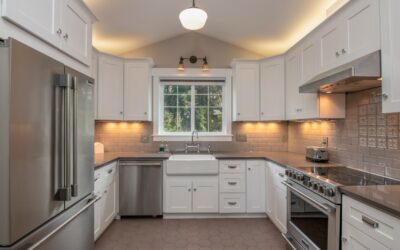
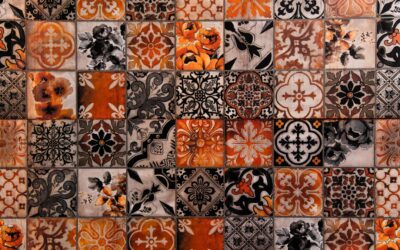
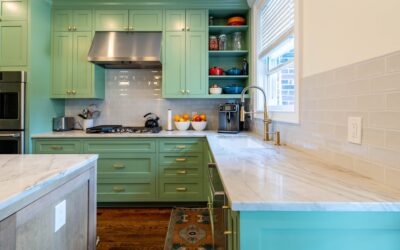
Green cabinets exploded in popularity around 2022, and most kitchens that installed them are now stuck staring at a builder-grade subway tile that fights the color. The right backsplash for green cabinets finishes the look — the wrong one makes the cabinets feel like a mistake. The good news is that green is one of the most forgiving cabinet colors to pair with, as long as you understand which undertone you are working with and which finishes amplify it.
Part of our Kitchen Remodeling guide — explore the full guide →
Identify Your Green First
Not all greens behave the same way. Before picking tile, pull a paint chip of your cabinet color and study it in natural light. Sage and sea-foam read cool and gray. Forest and hunter pull deep and warm. Olive and avocado carry yellow. Each one wants a different backsplash.
- Sage (Benjamin Moore Saybrook Sage, Sherwin-Williams Evergreen Fog): Cool, gray-leaning. Pairs with warm neutrals for contrast.
- Forest (Sherwin-Williams Pewter Green, Benjamin Moore Hunter Green): Deep, saturated. Wants light, simple backsplashes to breathe.
- Olive (Farrow & Ball Treron, Benjamin Moore Avocado): Earthy and yellow-toned. Looks best with cream or terracotta.
Warm White Subway: The Safe Win
A 3 by 6-inch warm white subway tile from Daltile (Color Wheel Linear in Almond) is the most foolproof choice for any green. It costs about $2.50 per sq ft, installs cleanly, and lets the cabinets stay the visual star. Lay it in a 1/3 offset and grout with a slightly darker warm gray like Mapei Pewter to add depth without competition.
Skip stark cool white. Bright white tile against sage or olive creates a fluorescent gym-locker vibe that flattens both colors.
Zellige Tile for Texture
Handmade zellige tiles, especially the Bedrosians Cloe line at $9 to $14 per sq ft, bring the kind of subtle irregularity that makes green cabinets feel collected rather than mass-produced. The slight color shifts and glossy variation catch light differently throughout the day. White zellige works with any green; cream zellige sings against forest green; soft pink zellige is a bold pairing that works surprisingly well with sage.
Marble and Marble-Look Slabs
A full-height marble backsplash takes a green kitchen from nice to magazine-cover. Carrara reads cool and pairs naturally with sage. Calacatta Gold, with its warm tan veining, is the textbook match for olive and hunter greens. Real marble slab runs $80 to $150 per sq ft installed; porcelain slabs that mimic it (Daltile Calacatta Vagli, MSI Statuario) drop the price to $25 to $45 per sq ft and resist staining better.
If you go the slab route, run it full-height behind the range with no upper cabinets to break the slab. That creates a focal point and lets the veining shine.
Brass and Copper Accents Multiply the Effect
Green and brass is a designer cliche for a reason. It works. Even if your backsplash is a simple white tile, swapping pulls and faucets to unlacquered brass (Rejuvenation Massey at $42 per pull, Kohler Purist faucet around $580) pulls warmth into the green cabinets and creates intentional contrast. Copper does the same job with a slightly more rustic feel.
If you want metal in the backsplash itself, look at hammered copper sheets or brass herringbone strips behind a range. Use them sparingly — a full wall of metal reads industrial.
Patterns That Hold Up
Bold patterns can work with green cabinets, but they have to be intentional. Black-and-white encaustic-look porcelain (Daltile Memoir, Bedrosians Cementine) costs $7 to $12 per sq ft and provides a graphic punch against muted sage. Reserve patterns for smaller stretches — a behind-range niche or a coffee bar wall — rather than the entire kitchen run.
Geometric mosaics in cream and taupe work for olive cabinets. Skip primary-color patterns; they fight the green instead of complementing it.
Grout Color Strategy
Grout is half the design choice and most people pick it last. Match grout to tile for a seamless monolithic look, or contrast it for a graphic grid. Against green cabinets, these grout pairings work consistently:
- White tile + warm gray grout: Adds depth, hides splatter.
- Cream zellige + ivory grout: Tone-on-tone, very Mediterranean.
- White subway + black grout: Graphic farmhouse, only works with mid-toned greens.
- Marble + light gray grout: Lets veining read continuously.
Don’t Forget the Countertop
The backsplash has to sit between the cabinets and the counter, so all three colors have to talk to each other. With green cabinets, the safest counter choices are white quartz with light gray veining (Caesarstone Statuario Maximus, $75 per sq ft), warm white marble, or honed black soapstone-look quartz for high contrast. If your counter is busy, simplify the backsplash. If your counter is calm, the backsplash can carry more pattern.
What to Avoid
A few combinations consistently disappoint in green kitchens:
- Glossy cool gray tile — adds nothing and reads cold.
- Beige travertine — clashes with most greens, especially sage.
- Glass mosaic mixes from the early 2010s — date the kitchen instantly.
- Red brick veneer — fights green on the color wheel without the warmth to bridge.
Pulling It Together
The strongest backsplash for green cabinets pairings rest on three principles: match temperature (warm to warm, cool to cool), add a metallic accent, and let one element be loud while the others stay quiet. Get those right and your green kitchen will photograph beautifully and live even better. Order samples of three to five options, tape them to the cabinets, and live with them for 48 hours under both daylight and evening light before committing.