A green backsplash tile kitchen has quietly become one of the most requested looks I install, and it is easy to see why. Green sits in a rare sweet spot: it feels fresh and natural without being trendy in a way that dates quickly, and it flatters an enormous range of cabinet colors and countertops. Whether you want a barely-there whisper of sage or a saturated emerald that stops people in their tracks, there is a shade and a tile format that will get you there. This guide walks through the shades, the materials, and the pairings so you can design a backsplash that still looks intentional five years from now.
Part of our Kitchen Remodeling guide — explore the full guide →
Choosing Your Shade of Green
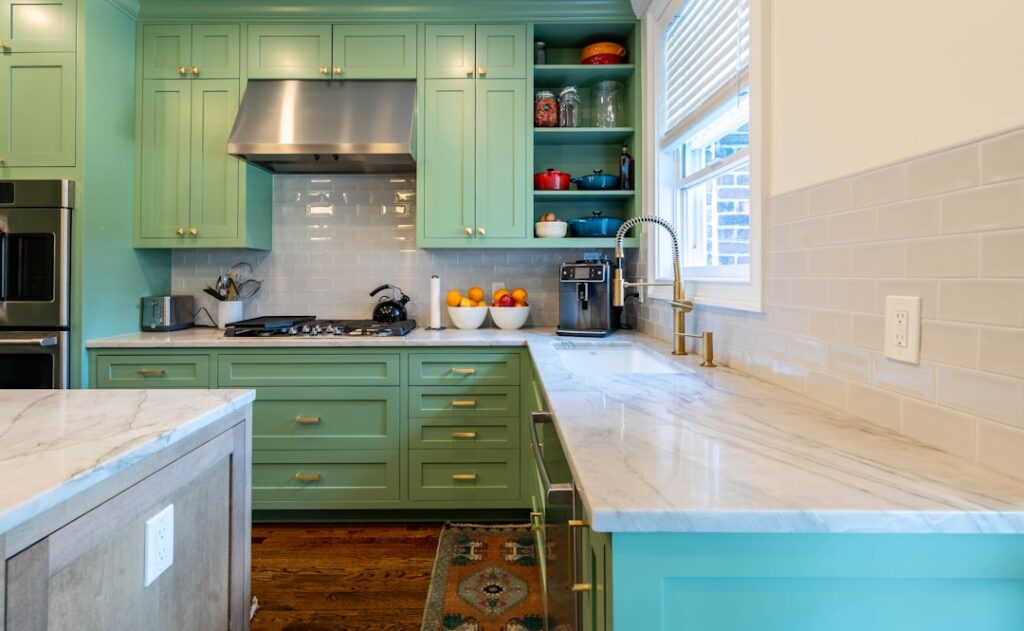
Green is not one color, and the shade you pick sets the entire mood of the room. Sage is the gentle, grayed-out green that reads almost neutral. It is the easiest to live with, pairs with nearly everything, and gives you color without commitment, which is why it dominates the softer, organic kitchens you see everywhere right now. If you want warmth and richness, sage is the safe, sophisticated starting point.
Olive and moss push into earthier, yellow-green territory. These shades feel vintage and grounded, and they play beautifully with brass hardware, wood tones, and warm-white walls. At the bold end sits emerald, a deep jewel-toned green that turns a backsplash into the star of the kitchen. Emerald is dramatic and best used with restraint, often paired with lots of white or with dark cabinetry for a moody, high-end look. Deciding where you land on this spectrum, quiet sage to loud emerald, is the first real decision in any green backsplash tile kitchen.
Subway Tile: The Timeless Workhorse
If you want green that will never look dated, glossy green subway tile is the reliable answer. The classic 3-by-6 format, and the trendier skinnier 2-by-8, delivers clean lines and a familiar rhythm that reads as timeless rather than of-the-moment. In a soft sage or a gentle seafoam, subway tile keeps a kitchen calm and bright. In a deep hunter or emerald, the same shape suddenly feels rich and custom.
The layout multiplies your options. A standard offset brick pattern is safe and classic, a vertical stack looks modern and makes low ceilings feel taller, and a herringbone adds movement and a bespoke feel. Subway tile is also budget-friendly, generally $8 to $20 per square foot installed depending on the tile, which makes it the most approachable way into a green kitchen.
Zellige for Depth and Character
When homeowners want that handmade, glowing, no-two-tiles-alike quality, I steer them toward zellige. These are traditional Moroccan tiles, made by hand and glazed so that light catches their uneven surface and slight color variation. In green, zellige is spectacular: the shifting tones of olive, jade, or emerald give a backsplash a living, water-like depth that no machine-made tile can replicate. It is the single fastest way to make a green backsplash tile kitchen feel high-end and one of a kind.
Fair warning on the tradeoffs. Zellige is more expensive, often $20 to $50 per square foot for the tile alone, and it demands a skilled installer because the irregular edges and variation require care to lay well. The color inconsistency that makes it beautiful can also surprise people who expected uniformity, so order from the same lot and embrace the variation as the feature it is.
Glass Tile for Brightness
Glass tile is the option to reach for when you want your green to feel luminous. Because light passes into the glass and reflects back, colors look deeper and more vivid, and the surface bounces natural light around a kitchen that might otherwise feel dark. Glass comes in subway shapes, mosaics, and elongated planks, and it wipes clean effortlessly, which is a real perk behind a busy cooktop.
Green glass mosaics in mixed sea-glass tones are a favorite for a coastal or spa-like feel, while a single-color glossy green glass plank gives a sleeker, more contemporary result. Glass typically runs $15 to $40 per square foot installed. The main thing to know is that installation is less forgiving, since the translucency means the adhesive and any imperfections behind the tile can show through, so this is not the place to cut corners on the setter.
Pairing Green With Cabinets and Counters
The magic of a green backsplash is how flexibly it pairs. Against white or off-white cabinets, almost any green pops cleanly and feels fresh, which is the most foolproof combination and a great choice if you are nervous about color. Against natural wood cabinets, olive and sage create a warm, organic, earthy kitchen that feels current and inviting. And for the bold, green tile against deep navy or charcoal cabinetry produces a rich, layered, jewel-box effect that looks expensive.
Countertops are the tiebreaker. White quartz or marble-look surfaces let the green tile take center stage and keep the room feeling light. Butcher block and warm wood counters reinforce the natural, earthy direction that olive and sage do so well. Be careful pairing busy, heavily veined stone with an equally busy zellige or mosaic, since two loud elements compete; let one be the star. Get the pairing right and a green backsplash tile kitchen feels cohesive and designed rather than like a color you bolted on.
Full Backsplash or Just Behind the Range
How much wall you cover changes the impact and the budget. The standard four-inch strip along the counter is the cheapest and most conservative approach, but it undersells a color as good as green. Running the tile the full height from counter to the underside of the upper cabinets, roughly 18 inches, is the sweet spot most homeowners choose, giving the green real presence without overwhelming the room. If you want drama, take the tile all the way to the ceiling behind the range or the sink to create a floor-to-ceiling feature wall, then keep the rest of the backsplash simpler. That focal-point approach lets you splurge on a pricey emerald zellige in one concentrated area while using a plain field tile elsewhere, which keeps the whole green backsplash tile kitchen within budget.
Think about sightlines too. In an open-concept kitchen, the backsplash is visible from the living and dining areas, so a bolder green reads as a deliberate design statement across the whole space. In a small, enclosed galley kitchen, a lighter sage keeps things from feeling closed in, while a saturated emerald can make a tight room feel cozy and jewel-like if you have enough light. Walk the room, notice where your eye lands from the doorway, and concentrate the strongest color there.
Finishing Touches That Sell the Look
Small choices decide whether the backsplash looks polished or unfinished. Grout color is huge: a matching green or soft greige grout keeps the field seamless and elegant, while a contrasting white grout emphasizes each tile’s shape and gives a more graphic, geometric result. For emerald or hunter green, a darker grout usually looks more intentional than stark white. Metal finishes tie it all together, brass and gold warm up olive and sage beautifully, while black or chrome hardware sharpens a deeper emerald into something modern. Layer these details thoughtfully and your green kitchen will read as a designer did it.
Prefer to explore on your own?
See how new flooring looks in your actual room in seconds — free, no signup.
Try the free Floor Studio →