Nothing extends the usable life of a patio or deck faster than getting the sun off it. Backyard awnings do exactly that, throwing shade over your outdoor space so you can enjoy it through the hottest part of the day, protecting furniture from fading, and even keeping the adjacent rooms of your house cooler by blocking sun before it hits the windows. Awnings range from a simple stationary canopy to a motorized, sensor-driven retractable system, and prices span from a couple hundred dollars to well over ten thousand. This guide breaks down the types, what they cost, and how to pick the right one for your yard.
- Why Add an Awning to Your Backyard
- Retractable Awnings
- Fixed (Stationary) Awnings
- Freestanding and Portable Awnings
- Awning Fabric and Material Choices
- What Backyard Awnings Cost
- Design Ideas to Make It Look Great
- Choosing the Right Awning for Your Space
- Installation: DIY or Hire a Pro
- Care, Wind, and Winterizing
Why Add an Awning to Your Backyard
The benefits go beyond shade, though shade is the headline. A well-placed awning drops the temperature underneath by 15 to 20°F compared to full sun, making a scorching patio genuinely comfortable. It shields outdoor furniture, cushions, and flooring from UV fading. Positioned over patio doors or windows, it reduces solar heat gain indoors, which can trim summer cooling costs. And depending on the fabric, it can let you sit outside through light rain. For many homeowners, an awning is the cheapest way to make an existing patio far more usable.
Retractable Awnings
The most popular backyard awning is the retractable type, a fabric canopy on folding arms that extends out from the house and rolls back into a housing when not in use. You get shade on demand and can retract it to protect the fabric from storms, snow, and winter weather, which greatly extends its life.
- Manual retractable: Operated with a hand crank. Affordable, reliable, no electrical needed. Typically $400 to $1,500.
- Motorized retractable: Extends and retracts with a remote, switch, or app. Often adds wind and sun sensors that deploy or retract automatically. Usually $1,500 to $4,500 installed, more for large spans.
Retractable awnings commonly project 8 to 12 feet from the wall and span 10 to 20 feet wide. Because you can pull them in, they are the best choice for four-season climates where leaving fabric exposed all winter would ruin it.
Fixed (Stationary) Awnings
A fixed awning is permanently mounted and does not retract. It uses a rigid frame, often with a fabric or metal cover, and stays in place year-round. Fixed awnings are sturdier in wind than retractables and provide constant, dependable shade and rain protection over a door, window, or small patio.
They cost less than motorized retractables, roughly $300 to $2,000 depending on size and material, but you lose the flexibility to open up to the sun, and in snowy climates a fabric fixed awning must be built to shed snow or be taken down for winter. Metal fixed awnings are extremely durable and low-maintenance, a good pick over an entryway or a spot you always want shaded.
Freestanding and Portable Awnings
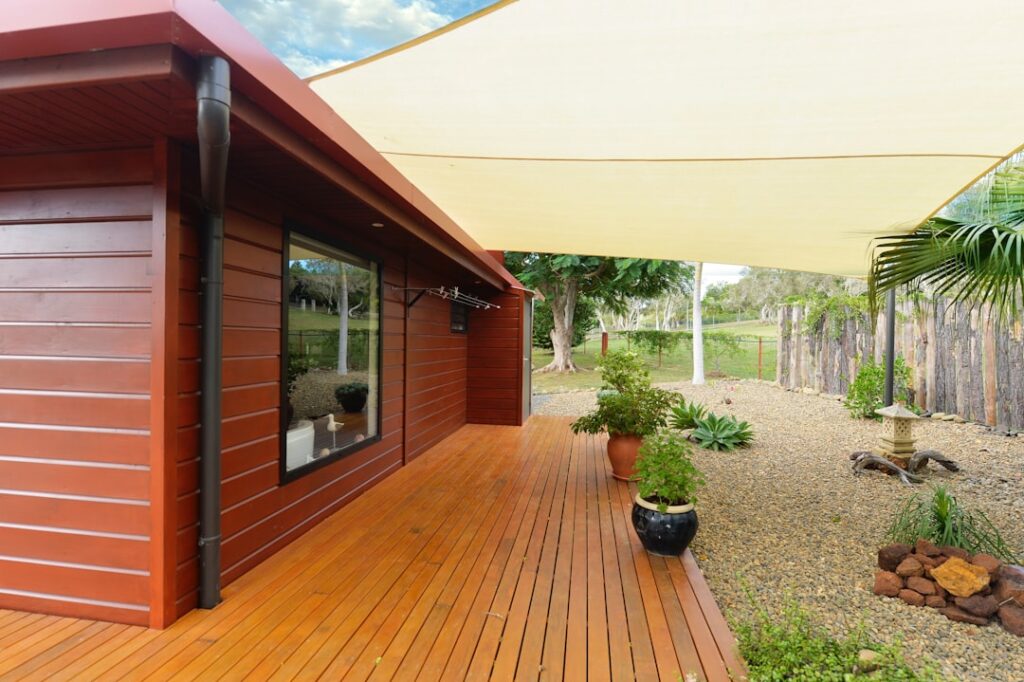
Not every awning attaches to the house. Freestanding awnings and canopies stand on their own posts, so you can shade a detached patio, a spot in the yard, or an area where wall mounting is not an option. Larger freestanding structures resemble a fabric-roofed pergola and can cover an outdoor kitchen or dining area.
At the portable end are pop-up canopies and cantilever patio umbrellas, budget options from $100 to $800 that provide instant, movable shade with no installation. They are perfect for renters or anyone who wants flexibility, though they offer less protection and durability than a mounted awning.
Awning Fabric and Material Choices
The cover material drives both looks and lifespan. Your main options:
- Solution-dyed acrylic (e.g., Sunbrella): The premium fabric. Color is woven into the fiber, so it resists fading, mildew, and stains, and typically carries a 10-year warranty. Breathable and water-resistant.
- Vinyl-coated polyester: More waterproof and easy to clean, good for rain protection, though less breathable and can trap heat.
- Aluminum or metal: Used on fixed awnings for maximum durability and a maintenance-free surface, but no flexibility and a more industrial look.
For hot climates, pick a tightly woven fabric that blocks 90 percent or more of UV. Lighter colors reflect heat; darker colors block more light but absorb more warmth.
What Backyard Awnings Cost
Budget depends mostly on size, operation, and whether it is motorized. As a general guide:
- Portable canopy or cantilever umbrella: $100-$800
- Fixed awning: $300-$2,000
- Manual retractable: $400-$1,500
- Motorized retractable with sensors: $1,500-$4,500+
- Large freestanding or custom systems: $3,000-$10,000+
Professional installation typically adds $300 to $1,000. Motorized units also need a power source nearby, so factor in an electrician if there is no exterior outlet on the wall.
Design Ideas to Make It Look Great
An awning should complement the house, not fight it. Coordinate the fabric color with your trim, shutters, or roof for a pulled-together look, or pick a subtle stripe for classic curb appeal. Size it generously, an awning that only half-covers your seating looks skimpy and leaves people chasing shade. Add integrated LED lighting strips or a valance for evening ambiance. For a defined outdoor room, pair a retractable awning with outdoor curtains on the open sides to block low sun and add privacy. Over an outdoor kitchen, a freestanding metal awning protects appliances while looking intentional.
Choosing the Right Awning for Your Space
Match the awning to how and where you will use it. If you want flexible shade over a patio against the house and live where winters are harsh, a motorized retractable that tucks away is the smart long-term choice. If you need reliable, permanent cover over a doorway or a small deck, a fixed awning costs less and stands up to wind. For a detached seating area or a rental, go freestanding or portable. Consider your sun direction too, west- and south-facing patios take the harshest afternoon sun and benefit most from a deep projection.
However you use your yard, backyard awnings are one of the highest-impact, lowest-hassle upgrades you can make, turning a sun-blasted patio into a shaded retreat and stretching your outdoor season by weeks. Pick a quality fabric, size it generously, and choose retractable or fixed based on your climate, and you will wonder how you ever sat out there without one.
Before you buy, take a few measurements and note the sun. Measure the wall width available for mounting and how far out you want the awning to reach, then watch where the sun falls across the patio through the afternoon so you size and position the awning to shade your actual seating, not empty pavement. Check your local codes too, since some areas require a permit for a permanently mounted awning. A little planning up front means the awning you install lands the shade exactly where you sit, which is the whole point.
Installation: DIY or Hire a Pro
Whether you can install an awning yourself depends on the type. Manual retractable awnings and fixed awnings are within reach for a handy homeowner, the critical part is anchoring the mounting brackets securely into the wall’s framing or masonry, not just the siding. A retractable awning cantilevers a lot of leverage when extended, so it must be lag-bolted into studs, a header, or solid masonry with the proper anchors. Get two people, a solid ladder, and a level, and a manual unit can go up in an afternoon.
Motorized awnings, especially large spans with sensors, are usually worth hiring out. They require precise mounting, careful leveling so the fabric rolls evenly, and electrical work to power the motor, which often means bringing in an electrician for a weatherproof exterior circuit. A professional install typically adds $300 to $1,000 but ensures the awning is anchored to handle wind loads and warrantied against installation faults. For freestanding structures, you will also set posts in concrete footings, another argument for professional help on larger builds.
Care, Wind, and Winterizing
An awning lasts far longer when you respect the weather. Wind is the number one enemy of any extended awning, so retract fabric units in gusty conditions, and if you have a motorized model, wind sensors that pull it in automatically are worth every penny. Snow is the other hazard; fabric awnings are not built to carry snow load, so retract or remove them before winter storms, and take down or reinforce fixed fabric awnings in heavy-snow regions.
For cleaning, brush off debris regularly and hose the fabric down a few times a season, spot-treating mildew and stains with a mild soap solution. Solution-dyed acrylic resists mold and fading, but trapped leaves and moisture will still shorten any fabric’s life. Retract the awning to let it dry fully before rolling it away wet, which prevents mildew. Metal awnings need almost nothing beyond an occasional rinse. Give a quality retractable or fixed awning this basic care, and it will shade your backyard reliably for 10 to 15 years, extending your outdoor season and protecting everything, and everyone, underneath it.