A bar sink faucet fails in a way big kitchen faucets never do: it splashes. Drop a full-size 9.5-inch-reach pull-down over a 15-inch prep bowl and the stream hits the far wall of the basin, ricochets onto the counter, and soaks the person mixing drinks. Bar and prep faucets are a distinct category — scaled-down reach, lower arcs, narrower bodies — and sizing one correctly is 90 percent arithmetic. This guide gives you the numbers, then the styles, then specific picks by budget.
Bar Sink Basics: What You’re Fitting
Bar sinks (also sold as prep, entertainment, or island sinks) typically measure 9.5 to 18 inches across and 5 to 10 inches deep, with a single 1-3/8-inch faucet hole. Common installs: wet bars, butler’s pantries, kitchen islands, basement bars, and outdoor kitchens. The faucet’s job list is short — rinse glasses, fill shakers and pots, wash produce — which means you can prioritize looks and scale over spray-head gadgetry.
The Sizing Math
Three measurements decide whether a faucet fits:
1. Spout reach (the critical one)
Reach is the horizontal distance from the faucet’s center post to the middle of the water stream. The stream should land at or just behind the drain, roughly the center of the bowl.
| Bowl width (front to back) | Ideal spout reach |
|---|---|
| 10–12 in. | 4–5.5 in. |
| 13–15 in. | 5–6.5 in. |
| 16–18 in. | 6–8 in. |
Measure from where the faucet hole sits — if the hole is set back 2 inches from the bowl rim, add that setback to the required reach. Most purpose-built bar faucets run 4.5 to 6.5 inches of reach; most full-size kitchen faucets run 8 to 10. That gap is why repurposed kitchen faucets splash.
2. Spout height
Height matters two ways. Under a cabinet or shelf (common at back-wall wet bars), total faucet height must clear: measure counter-to-obstruction and subtract 2 inches for operating room. In the open (islands), taller is fine and often looks better. Standard bar faucet heights run 8 to 14 inches overall. High-arc bar models give you pot-filling clearance in a small footprint; low-profile models (6–8 inches) tuck under upper cabinets.
3. Depth of bowl vs. splash
Shallow bowls (5–6 inches) splash easily. Compensate with lower flow (a 1.2 gpm aerator, $6), a laminar-stream faucet, or an angled stream landing near the drain. Deep 10-inch bowls forgive almost anything.
Styles That Work
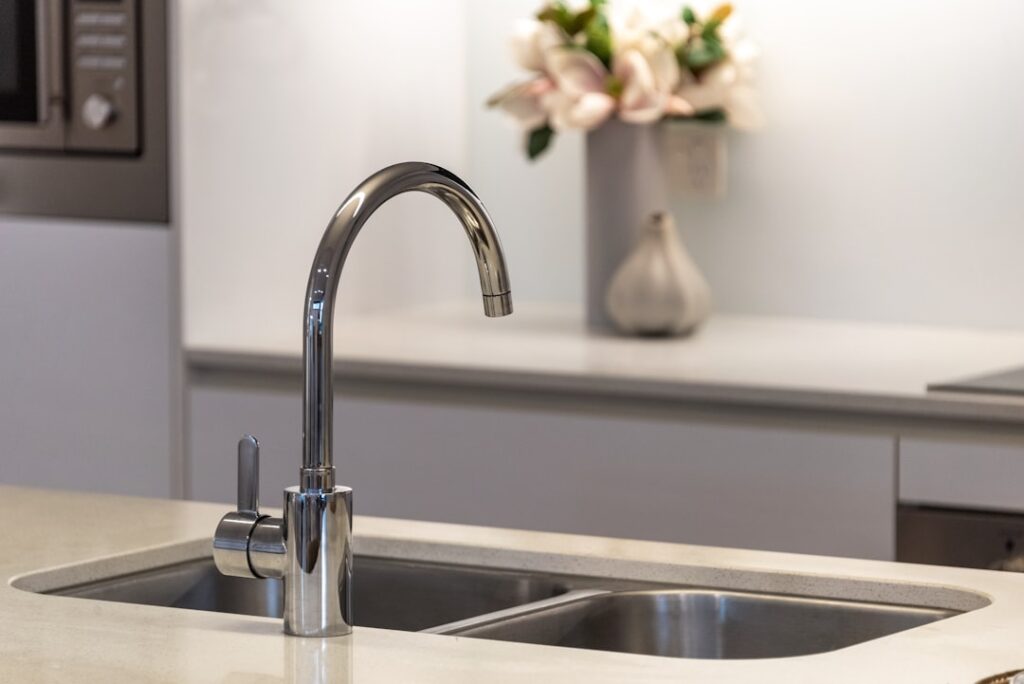
- Classic high-arc single handle: the default. A shrunken version of the kitchen faucet above, 10–12 inches tall with 5–6 inches of reach. $60–$200.
- Mini pull-down: compact pull-downs (Delta Trinsic Bar, Kohler Purist Bar, Moen Align Bar) give a working sprayer for rinsing produce. $180–$450. Worth it if the sink is a true second prep station; skip for a drinks-only bar.
- Vintage bridge and cross-handle: two-handle bar faucets in unlacquered brass or polished nickel — the cocktail-bar look. $200–$600. Pairs beautifully with the warm-metal trend; the brass faucet guide covers how these finishes age.
- Modern cylinder/square: matte black or brushed gold minimalist posts to match contemporary kitchens. $90–$300.
- Cold-only or filtered: if the bar sink exists mainly for drinking water and ice, a single-temp filtered water faucet or a dedicated reverse osmosis faucet may serve better than a hot/cold mixer — and simplifies plumbing to one supply line.
Finish Strategy for a Second Sink
The bar faucet does not have to match the main kitchen faucet — it has to relate. Three approaches that work:
- Match exactly: same brand, same finish, smaller model. Safest, and most brands sell bar versions of their flagship kitchen lines for this reason.
- Accent metal: main kitchen in stainless, bar in brushed gold or matte black. The bar zone becomes a jewelry moment — popular with dark island cabinetry.
- Theme the zone: basement or outdoor bars can go fully independent — copper, ORB, or industrial galvanized looks that would fight the main kitchen upstairs.
Whatever you choose, match the faucet to the bar sink’s drain flange and any soap dispenser at the same deck. Mixed metals within one 18-inch sink zone read as accidental.
Flow, Supply, and Install Notes
- Flow rate: bar faucets ship at 1.2–1.8 gpm. For glass-rinsing and shaker-filling, 1.2 is plenty and splashes less.
- Supplies: standard 3/8-inch compression, same as any faucet. Island and basement bars sometimes have 1/2-inch stub-outs — a $4 adapter handles it.
- Hot water: long dead-leg runs to a remote bar mean 30–60 seconds of waiting. Options: cold-only plumbing (fine for a drinks bar), a $200 point-of-use 2.5-gallon mini water heater under the cabinet, or accept the wait.
- Shut-offs: add quarter-turn stops under every bar sink. Remote sinks freeze first in cold snaps and get discovered last.
- Outdoor bars: use a frost-rated supply plan — interior shut-off and drain-down before winter — and pick PVD finishes; lacquered finishes chalk in UV.
Picks by Budget
| Budget | Pick | Why |
|---|---|---|
| $60–$100 | Kingston Brass or Kraus bar models | All-brass bodies at commodity prices; check reach spec |
| $100–$200 | Moen Align Bar, Delta Trinsic Bar (standard) | Name-brand cartridges, lifetime finish warranties |
| $200–$350 | Kohler Purist Bar, Delta Trinsic Pro Bar pull-down | Designer looks, mini pull-down function |
| $350–$600+ | Perrin & Rowe, Waterstone, Brizo Litze bar | Statement metals, unlacquered living finishes |
Mistakes to Avoid
- Reusing the old kitchen faucet. The reach is wrong. It will splash. Sell it instead.
- Ignoring the setback. A faucet hole drilled 3 inches behind the bowl rim eats 3 inches of reach.
- Buying a 16-inch showpiece for under-cabinet placement. Measure the clearance first; returns on faucets run 15 percent restocking at some suppliers.
- Skipping the aerator swap. If a faucet you love splashes in a shallow bowl, a $6 low-flow or laminar aerator usually cures it.
- Forgetting the drain. Bar sinks use 1-1/2 or 2-inch drains with small-format flanges; order the flange in the faucet’s finish at the same time.
Matching the Faucet to the Sink Material
Bar sinks come in more materials than kitchen sinks, and the pairing changes both looks and splash behavior. Stainless steel (16–18 gauge undermounts) is the workhorse — any finish works visually, but stainless is the loudest under a hard stream, so favor a laminar or low-flow head in shallow bowls. Copper bar sinks, hammered or smooth, are the signature wet-bar move; pair them with ORB, copper-toned, or unlacquered brass faucets and let both patina together — chrome against copper reads like a parts-bin accident. Fireclay and porcelain prep sinks want traditional faucets (bridge, cross handles) and tolerate splash beautifully thanks to their depth. Granite composite in matte black or gray pairs naturally with matte black and gunmetal faucets and mutes water noise better than any metal bowl. Glass and hand-painted vessel-style bar sinks — occasionally used in built-in bar cabinetry — need gentle flow above all; fit a 1.0 gpm aerator regardless of the faucet you choose. Two practical notes across all materials: order the drain assembly and basket strainer in the faucet’s finish at purchase time (small-format 2-inch and 3.5-inch bar drains sell out in odd finishes constantly), and if the sink is a drop-in with a shiny rim, match rim metal to faucet metal or the mismatch sits an inch apart forever.
FAQ
Can I use a bathroom faucet on a bar sink?
Physically yes — the hole sizes match on single-hole models — but bath faucets run 1.2 gpm with pop-up drain holes you won’t use, and their 3–5 inch reaches suit only the smallest bowls. Purpose-built bar faucets cost the same and fit better.
What size faucet for a 15-inch bar sink?
About 5.5–6.5 inches of reach and any height that clears obstructions. That’s the center of the bar-faucet market, so selection is widest here.
Do bar faucets come touchless?
A few (Moen Align Bar MotionSense, some Kohler models). Useful at a true prep sink; overkill at a drinks station.
One handle or two?
Single-handle wins for one-handed use while the other hand holds a glass. Choose two-handle bridge styles for looks, knowingly.
Get the reach number right and everything else about a bar sink faucet is taste. Measure the bowl, add the setback, buy scaled — and the prep sink becomes the most-used 15 inches of the kitchen instead of the splashiest.