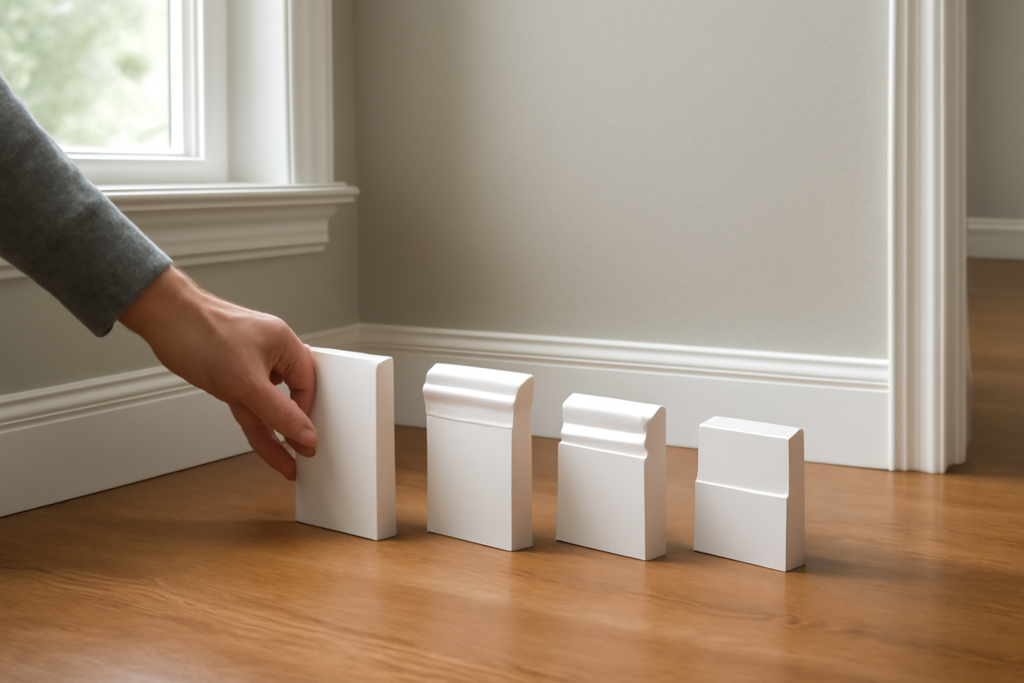
Baseboards are easy to overlook, but they quietly shape how finished a room feels. The right baseboard styles tie the walls to the floor, hide the gap where the two meet, and reinforce a home’s overall character, whether that is crisp modern, warm traditional, or somewhere in between. Swapping thin builder-grade trim for a taller, more detailed profile is one of the highest-impact upgrades you can make for the money.
This guide walks through the main profiles, how to choose height and material, and roughly what to expect on cost.
Common Baseboard Profiles
The profile is the shape you see in cross-section. The most common options:
- Flat or square-edge: a plain rectangular board, the cleanest look. Perfect for modern and minimalist interiors.
- Rounded (bullnose) top: a gently curved upper edge that softens the line and resists chipping.
- Colonial: a stepped, gently sculpted profile that suits traditional and craftsman homes.
- Ogee: an S-shaped curve that reads formal and detailed, common in older and upscale homes.
- Stepped or sculpted: layered profiles with multiple curves and reveals for the most ornate look.
For a custom, substantial appearance, many homeowners stack a flat baseboard with a separate shoe molding or cap, building up height and detail without buying a single expensive board.
Choosing the Right Height
Baseboard height should relate to ceiling height and the scale of the room. A few rules of thumb:
- Standard 8-foot ceilings pair well with 3- to 5-inch baseboards.
- Taller 9- and 10-foot ceilings can carry 5- to 7-inch baseboards without looking heavy.
- A common guideline is roughly 7 percent of the ceiling height, then round to a stock size.
Going slightly taller than builder-standard almost always looks more intentional, but match the rest of the trim; a tall baseboard looks odd next to skinny door and window casings.
Material Choices
The material affects both look and budget:
- MDF: smooth, affordable, and stable, ideal for painted trim. It does not handle moisture well, so avoid bathrooms and basements prone to damp.
- Pine and softwood: economical solid wood that paints nicely and is easy to cut.
- Hardwood (oak, maple, poplar): the choice for stained, natural-wood baseboards and high-traffic areas.
- PVC or composite: waterproof options for bathrooms, laundry rooms, and basements.
For most painted interiors, primed MDF gives the best value and the smoothest finished look.
What Baseboards Cost
Material runs from roughly $1 to $3 per linear foot for basic MDF and pine, up to $4 to $8 or more per linear foot for hardwood and ornate profiles. Professional installation typically adds $1 to $3 per linear foot. An average room of 50 to 60 linear feet is an affordable upgrade in materials, with labor being the bigger line item if you hire out the work.
Replacing baseboards is also a realistic DIY project if you own or rent a miter saw and a finish nailer, which keeps the cost to materials alone.
Matching Style to Your Home
Let the home’s age and overall design guide the choice. Clean flat or bullnose profiles suit contemporary builds and open floor plans. Colonial and ogee profiles complement traditional, farmhouse, and craftsman homes. In an older home with existing ornate trim, match the new baseboard to what is already there for a cohesive look rather than mixing eras.
Color matters too. Crisp white is timeless and brightens a room, while matching the baseboard to the wall color makes ceilings feel taller and the space more seamless and modern.
Matching Baseboards to Flooring
The flooring underneath influences how a baseboard should be detailed. With hard floors like tile, hardwood, and laminate, baseboards usually sit directly on the finished floor and are often finished with a small shoe molding or quarter round to cover the expansion gap left along the wall. With carpet, the baseboard typically stops just above the subfloor so the carpet tucks underneath, which means you can skip shoe molding for a cleaner line.
Color coordination matters here too. White baseboards crisp up almost any floor, while baseboards stained or painted to relate to the flooring create a more custom, built-in look. For dark floors, a clean white baseboard provides contrast and definition; for light floors, either white or a tone-on-tone baseboard works well depending on whether you want the trim to stand out or recede.
Painting and Finishing Baseboards
The finish makes or breaks the look. For painted baseboards, a semi-gloss or satin enamel is the standard choice because it wipes clean and resists scuffs from feet, vacuums, and furniture. Prime any bare wood or MDF first, sand lightly between coats, and apply two thin coats rather than one heavy one for a smooth, drip-free surface. Caulk the top seam and fill nail holes before the final coat so the trim reads as one continuous piece.
For stained hardwood baseboards, choose the stain and topcoat before installation when possible, finishing the boards flat where it is easier to get an even result, then touching up cut ends and nail holes after install. Either way, a careful finish is what gives baseboards that crisp, intentional look that elevates the whole room.
Combining Baseboards With Other Trim
Baseboards rarely stand alone in a finished room; they work as part of a trim package that includes door and window casings, crown molding, and sometimes wainscoting. For a cohesive look, scale the baseboard to relate to the casings, since a tall, substantial baseboard next to thin window trim looks unbalanced. Many builders keep casing and baseboard widths within a similar range so the room reads as designed rather than pieced together. If you plan to add wainscoting or chair rail later, choose a baseboard profile that complements those elements so the whole wall composition feels intentional.
Installation Tips
Cut inside corners with a coped joint rather than a simple miter for tight seams that stay closed as the wood moves with humidity. Use a stud finder and nail into framing where possible, fill nail holes and seams with caulk and wood filler, and prime any raw cut ends before painting. A thin bead of paintable caulk along the top edge where the baseboard meets the wall gives that clean, gap-free, professional finish.
Final Thoughts
Baseboard styles range from barely-there flat trim to richly sculpted profiles, and the best choice flows from your ceiling height, your home’s character, and your budget. Pick a profile that matches your other trim, size it to the room, choose a material suited to the location, and finish it carefully. The result is a room that simply looks complete.