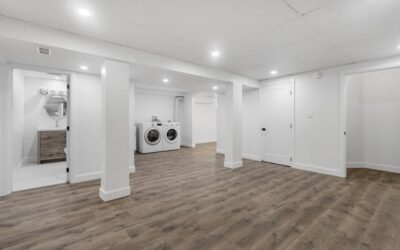
Basement flooring needs to handle what no other floor in the house deals with — moisture migrating up through concrete, potential flooding, temperature swings, and often an uneven slab. The cheapest option is not always the smartest one. Here are eight budget-friendly basement flooring options ranked from least to most expensive, with honest assessments of how each handles basement conditions.
Part of our Epoxy, Concrete & Garage Floors guide — explore the full guide →
- Moisture: The Factor That Overrides Everything
- 1. Painted Concrete
- 2. Peel and Stick Vinyl Tiles
- 3. Interlocking Foam Tiles
- 4. Carpet Tiles
- 5. Luxury Vinyl Plank (LVP) — Click-Lock
- 6. Laminate Flooring
- 7. Rubber Flooring
- 8. Engineered Wood with Vapor Barrier
- Cost Comparison for a 500 Sq Ft Basement
- Prep Work Every Basement Needs
- The Best Value Pick
Moisture: The Factor That Overrides Everything
Before choosing any basement flooring, test your concrete slab for moisture. Tape a 2×2-foot sheet of plastic to the floor and leave it for 48 hours. If moisture collects underneath, you have vapor transmission that will destroy most flooring types.
For accurate results, use a calcium chloride test kit ($20 to $30). Readings above 3 lbs per 1,000 sq ft over 24 hours indicate a moisture problem that needs a vapor barrier, sealant, or drainage solution before any flooring goes down.
1. Painted Concrete
Cost: $0.25 to $0.75 per square foot
The absolute cheapest option. Concrete floor paint or stain transforms a gray slab into a finished-looking floor for almost nothing.
- Best products: Epoxy-based concrete paint ($35 to $50 per gallon, covers 250 to 400 sq ft) or concrete stain ($30 to $45 per gallon)
- Pros: Extremely cheap, easy DIY, no height added, easy to redo
- Cons: Cold underfoot, hard on joints, peels if moisture is present, no sound dampening
- Moisture tolerance: Low. Paint traps moisture and peels. Stain penetrates and handles moisture slightly better.
- Best for: Utility basements, workshops, storage areas, laundry rooms
Application Tips
Etch the concrete with muriatic acid or a concrete etching solution first. Apply a concrete primer, then two coats of paint with 24 hours between coats. Add non-slip additive to the final coat for safety.
2. Peel and Stick Vinyl Tiles
Cost: $0.50 to $3.00 per square foot
Quick to install with no tools beyond a utility knife. Available in wood, stone, and geometric patterns.
- Pros: Cheap, fast installation, easy to replace individual tiles, many design options
- Cons: Adhesive fails in damp conditions, edges curl over time, thin (no insulation), can trap moisture against concrete
- Moisture tolerance: Poor. The adhesive breaks down with moisture from below.
- Best for: Dry basements only, temporary solutions, renters who need a quick fix
If you go this route, apply a concrete sealer first and consider a peel and stick product with a built-in moisture barrier. Budget about $1.50 to $3.00 per square foot for a product that will last more than two years.
3. Interlocking Foam Tiles
Cost: $1.00 to $3.00 per square foot
EVA foam tiles snap together like puzzle pieces. They are warm, soft, and require zero adhesive or tools.
- Pros: Comfortable, warm underfoot, great sound dampening, easy to remove and clean underneath, no adhesive needed
- Cons: Look like a gym floor, dent easily under furniture, not suitable for finished living spaces
- Moisture tolerance: Good. Foam does not absorb water and the floating design allows air circulation underneath.
- Best for: Kids’ play areas, home gyms, craft rooms
4. Carpet Tiles
Cost: $1.00 to $5.00 per square foot
Modular carpet squares (typically 18×18 or 24×24 inches) install without stretching or tack strips. Peel and stick or loose-lay options are available.
- Pros: Warm, comfortable, good sound absorption, replace individual tiles if stained or damaged, many colors and patterns
- Cons: Can develop mold and mildew if moisture is present, harder to clean than hard surfaces, some off-gassing with cheaper brands
- Moisture tolerance: Moderate. Choose tiles with waterproof backing (like Flor or Shaw carpet tiles). Avoid any carpet tile with organic backing in basements.
- Best for: Basement bedrooms, family rooms, home offices
The sweet spot is $2.00 to $3.50 per square foot for commercial-grade carpet tiles with moisture-resistant backing. FLOR tiles run higher ($5 to $14) but offer premium quality and easy replacement.
5. Luxury Vinyl Plank (LVP) — Click-Lock
Cost: $2.00 to $5.00 per square foot
This is the most popular basement flooring choice in 2026 for good reason. Click-lock LVP floats over the concrete with no adhesive, is 100% waterproof, and looks convincingly like real wood or stone.
- Pros: Waterproof, realistic appearance, comfortable with underlayment, floats over uneven concrete (minor irregularities), easy DIY installation
- Cons: Expands and contracts with temperature changes, cheaper products can look plastic, needs flat subfloor (within 3/16 inch over 10 feet)
- Moisture tolerance: Excellent. The planks themselves are waterproof. Use an underlayment with a built-in vapor barrier.
- Best for: Any finished basement space — living rooms, bedrooms, offices, entertainment areas
Budget LVP Picks
Home Depot’s Lifeproof line and Lowe’s SmartCore run $2.50 to $4.00 per square foot and include decent wear layers (12 to 20 mil). For a 500-square-foot basement, total material cost is $1,250 to $2,000 plus $100 to $200 for underlayment.
6. Laminate Flooring
Cost: $1.50 to $4.00 per square foot
Laminate is cheaper than LVP but comes with a critical weakness: the fiberboard core swells and warps when wet.
- Pros: Affordable, huge style selection, easy click-lock installation, harder surface than vinyl (more scratch resistant)
- Cons: Not waterproof — the HDF core absorbs water and swells permanently. Cannot be used in basements with any moisture risk.
- Moisture tolerance: Poor. Even “water-resistant” laminate only handles surface spills for a limited time. Subfloor moisture will destroy it.
- Best for: Only bone-dry basements with confirmed low moisture readings and a quality vapor barrier underlayment
If your basement has passed moisture testing with flying colors, laminate can save 20% to 40% compared to LVP. But one flooding event or slow leak, and the entire floor is ruined. LVP is the safer investment.
7. Rubber Flooring
Cost: $2.00 to $6.00 per square foot
Interlocking rubber tiles or rolled rubber sheeting provide a tough, moisture-proof surface.
- Pros: Extremely durable, waterproof, sound dampening, slip resistant, comfortable for standing
- Cons: Limited aesthetic options (mostly solid colors or speckled), strong rubber smell initially, heavy
- Moisture tolerance: Excellent. Rubber is impervious to water.
- Best for: Home gyms, workshops, utility areas, laundry rooms
For a home gym setup, 3/8-inch interlocking rubber tiles at $2.50 to $4.00 per square foot are the standard. For a finished look, rubber plank flooring mimicking wood is available at $4.00 to $7.00 per square foot.
8. Engineered Wood with Vapor Barrier
Cost: $4.00 to $8.00 per square foot
The priciest option on this list but the only way to get real wood in a basement. Engineered wood’s plywood core handles humidity better than solid hardwood.
- Pros: Real wood appearance and feel, can be refinished (depending on veneer thickness), adds home value
- Cons: Not waterproof — standing water will damage it, most expensive option, requires quality vapor barrier and underlayment
- Moisture tolerance: Moderate. Handles humidity fluctuations but not standing water or high moisture transmission.
- Best for: Dry, well-insulated basements being converted to high-end living space
Cost Comparison for a 500 Sq Ft Basement
- Painted concrete: $125 to $375
- Peel and stick vinyl: $250 to $1,500
- Foam tiles: $500 to $1,500
- Carpet tiles: $500 to $2,500
- LVP (click-lock): $1,000 to $2,500 (plus $100–$200 underlayment)
- Laminate: $750 to $2,000 (plus $75–$150 underlayment)
- Rubber: $1,000 to $3,000
- Engineered wood: $2,000 to $4,000 (plus $150–$300 underlayment)
Prep Work Every Basement Needs
Regardless of which flooring you choose, take care of these first:
- Level the slab. Use self-leveling compound ($25 to $50 per 50-lb bag, covers about 50 sq ft at 1/8 inch) to fill low spots and smooth rough areas.
- Seal the concrete. Apply a concrete moisture sealer ($30 to $50 per gallon) if moisture testing shows borderline results.
- Install a vapor barrier. 6-mil polyethylene sheeting ($25 to $50 per 500 sq ft roll) goes under any flooring that sits directly on concrete. Many underlayments include a built-in vapor barrier.
- Check for radon. While you have the floor exposed, test for radon ($15 for a home test kit). If levels exceed 4 pCi/L, mitigate before covering the slab.
- Address water entry. If water comes in through walls or floor cracks, no flooring will solve the problem. Fix the water first with exterior grading, French drains, or a sump pump.
The Best Value Pick
For most basements in 2026, click-lock LVP in the $2.50 to $3.50 range delivers the best combination of appearance, durability, waterproofing, and cost. It handles the unique challenges of basement environments, looks great, installs in a weekend, and costs $1,250 to $1,750 for a 500-square-foot space. Pair it with a vapor barrier underlayment, and you have a floor that will perform for 15 to 25 years.
Prefer to explore on your own?
See how new flooring looks in your actual room in seconds — free, no signup.
Try the free Floor Studio →