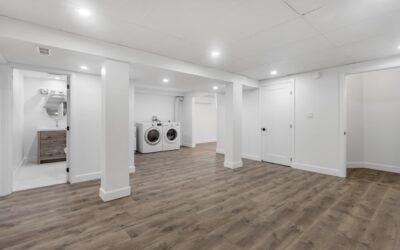
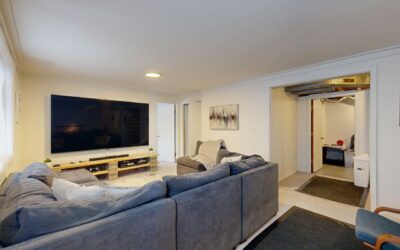
Basements punish flooring in ways above-grade rooms never do. Slab moisture, seasonal humidity above 60 percent, cooler year-round temperatures, and the constant threat of a sump-pump failure or supply-line leak push most mainstream products into early failure. The best flooring for finished basement use balances waterproof performance, comfort underfoot, and warmth — three priorities that lead different homeowners to different picks. Knowing the trade-offs prevents the most common mistake: choosing the same flooring the upstairs has and watching it cup or buckle within two seasons.
- What Disqualifies Most Flooring Below Grade
- Rigid-Core LVP Is the Practical Default
- Porcelain Tile for Maximum Durability
- Engineered Hardwood — The Premium Option
- Carpet Picks That Survive Basements
- Moisture Testing Comes First
- Underlayment and Vapor Barrier
- Comfort and Sound Considerations
- Realistic Pricing by Material
- Should You Pick LVP, Tile, Wood, or Carpet?
What Disqualifies Most Flooring Below Grade
Three failure modes drive product selection. Slab moisture vapor releases continuously even from decades-old slabs — most slabs read 70 to 90 percent relative humidity below the surface, well above the 75 percent threshold standard laminate tolerates. Seasonal humidity above 65 percent during humid summers swells wood-fiber cores and HDF-based laminates at seams. And catastrophic water events (failed sump, frozen pipe burst, washer overflow) submerge basement flooring while the homeowner is asleep — products that cannot dry out get tossed.
Those three failure modes rule out solid hardwood, standard laminate, glue-down LVT over untreated slabs, and most engineered hardwood without specific below-grade warranties.
Rigid-Core LVP Is the Practical Default
SPC (stone-plastic composite) rigid-core LVP wins on the most criteria. The mineral-filled core does not swell, the click-lock system handles minor slab movement, and 24 to 48-hour submersion typically does no permanent damage. Most premium lines warrant the product for below-grade use without additional conditioning.
Top picks for finished basements:
- COREtec Pro Plus Enhanced — 20-mil wear, attached cork underlayment, $4.99 per sq ft
- Mohawk SolidTech Plus — 22-mil wear, IXPE pad, $5.49 per sq ft
- Mannington Adura Rigid — 20-mil wear, FloorScore certified, $5.49 per sq ft
- Shaw Floorte Pro Endura Plus — 20-mil wear, lifetime residential, $4.49 per sq ft
Installed pricing lands $7 to $10 per square foot. The product carries 100 percent of the visual appeal of hardwood at half the price and far better moisture tolerance.
Porcelain Tile for Maximum Durability
For basements that double as workout rooms, workshops, or wet bars, porcelain tile offers the longest-lasting solution. The material survives floods, hose-down cleaning, dropped tools, and pet accidents indefinitely. Through-body porcelain in 12 by 24-inch large-format format reads modern, and pairing with radiant floor heat under the slab solves the cold-feet problem that drives most homeowners away from tile.
Specs that matter:
- DCOF rating 0.42 or higher
- Through-body color (chips do not show)
- Set on uncoupling membrane (Schluter Ditra-Heat with radiant cable, or plain Ditra)
- Epoxy grout in narrow joints if water exposure is a concern
Expect $10 to $16 per square foot installed without radiant heat, $14 to $20 with hydronic or electric radiant.
Engineered Hardwood — The Premium Option
Engineered hardwood works in finished basements when three conditions are met. Slab moisture tests below 5 lbs per 1,000 sq ft per 24 hours on calcium chloride or 85 percent RH on F2170 probes. The space stays climate-controlled year-round, 65 to 75°F and 45 to 60 percent humidity. The product carries an explicit below-grade warranty (Hallmark Origins, Provenza, and DuChateau all offer this).
Installation method matters. Glue-down with a moisture-cure polyurethane (Bostik Best, Mapei Ultrabond ECO 980) outperforms floating click-lock below grade because the adhesive bonds plank to slab and prevents the hollow-sound problem. Expect $9 to $14 per square foot installed.
Carpet Picks That Survive Basements
Synthetic carpet (nylon or polyester) over a moisture-resistant pad still has a role in basements meant as bedrooms, theater rooms, or play spaces. The combination is warm, quiet, and soft underfoot. The trick is choosing components rated for below-grade use:
- 100 percent synthetic fibers (no wool or blends)
- Synthetic backing (no jute)
- Moisture-barrier pad like Healthier Choice Carpet Cushion or Tac-Fast
- Direct-glue or stretch-in over slab with continuous moisture pad
If the basement floods, expect to replace carpet and pad — they cannot be salvaged. Plan accordingly with insurance and consider zoning carpet to non-flood-prone areas only.
Moisture Testing Comes First
Every basement install starts with documented slab moisture. ASTM F2170 RH probes give the most accurate reading — set probes to 40 percent slab depth, seal for 72 hours, then read. Target below 85 percent RH for most flooring; below 75 percent for engineered hardwood. ASTM F1869 calcium chloride works as a backup but is less accurate.
If the slab reads above spec, options include surface vapor barriers (Bostik MVP4, Mapei Planiseal VS — $0.60 to $1.20 per sq ft), liquid sealers, or switching to a product with higher moisture tolerance. Skipping the test is the fastest way to a warranty denial.
Underlayment and Vapor Barrier
Every basement install needs a vapor barrier even with passing moisture readings — slab moisture changes seasonally and a hot summer pushes vapor higher. Options include 6-mil poly under floating products, combination underlayment with integral vapor protection, or liquid-applied membranes under glue-down installs. Skipping the vapor barrier puts the warranty in jeopardy and risks mold growth between the floor and slab.
Comfort and Sound Considerations
Basements feel different underfoot than upstairs. Concrete-and-product assemblies sound hollow and stay cool. Three upgrades soften the difference. An acoustical underlayment (MP Global QuietWalk Plus, FloorMuffler Ultra Seal) cuts impact noise by half. Radiant floor heat under tile or LVP solves cold-feet complaints. Area rugs in living and reading zones add warmth and absorb echo.
Realistic Pricing by Material
For a 600 sq ft finished basement, the installed cost ranges:
- Premium SPC LVP — $4,200 to $6,000
- Porcelain tile without radiant heat — $6,000 to $9,600
- Porcelain tile with electric radiant — $8,400 to $12,000
- Engineered hardwood (glue-down) — $5,400 to $8,400
- Direct-glue carpet over moisture pad — $2,400 to $4,200
Should You Pick LVP, Tile, Wood, or Carpet?
Match the product to the use. For multi-purpose family basements with home offices, theaters, and play zones, the best flooring for finished basement use is premium SPC LVP — it handles most failure modes and delivers wood-look aesthetics. For workout rooms, workshops, or wet bars, porcelain tile is the most durable choice. For sleeping rooms or theater areas, carpet over a moisture pad adds the warmth that LVP cannot match. Many basements use two or three flooring types zoned by room function — and that hybrid approach typically delivers the best long-term satisfaction.
Prefer to explore on your own?
See how new flooring looks in your actual room in seconds — free, no signup.
Try the free Floor Studio →