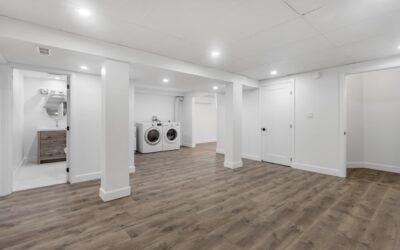
Here is the hard truth most homeowners do not want to hear: installing a traditional solid hardwood floor in basement spaces is one of the most common, and most expensive, flooring mistakes you can make. Basements sit below grade, where moisture migrates up through concrete and seasonal humidity swings constantly. Solid hardwood is hygroscopic, meaning it absorbs and releases moisture, so it cups, gaps, and buckles in below-grade conditions. That does not mean you have to give up the warm look of wood downstairs. It means you need to choose the right product and prep the slab correctly.
This guide explains why solid wood fails in basements, which wood-look options actually survive there, and the moisture controls that make or break any basement flooring project.
Why Solid Hardwood Doesn’t Belong Below Grade
Solid hardwood is a single piece of wood, typically 3/4 inch thick, that expands and contracts with humidity. Manufacturers almost universally do not warranty solid hardwood for below-grade installation, and for good reason. Even a “dry” basement releases water vapor through the concrete slab year-round, and that constant moisture exposure leads to predictable failure.
- Cupping: Boards curl up at the edges as they absorb moisture from below.
- Gapping: Boards shrink and pull apart during dry seasons.
- Buckling: In severe cases, planks lift entirely off the subfloor.
- Mold risk: Trapped moisture under wood can foster mold growth you cannot see.
You also cannot nail solid hardwood into a concrete slab the way you would over a wood subfloor, which compounds the problem. For all these reasons, solid wood is the wrong tool for a basement.
The Better Choices: Engineered Wood and LVP
If you want real wood underfoot, engineered hardwood is the answer. Engineered planks are built from a thin hardwood veneer bonded over a plywood or HDF core, which gives them far better dimensional stability against humidity. Many engineered products are rated for below-grade installation as a floating floor, exactly what a basement needs.
If you want bulletproof performance, luxury vinyl plank (LVP) is the smarter pick. Rigid-core SPC vinyl is waterproof, dimensionally stable, and entirely comfortable over concrete. It mimics wood convincingly and shrugs off the occasional minor leak that would destroy real wood. For most homeowners, the basement decision comes down to engineered wood (for authentic wood) versus LVP (for maximum moisture resistance and value).
Test Your Slab for Moisture First
Before you buy anything, you have to know how wet your slab is. Skipping this step is how people install floors that fail within a year. Two simple tests give you a baseline:
- The plastic sheet test: Tape a 2-by-2-foot square of clear plastic to the concrete and leave it 24 to 72 hours. Condensation under the plastic or darkened concrete signals a moisture problem.
- Calcium chloride or relative humidity test: For a precise reading, use a moisture test kit. Most flooring manufacturers specify a maximum vapor emission rate; staying under it is required to keep your warranty valid.
If your slab fails these tests, address the source, grading, gutters, drainage, before installing any flooring. No floor system survives a chronically wet basement.
Vapor Barriers and Subfloor Systems
Even a dry-testing slab benefits from a moisture barrier in a basement. For floating engineered wood or LVP, install a quality vapor barrier underlayment (typically 6-mil poly or a manufacturer-approved film) between the concrete and the flooring to block residual vapor.
For added warmth and a buffer against minor moisture, consider a subfloor system, interlocking panels with a built-in vapor gap, or a sleeper system with rigid foam, laid over the slab first. These raise the finished floor slightly and create an air gap that keeps the flooring drier and warmer underfoot. Always confirm your finished height still clears doors, stairs, and appliances.
Acclimation and Installation Tips
Whatever product you choose, acclimate it properly. Bring the unopened boxes into the basement and let them sit for the time the manufacturer specifies, often 48 to 72 hours, so the material adjusts to the room’s temperature and humidity before installation. Skipping acclimation is a leading cause of gapping and buckling after the fact.
Leave the required expansion gap around the perimeter (usually 1/4 to 3/8 inch) so the floor can move seasonally without buckling, then cover it with baseboard. Keep the basement conditioned year-round; a dehumidifier holding relative humidity in the 30 to 50 percent range protects both engineered wood and the room itself.
Honest Pros and Cons
To summarize the trade-offs clearly:
- Engineered hardwood, pros: Real wood look and feel, refinishable if the veneer is thick enough, rated below-grade when floated. Cons: Costs more than LVP, still vulnerable to standing water and flooding.
- Luxury vinyl plank, pros: Waterproof, stable, affordable, easy DIY install over concrete. Cons: Not real wood, cannot be refinished, lower-end products can look or feel synthetic.
- Solid hardwood: Not recommended below grade under any circumstances.
Cost Considerations for Basement Wood Floors
Budgeting for a basement floor means accounting for more than just the planks. The flooring itself is often the smaller line item once you add the moisture controls a basement demands. Plan for a vapor barrier or subfloor system on top of the material and labor, because skipping that prep is exactly what causes premature failure and far costlier repairs down the road.
As rough planning ranges, engineered hardwood commonly runs $8 to $15-plus per square foot installed depending on species and veneer, while rigid-core LVP typically lands around $5 to $9 per square foot installed. A vapor barrier underlayment adds a modest per-square-foot cost, and a dedicated subfloor panel system adds more but buys you warmth and an insurance layer against minor moisture. Factor in a dehumidifier as an ongoing cost if your basement runs humid. When you compare the upfront premium of doing it right against the price of tearing out a failed floor and replacing it, the moisture-managed approach is almost always the cheaper option over the life of the floor.
The Bottom Line
A genuine solid hardwood floor in basement conditions is a setup for cupping, gapping, and warranty denial. Choose engineered hardwood if you want authentic wood and your slab tests dry, or luxury vinyl plank if you want maximum moisture resistance and value. Either way, test the slab, install a vapor barrier, acclimate the material, and keep the space conditioned. Get the moisture management right and your basement floor will look good and stay flat for years; get it wrong, and no product will save you.
Prefer to explore on your own?
See how new flooring looks in your actual room in seconds — free, no signup.
Try the free Floor Studio →