A finished basement can add real living space and value, but the floor decision trips up more homeowners than any other part of the project. Choosing carpet for basement floor installations is entirely doable, yet it demands a different playbook than carpeting an upstairs bedroom. The reason is simple: below-grade concrete pulls moisture from the surrounding soil, and the wrong carpet for basement floor setup traps that dampness against the fibers, inviting mold within a single humid summer.
Get the fiber, backing, subfloor, and moisture control right, though, and carpet turns a cold slab into the coziest room in the house. Here is how to do it.
The Moisture Problem Every Basement Shares
Concrete is porous. Even a slab that looks bone dry wicks water vapor up from the ground continuously, a process called hydrostatic pressure. Add the humidity that collects in below-grade air, and you have the two ingredients mold needs: moisture and an organic food source.
Before you shop for a single yard of carpet, test the slab. Tape a two-foot square of plastic sheeting to the concrete, seal all four edges, and leave it 48 to 72 hours. Condensation or a darkened slab underneath means you have a vapor problem that must be solved before carpet goes down. Skip this step and you risk tearing everything out a year later.
Choose Synthetic Fibers, Never Natural
Fiber choice is where basements diverge sharply from the rest of the house. Natural fibers like wool absorb moisture and feed mold, so keep them upstairs. In a basement, stick strictly to synthetics that shed water and resist rot.
- Polypropylene (olefin): The classic basement fiber. It is nearly hydrophobic, resists mildew, and costs $1 to $3 per square foot. Its weakness is crushing under heavy traffic, so keep it in low-to-moderate use rooms.
- Polyester (PET): Soft, stain-resistant, and affordable at $2 to $4 per square foot. A good balance of comfort and moisture tolerance for family basements.
- Solution-dyed nylon: The most durable choice, running $3 to $5 per square foot. Choose solution-dyed so the color and stain resistance run through the fiber, which shrugs off bleach cleanup after a mold scare.
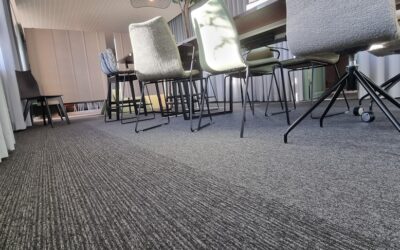
Whichever fiber you pick, pair it with a synthetic or moisture-resistant backing rather than jute, and choose a low-pile or loop construction that dries faster and holds less trapped humidity than deep plush.
Why Carpet Tiles Often Beat Broadloom
For below-grade rooms, modular carpet tiles frequently outperform wall-to-wall broadloom. Most basement-rated tiles come with a raised, impervious backing of PVC or rubber that lifts the fiber off the cold slab and lets air circulate underneath.
The real advantage shows up after a leak. If a water heater fails or a storm pushes water across one corner, you pull up and replace only the affected tiles instead of scrapping an entire room of broadloom. Peel-and-stick and interlocking basement tiles run $2 to $5 per square foot and install as a weekend DIY project. For flood-prone basements, they are the smart hedge.
Subfloor and Vapor Barrier: The Layer That Saves You
Never lay carpet directly on bare basement concrete. That single shortcut causes most basement carpet failures. Instead, build a moisture break between the slab and the cushion.
Subfloor Panels
Raised subfloor systems such as tongue-and-groove OSB panels with a dimpled plastic underside create an air gap that channels moisture away and insulates against the cold slab. They add $1.50 to $3 per square foot but dramatically cut mold risk and make the floor warmer underfoot.
Vapor Barrier and Pad
At minimum, roll out a 6-mil polyethylene vapor barrier over the slab, then use a moisture-barrier carpet pad rated for below-grade use. Avoid standard rebond foam directly on concrete; it soaks up humidity. A synthetic fiber pad or a pad with a top moisture film is the safer basement choice.
Weighing the Pros and Cons
Carpet is not automatically the right basement floor, so weigh the trade-offs honestly against the alternatives like luxury vinyl plank.
Pros
- Warm and soft underfoot on an otherwise cold, hard slab.
- Dampens sound in a room often used as a theater, gym, or playroom.
- Lower material cost than tile or hardwood.
- Adds a layer of insulation, trimming the chill from below-grade air.
Cons
- Vulnerable to mold and odor if moisture control fails.
- Total loss in a flood, unlike waterproof vinyl or tile.
- Requires the extra subfloor and vapor-barrier investment to do right.
Installation and Long-Term Care
Once the moisture layers are in place, keep the room dry going forward. Run a dehumidifier to hold basement humidity below 50 percent, especially through summer. Address any foundation cracks or grading issues that let water in, because no carpet system survives a genuine seepage problem.
Vacuum regularly, and if a spill or minor leak occurs, dry the area fast with fans and the dehumidifier within 24 to 48 hours to stop mold before it starts. With tiles, lift the affected squares and let both sides air-dry. Handled this way, a well-built basement carpet lasts 8 to 12 years even in a climate with real seasonal humidity.
Comparing Your Basement Flooring Options
It helps to see where carpet lands against the alternatives before you commit, because the best choice depends on how you use the space and how dry it stays.
- Carpet with subfloor: $4 to $8 per square foot installed. Warmest and quietest, but a total loss in a real flood.
- Luxury vinyl plank: $3 to $7 per square foot. Waterproof and forgiving, but harder and colder underfoot without a rug.
- Carpet tiles: $2 to $5 per square foot. The pragmatic middle ground, combining comfort with tile-by-tile replacement after a leak.
- Sealed concrete or epoxy: $3 to $8 per square foot. Fully waterproof but industrial in feel and unforgiving for a family room.
For a dry, well-sealed basement used as a bedroom, office, or media room, carpet delivers comfort the hard options cannot match. For a basement with any history of water, lean toward tiles or vinyl and accept the trade-off in warmth.
Frequently Asked Questions
Can I put regular carpet in a basement?
Standard upstairs carpet with a jute backing and natural-fiber content is a poor basement choice because it absorbs moisture and molds. Use synthetic fiber carpet with a synthetic backing, over a vapor barrier and moisture-resistant pad, and it will hold up.
Is carpet or vinyl plank better for a basement?
Waterproof luxury vinyl plank survives flooding and is the safer pick for damp or flood-prone basements. Carpet wins on warmth, softness, and sound control for dry, well-sealed basements. Many homeowners split the difference with carpet tiles that combine comfort with easy replacement.
How do I stop mold under basement carpet?
Control moisture at every layer. Test the slab, install a raised subfloor or 6-mil vapor barrier, use a moisture-barrier pad, run a dehumidifier below 50 percent humidity, and dry any spills within 48 hours. Choose synthetic fibers that will not feed mildew.
What thickness of carpet is best for a basement?
Low-pile or loop carpet is better than deep plush because it dries faster and traps less humidity. Keep the total system low-profile, and rely on a raised subfloor rather than a thick pad for warmth and comfort.
Bottom line: carpet for basement floor projects rewards preparation. Solve the moisture first, choose synthetic fiber and smart backing, add a subfloor or vapor barrier, and you get a warm, quiet, comfortable lower level that holds up for a decade or more.