The typical before and after cabinet refacing cost lands between $4,000 and $10,000 for an average kitchen, versus $12,000 to $30,000 to tear out and replace those same cabinets. That gap is why refacing has become the go-to mid-range kitchen update. Understanding the real before and after cabinet refacing cost, what drives it up or down, and how it compares to refinishing and replacement lets you budget accurately instead of getting blindsided by a quote. This guide leads with the numbers, then explains exactly where the money goes.
Part of our Kitchen Remodeling guide — explore the full guide →
- The Price Ranges at a Glance
- What Refacing Actually Includes
- Real Before-and-After Cost Examples
- Labor vs Materials: Where the Money Splits
- The Cost Drivers That Move Your Quote
- DIY Refacing: Cutting the Cost in Half
- Is Refacing Worth It Over Replacement?
- Timeline and What to Expect During the Job
- Resale Value and Return on Investment
- Refinishing vs Refacing: Choosing the Cheaper Path
The Price Ranges at a Glance
Start with the three ways to update cabinets, ranked by cost:
- Refinishing (paint or restain): $1,500 to $4,000. Keeps existing doors and boxes, just recoats them.
- Refacing (new fronts, veneered boxes): $4,000 to $10,000. New doors, drawer fronts, and matching veneer over the existing box faces.
- Full replacement (new cabinets): $12,000 to $30,000. Everything comes out and new boxes go in.
Measured per linear foot, refacing runs roughly $100 to $350. A standard 10-by-10 kitchen has about 20 linear feet of cabinetry, which is how you get from the per-foot rate to the total project number.
What Refacing Actually Includes
Refacing keeps your existing cabinet boxes, the structural carcasses bolted to the wall, and replaces everything you see. New doors and drawer fronts go on, and the exposed faces and end panels of the boxes get covered in a matching wood veneer or laminate. New hinges, and usually new hardware, complete the transformation.
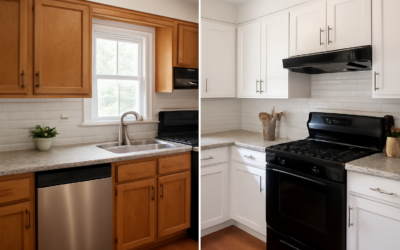
The before is dated oak with worn finishes; the after looks like brand-new cabinets, because every visible surface is new. What you don’t get is a new layout or new box interiors, so if your cabinets are falling apart or you want to move them, refacing isn’t the answer, replacement is.
Real Before-and-After Cost Examples
Here’s how the numbers play out across three common kitchen sizes, assuming a mid-grade material choice and professional installation:
- Small kitchen (~15 linear ft): Before, tired 1990s laminate. After, refaced in Shaker-style RTF doors. Cost: roughly $3,500 to $6,000.
- Medium 10×10 kitchen (~20 linear ft): Before, orange-toned oak. After, painted-look white veneer with soft-close hinges. Cost: roughly $6,000 to $9,000.
- Large kitchen (~30 linear ft): Before, dark dated cherry. After, real wood veneer with new hardware throughout. Cost: roughly $9,000 to $15,000.
The same medium kitchen fully replaced would run $15,000 to $25,000, so refacing typically saves 30 to 50 percent while delivering a similar visual result.
Labor vs Materials: Where the Money Splits
On a professional reface, expect labor to account for roughly 40 to 60 percent of the total, with materials making up the rest. A skilled installer spends one to four days measuring, applying veneer cleanly, hanging doors dead-level, and adjusting soft-close hinges, precision work that’s harder than it looks, which is what you’re paying for.
Materials cover the new doors and drawer fronts, veneer or laminate sheets, hinges, and hardware. Because labor is such a large share, a smaller kitchen doesn’t cut the cost proportionally, the setup and skill time stay similar whether you have 15 or 25 linear feet.
The Cost Drivers That Move Your Quote
Several choices swing the price within, or beyond, the typical range:
- Door material: Laminate and thermofoil (RTF) are cheapest; solid wood and real wood veneer cost the most. This is the single biggest lever.
- Soft-close hinges and slides: Add roughly $5 to $15 per door and drawer but feel premium.
- Hardware: New knobs and pulls at $3 to $15 each add up across 30-plus pieces.
- Door style: Simple Shaker is affordable; raised-panel and custom profiles cost more.
- Kitchen size and layout: More linear feet, more corners, and glass inserts all raise the total.
Choosing RTF Shaker doors over solid wood raised-panel can cut a project’s material cost by a third with little visible difference from a few feet away.
DIY Refacing: Cutting the Cost in Half
A determined DIYer can reface cabinets with a veneer kit for $1,000 to $3,000 in materials, eliminating the labor half of a pro job. Kits include peel-and-stick or contact-cement veneer, new doors, and hinges. The work is doable with patience, careful measuring, and a steady hand for the veneer.
Be realistic about the difficulty, though. Applying veneer without bubbles, cutting clean inside corners, and hanging 20-plus doors perfectly level takes time and skill, a botched veneer job looks worse than the cabinets you started with. Budget a long weekend or more, and if you’re not confident, the pro premium buys a guaranteed result.
Is Refacing Worth It Over Replacement?
Refacing makes the most sense when your cabinet boxes are structurally sound and you’re happy with the layout, you’re paying only to change how they look, at 30 to 50 percent less than new cabinets. It’s also faster, most jobs finish in a few days versus a multi-week replacement, and it keeps a kitchen usable throughout.
Replacement wins when boxes are water-damaged, the layout needs to change, or you want features like deeper drawers and pull-outs that refacing can’t add. For the majority of kitchens where the bones are fine and only the style is dated, the before and after cabinet refacing cost delivers the biggest visual payoff per dollar of any kitchen update short of a full remodel. Get two or three quotes, decide between RTF and real wood early, and you’ll land a like-new kitchen for a fraction of replacement.
Timeline and What to Expect During the Job
One reason refacing appeals to families is speed. A professional reface of an average kitchen typically takes two to four days, versus two to four weeks for a full replacement that involves demolition, new boxes, and often countertop and plumbing work. Because the boxes stay put, your sink, counters, and appliances usually stay in place and usable through most of the project.
Day one is measuring and template confirmation; the crew then removes old doors and drawer fronts, cleans and preps the box faces, and applies veneer or laminate to the exposed surfaces. New doors, drawer fronts, hinges, and hardware go on next, followed by adjustment so every door hangs dead-level and every soft-close closes quietly. The dust and disruption are modest compared with a gut job, which is a real, if hard-to-price, part of refacing’s value.
Resale Value and Return on Investment
From a resale standpoint, cabinets drive the perceived value of a kitchen more than almost any other element, and dated cabinets can make an otherwise fine kitchen read as “needs work.” Refacing at $4,000 to $10,000 refreshes that first impression for a fraction of a full remodel, which is why real estate agents often suggest it before listing.
Return on investment depends on your market and how dated the originals were. A reface rarely returns 100 percent of its cost in a straight dollar sense, but it can meaningfully speed a sale and support a higher asking price by removing a visible objection. For homeowners staying put, the return is measured in daily enjoyment, a kitchen that looks new for years, delivered at the before and after cabinet refacing cost of a mid-range update rather than a major renovation. Weigh how long you’ll stay and how tired the current cabinets look, and the math usually favors refacing over both cheap paint and expensive replacement.
Refinishing vs Refacing: Choosing the Cheaper Path
If the refacing number still feels steep, weigh it honestly against refinishing, the cheapest update of all. Refinishing keeps your existing doors and simply strips, primes, and repaints or restains them, running $1,500 to $4,000 for a typical kitchen. It works only when your current doors are structurally sound and you’re happy with their style; a coat of paint can’t turn a dated cathedral-arch oak door into a clean Shaker profile.
Refacing costs more because you get brand-new door and drawer fronts in whatever style you want, plus veneered boxes that make the whole kitchen read as new. The rule of thumb: refinish when you love the door shape and only want a color change; reface when the doors themselves look dated or worn. Spending $6,000 to reface often satisfies where a $2,500 refinish would leave you staring at the same old door style in a new color, so match the method to how tired the cabinets actually look before you chase the lowest before and after cabinet refacing cost.