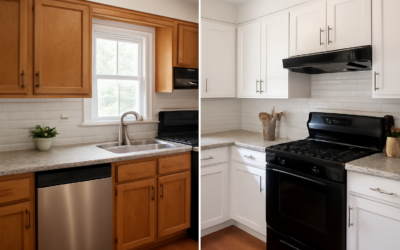
If you are weighing a kitchen refresh, the first question is almost always about price. So here it is up front: how much does cabinet refacing cost for a typical kitchen? Plan on $4,000 to $10,000 for professional refacing, or roughly $100 to $400 per linear foot of cabinetry. That price gets you new doors, drawer fronts, and matching veneer over your existing boxes, without the demolition and expense of a full replacement.
Part of our Kitchen Remodeling guide — explore the full guide →
Refacing sits in the middle of the kitchen-update spectrum: pricier than painting, far cheaper than tearing everything out. Below is a full breakdown of what drives the number, how the alternatives compare, and whether the investment actually pays off.
- Cabinet Refacing Cost at a Glance
- What Refacing Actually Includes
- Door Material: The Biggest Price Lever
- The DIY Refacing Route
- Refacing vs. Refinishing vs. Replacement
- What Drives Your Final Price
- Is Cabinet Refacing Worth It?
- Bottom Line
- Veneer vs. Rigid Thermofoil Doors Explained
- Timeline and What to Expect
- Ways to Save on a Reface
Cabinet Refacing Cost at a Glance
- Typical professional kitchen: $4,000 to $10,000
- Per linear foot: $100 to $400
- Small kitchen (under 12 linear feet): $2,500 to $5,000
- Large or luxury kitchen (25+ linear feet): $10,000 to $15,000+
- DIY refacing kit: $1,000 to $3,000
- Veneer refacing (mid-grade): $150 to $300 per linear foot
- Rigid thermofoil (RTF) doors: $100 to $250 per linear foot
- Solid wood doors: $250 to $400+ per linear foot
Linear feet are measured along the base and wall cabinets, not the floor. A quick way to estimate: count the running feet of cabinetry, then multiply by your chosen material’s per-foot rate.
What Refacing Actually Includes
Refacing keeps the cabinet boxes in place and replaces or resurfaces everything you see. A standard job covers:
- New doors and drawer fronts in your chosen style and finish
- Matching veneer or laminate applied over the exposed box faces and end panels
- New hinges, and usually new drawer glides
- New knobs or pulls
- Optional add-ons like soft-close hardware, crown molding, or a new toe kick
Because the layout and boxes stay put, refacing avoids plumbing, electrical, and countertop disruption. That is the core reason it costs a fraction of replacement.
Door Material: The Biggest Price Lever
The door material you pick moves the total more than any other single factor:
- Rigid thermofoil (RTF): A vinyl skin heat-fused over MDF. The most affordable option at $100 to $250 per linear foot. Smooth, uniform, and great for clean modern looks, though it can struggle near high heat.
- Wood veneer: A thin layer of real wood over a stable core. The mid-range choice at $150 to $300 per linear foot, offering authentic grain that matches the box veneer seamlessly.
- Solid wood: The premium tier at $250 to $400+ per linear foot. It brings the richest look and takes stain well, but it is the priciest and can expand or contract with humidity.
For most homeowners, wood veneer hits the value sweet spot: real-wood appearance without the solid-wood premium.
The DIY Refacing Route
Motivated homeowners can reface cabinets themselves with a kit for $1,000 to $3,000 in materials, cutting labor entirely. Kits include peel-and-stick veneer sheets, pre-finished doors, and hardware. Expect a full weekend or two of careful work.
DIY makes sense if you are comfortable measuring precisely and applying veneer without bubbles or lifted edges. The savings are real, but so is the risk: a botched veneer application looks worse than the cabinets you started with, and doors that hang unevenly announce the shortcut. If your boxes are out of square or you want a flawless finish, professional labor earns its cost.
Refacing vs. Refinishing vs. Replacement
Refacing is one of three common paths, and choosing correctly depends on the condition of your boxes and your budget:
- Refinishing (cheapest): $1,500 to $4,000. Sanding and repainting or restaining your existing doors and boxes. Best when the cabinets are solid and you only want a color change. It keeps the same doors, so dated door styles stay dated.
- Refacing (middle): $4,000 to $10,000. New doors and veneer over existing boxes. The right call when the boxes are sound but you want a genuinely new look, including a new door style.
- Replacement (most expensive): $12,000 to $30,000+. Full tear-out and new cabinetry. Necessary when boxes are damaged, water-swollen, or the layout itself needs to change.
The deciding question is the condition of your cabinet boxes. If they are structurally solid, refacing or refinishing saves thousands. If they are falling apart or the layout frustrates you daily, replacement is the honest answer.
What Drives Your Final Price
Two kitchens of the same size can quote very differently. The main cost factors:
- Kitchen size: More linear feet means more doors, more veneer, and more labor.
- Door material: As covered, RTF to solid wood can nearly double the per-foot rate.
- Number of doors and drawers: A layout with many small drawers costs more than one with fewer large doors, since each front is priced individually.
- Hardware upgrades: Soft-close hinges and glides, plus premium pulls, add up across 30-plus openings.
- Add-ons: Crown molding, glass door inserts, new end panels, and matching accessory panels raise the total.
- Regional labor rates: Metro-area labor can run 20 to 40 percent above rural pricing.
Is Cabinet Refacing Worth It?
For the right kitchen, refacing delivers a near-new look at roughly one-third the cost of replacement. It shines when your boxes are solid, your layout works, and you mainly dislike the color or door style. You keep your countertops and avoid weeks of demolition, since most refacing jobs finish in three to five days.
Refacing is the wrong choice if your boxes are damaged, your kitchen layout frustrates you, or you plan to move walls and appliances. In those cases the money is better spent on replacement. So when someone asks how much does cabinet refacing cost and whether it is worth it, the answer is yes for a cosmetic transformation of sound cabinets, and no when the bones of the kitchen need real change.
Bottom Line
Budget $4,000 to $10,000 for a professional kitchen reface, or $1,000 to $3,000 if you tackle a DIY kit. Compare that against $1,500 to $4,000 to refinish or $12,000 to $30,000+ to replace, and match the method to the condition of your boxes. Done on the right kitchen, refacing is one of the highest-return updates in home improvement.
Veneer vs. Rigid Thermofoil Doors Explained
Two terms trip up shoppers more than any others, so it helps to see them side by side. Wood veneer is a genuine thin slice of hardwood bonded to a stable substrate, giving you real grain, real stain compatibility, and a warm, natural look. Rigid thermofoil, or RTF, is a durable vinyl film heat-fused over a shaped MDF core, producing a seamless, wipe-clean surface with no wood grain unless it is printed on.
RTF costs less and resists moisture and daily wear extremely well, which makes it popular for busy family kitchens and clean modern designs. Its weakness is heat: RTF can delaminate near an oven or a pull-out toaster over years of exposure. Veneer costs more and needs a bit more care, but it ages like real furniture and can be refinished later. Solid wood sits above both, offering the richest depth at the highest price and with the most movement in humid conditions.
Timeline and What to Expect
One underrated advantage of refacing is speed. A typical professional job runs three to five working days from the first day of measurement templates to final hardware. Compare that to a full replacement, which routinely stretches two to four weeks and leaves you without a functional kitchen for much of it. Because refacing keeps the boxes, countertops, plumbing, and appliances in place, you can usually cook through most of the project.
The process starts with an in-home measurement, followed by two to four weeks of off-site fabrication for your custom doors. Installation crews then apply the veneer, hang the new doors and drawer fronts, and set the hardware. Ask your contractor whether they template digitally, since laser measuring catches out-of-square boxes that a tape measure can miss and prevents ill-fitting doors down the line.
Ways to Save on a Reface
Refacing already saves against replacement, but a few smart moves trim the number further. Keeping your existing layout untouched avoids any structural work. Choosing rigid thermofoil over solid wood can cut the material line by 30 to 40 percent while still delivering a fresh, uniform look. And sourcing your own knobs and pulls from a home center rather than the fabricator often saves several dollars per opening, which adds up fast across a kitchen with 30 or more.
- Reface only the visible cabinets and skip the interior of a pantry or a rarely opened corner unit.
- Get at least three itemized quotes so you can compare per-linear-foot pricing apples to apples.
- Schedule in a contractor’s slower season, often late winter, when crews may discount to fill the calendar.
- Bundle the reface with a hardware and lighting refresh you do yourself for maximum visual impact per dollar.
Beware the false economy of the cheapest bid, though. Ultra-thin veneer and stapled-on doors fail early, and a redo erases the savings. Look for a written warranty on the veneer adhesion and the door hardware before you sign.