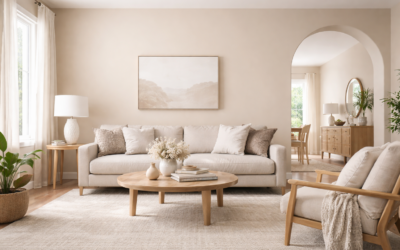
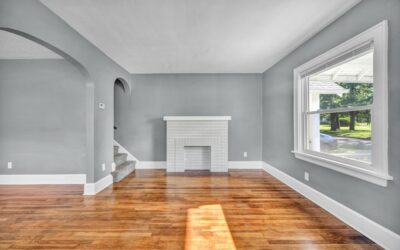
Beige has a reputation for looking dated, yet the right one makes a house feel warm instead of flat. Behr Aged Beige (PPU7-09) is a light, warm neutral that sits between classic beige and greige, so it avoids both the yellow cast of older beiges and the chilly feel of many grays. Sample sellers describe it as a versatile neutral evoking sun-bleached driftwood, which is a fair summary of how it reads on a wall.
It is light enough for whole-house use, with a light reflectance value (LRV) of roughly 63 per sample retailers and color databases. That means it reflects a bit less than two-thirds of the light hitting it: bright, but not white. In a dim room it settles into a soft putty tone; in a sunny room it can look close to an off-white.
Here are the specs, its undertones, pairing ideas, close matches from other paint lines and the rooms where it performs best.
Behr Aged Beige Specs and Undertones
Check the current chip or color page at the paint counter before you buy.
| Spec | Value | What it means |
|---|---|---|
| Code | PPU7-09 | Order by code; PPU7-08 (Almond Latte) is a different color |
| Hex | About #D7CFC1 | Screen preview only; trust the chip |
| Family | Beige and greige neutral | Works as a whole-house background |
| LRV | About 63 (listed 62.75 to 62.85) | Light, but with visible color |
| Temperature | Warm | Feels cozy rather than crisp |
| Undertone | Soft warm (slightly red-leaning) with a gray softness | Can read faintly pink-beige in warm light |
| Use | Interior and exterior | Walls, trim-contrast bodies, siding |
| Closest look-alikes | Edgecomb Gray HC-173, Cedar Key OC-16 | Sample beside these to compare |
How the Undertone Behaves
Every beige has an undertone, and it is the undertone that decides whether the walls look clean or dingy. Behr Aged Beige carries a soft warm undertone, with color databases tagging it slightly red-leaning, plus enough gray to keep it from turning yellow. In practice:
- North-facing rooms: cool light brings out the gray, and Aged Beige reads as a warm greige or soft putty. This is often where it looks best, because the warmth counters the cool daylight.
- South-facing rooms: strong warm light lightens it and can push it toward a creamy off-white. A faint blush may show late in the day.
- East and west rooms: it shifts through the day, lighter and fresher at one end, warmer and deeper at the other.
- Artificial light: warm bulbs (2700K) emphasize the beige; neutral bulbs (3000K to 3500K) keep it balanced. Very cool bulbs can make it look slightly gray and flat.
Coordinating Colors and Pairings
Aged Beige is a background color, so pairings matter more than the wall itself. These combinations work reliably.
| Element | Pairing | Why it works |
|---|---|---|
| Trim and ceilings | Soft warm white | Clean contrast without making the beige look dirty |
| Accent wall or cabinets | Deep navy or blue | Blue is the visual complement to warm beige |
| Kitchen island | Muted sage or olive green | Earthy pairing that feels current |
| Front door (exterior) | Black, deep blue or dark green | Strong anchor on a light body |
| Floors | Mid-tone oak, walnut, warm LVP | Warm wood matches the warm undertone |
| Hardware and fixtures | Brass, bronze or matte black | Warm metals echo the beige; black sharpens |
For layered neutrals, the same paint line offers Swiss Coffee as a soft trim white and Almond Latte (PPU7-08) as a neighboring beige. For contrast, deep navy blues make great accent walls, lower cabinets or exterior doors against Aged Beige.
Be careful with stark, blue-white trim. Next to a very cool white, any warm beige can look muddy. A soft warm white or creamy white keeps the scheme clean.
Comparisons With Near Beiges
The fastest way to know whether Behr Aged Beige is right is to sample it beside its close neighbors.
Edgecomb Gray HC-173
This popular greige from another paint maker has a published LRV of 63.09, essentially the same lightness as Aged Beige. Its manufacturer describes it as a go-to neutral with a warm, welcoming feeling. Side by side, the difference is in undertone: compare them in your own light, since both can look nearly identical in some rooms and distinctly different in others.
Cedar Key OC-16
Cedar Key, with a published LRV of 61.05, is slightly deeper. Its manufacturer describes it as a crisp neutral that conjures driftwood washed ashore, which is a strikingly similar mood. If Aged Beige washes out in a sunny room, Cedar Key is a sensible step deeper to test.
Within the same paint line
Neighboring chips on the same paint strip are a step lighter or darker in the same undertone family. If you like the undertone but need it lighter for a dark hallway or darker for a sun-drenched room, ask the paint counter for the adjacent chips on the PPU7 strip.
Best Rooms for Aged Beige
- Open-plan living spaces: a warm neutral that ties together kitchen, dining and living areas without feeling sterile.
- North-facing bedrooms: the warmth offsets cool light, making the room feel inviting.
- Hallways and stairwells: forgiving of scuffs and shadows compared with bright white.
- Homes with warm wood floors: the undertones match oak, hickory and warm-toned vinyl plank.
- Exteriors: a soft, light body color with white trim and a dark door, especially on traditional and craftsman homes.
Rooms with very cool finishes, such as blue-gray tile or bright white quartz with cool veining, may make it look slightly dingy. Sample there first.
How to Sample It Correctly
- Use paint sample swatches or a sample pot on a white board at least 12 by 12 inches; avoid painting small test patches directly on old wall colors, which skew the read.
- Tape the swatch on each wall of the room, including the darkest corner.
- Check it at morning, midday and evening, plus under your actual lamps.
- Hold it against your floor, counters and largest fabrics.
- Put the near beiges from the comparison section beside it to see the undertone difference clearly.
Troubleshooting
- Looks pink: warm light is exaggerating the undertone. Use neutral bulbs or sample a slightly grayer greige.
- Looks gray and flat: the room is cool and dim. Add warm lighting or wood tones.
- Looks yellow next to trim: your trim white is too cool. Switch to a warmer white.
- Uneven sheen: touch-ups in eggshell often flash. Repaint corner to corner.
- Wrong color delivered: confirm the code PPU7-09 on the can label before you open it.
Using Aged Beige Throughout a Whole House
Many homeowners pick a warm beige precisely because they want one color that flows through every common room. Behr Aged Beige suits that job because its lightness keeps hallways from feeling dim while its warmth keeps big open spaces from looking sterile. A few rules make a whole-house scheme work.
- Keep one trim white everywhere. Switching whites from room to room makes the beige look like it changes too.
- Use the same sheen on connected walls. Eggshell in the living room next to flat in the hallway shows a visible line at the corner.
- Let accent colors change, not the background. Bring personality in with a navy dining room, a sage island or a dark front door while the main walls stay consistent.
- Adjust for dark rooms. If one interior hallway has no windows, a chip one step lighter on the same strip keeps the look consistent without the hallway feeling gloomy.
On exteriors, light colors fade and wash out under strong sun, so the house will look lighter than the chip. Many homeowners go a step deeper on the strip for siding and keep the chosen shade for porch ceilings or shaded walls. Always use an exterior-grade product outdoors.
Cost and When to Hire a Painter
Interior paint generally costs about $35 to $80 per gallon depending on the product line, and a 12 by 14 foot room usually needs about 2 gallons for two coats. Professional painters commonly charge roughly $2 to $6 per square foot of wall area. Hire a pro for tall spaces, full-house repaints or exterior work higher than one story. In homes built before 1978, test existing paint for lead before sanding.
Frequently Asked Questions
What is the code for Behr Aged Beige?
Aged Beige is PPU7-09. The neighboring code, PPU7-08, is a different color, so double-check the code on the order.
Is Aged Beige warm or cool?
It is warm, with a soft gray quality that keeps it from looking yellow.
What is the LRV of Aged Beige?
Sample retailers and color databases list it at about 63. Confirm on the current chip before buying.
Does Aged Beige look pink?
It can show a faint warm blush in strong warm light. Neutral bulbs and warm white trim keep it balanced.
What trim color goes with Aged Beige?
A soft warm white works best. Very cool, blue-leaning whites can make the beige look dull.
Can I use Aged Beige on a house exterior?
Yes, it is listed for interior and exterior use. Pair it with white trim and a dark door for a classic look.