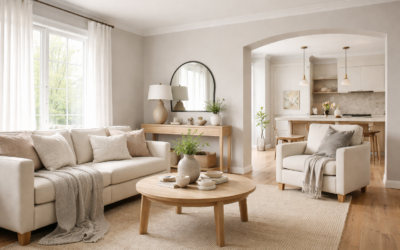
Beige has a reputation for looking dated, yet a well-chosen one makes a room feel warm without shouting. Behr Even Better Beige (DC-010) is a light, warm neutral from the Behr Designer Collection. It reads as a true beige with soft yellow warmth, tempered by enough gray to keep it from looking golden or peachy.
Its LRV is commonly listed at about 60, which places it in the light-to-mid range: bright enough for main living spaces, deep enough that it won’t wash out to off-white. Behr also lists it as comparable to a well-known beige from another maker, Sherwin-Williams Accessible Beige, which is one reason it gets so much attention from people matching an existing room.
- Behr Even Better Beige Specs and Swatch
- Understanding Its Undertone
- Even Better Beige vs Nearby Behr Beiges
- Best Rooms for Even Better Beige
- Trim, Floors and Accent Pairings
- How to Test and Paint It
- Choosing the Right Sheen
- A Whole-House Palette Built Around It
- Troubleshooting
- Costs and Hiring a Painter
- Frequently Asked Questions
Because Behr can update chip data, confirm the LRV on the current color page or chip before relying on an exact number.
Behr Even Better Beige Specs and Swatch
| Spec | Value | What it means |
|---|---|---|
| Color code | DC-010 | Give this code at the counter for the right mix |
| Collection | Behr Designer Collection | A curated group of designer-favorite colors |
| LRV | About 60 (commonly listed) | Light-to-mid; bright without looking white |
| Hex | #D4CABA | For digital mockups; screens vary |
| RGB | 212, 202, 186 | Red and green above blue, so clearly warm |
| Undertone | Yellow, softened by gray | Warm and cozy, not pink or orange |
| Comparable color | Sherwin-Williams Accessible Beige (per Behr) | Useful when matching an existing palette |
Understanding Its Undertone
Even Better Beige is usually described as a warm beige with yellow undertones and a touch of gray. Its RGB values back that up: blue sits well below red and green, which produces warmth, while the small gap between red and green keeps it from tipping orange or pink.
Some people see it as a greige in certain light. That happens because its saturation is low, so cool light or nearby grays pull out the gray component. In warm light it looks clearly beige.
How it shifts with light
- North-facing rooms: cooler light mutes the yellow, and the color reads soft and slightly gray.
- South-facing rooms: warm daylight brings out its yellow, making the room feel sunny and cozy.
- East and west rooms: warmer during direct sun, more neutral in shade.
- Warm bulbs (2700K): can push it toward tan; neutral bulbs around 3000K to 3500K show it most accurately.
Even Better Beige vs Nearby Behr Beiges
These comparisons use LRVs as commonly listed for each Behr color. Third-party listings sometimes disagree, so test real samples before deciding.
Smoked Oyster (780A-2)
Smoked Oyster is lighter than Even Better Beige and reads more neutral, with less obvious yellow. Choose it for a soft, barely-there warmth or for dim rooms. Choose Even Better Beige when you want a clear, comfortable beige.
Wheat Bread (720C-3)
Wheat Bread is slightly deeper, with an LRV commonly listed around 56, and leans more toward greige thanks to its gray undertone. If Even Better Beige looks too yellow in your room, Wheat Bread is the calmer alternative.
Sculptor Clay (PPU5-08)
Sculptor Clay sits at a similar depth, commonly listed around 55, and is known for shifting between beige and greige depending on light. It suits homes that mix warm wood with gray stone or tile.
Compared with Accessible Beige
Behr lists Even Better Beige as comparable to Sherwin-Williams Accessible Beige (SW 7036). Comparable is not identical. If you are touching up a wall painted in one, repaint the whole wall corner to corner rather than spot-patching with the other.
Best Rooms for Even Better Beige
Living rooms and family rooms
Its light-to-mid value keeps large rooms bright, while the warmth makes them feel inviting. It pairs naturally with leather, linen, jute rugs and mid-tone wood furniture.
Bedrooms
Warm beige is restful. Combine it with white or cream bedding, natural wood and soft textiles for a calm, cozy space.
Kitchens
It complements white, cream or wood cabinets and warm stone or quartz counters. Avoid pairing it with very cool gray cabinets, which can make it look yellow.
Hallways and open plans
As a whole-house neutral, it ties rooms together and hides scuffs better than bright white. Use a scrubbable eggshell or satin in high-traffic areas.
Where to be careful
In rooms with strong yellow light or orange-toned floors, it can look too golden. Sample against the floor first.
Trim, Floors and Accent Pairings
- Trim: a soft warm white keeps the look cohesive. A stark, cool white increases contrast and makes the beige look warmer.
- Accent colors: sage and olive greens, deep navy, terracotta and chocolate brown.
- Hardwood: white oak, natural hickory and walnut all work; very orange red oak can amplify the yellow.
- Vinyl and laminate: warm, natural wood looks fit best. Cool gray planks may clash.
- Tile and stone: travertine, warm limestone looks, cream tile and warm-veined quartz.
How to Test and Paint It
- Use large samples: peel-and-stick paint swatches or a painted board at least 12 by 12 inches.
- Test against fixed elements: hold the sample next to flooring, counters, tile and trim.
- Check in all lighting: morning, afternoon and night with your usual bulbs.
- Prep surfaces: fill holes, sand patches and wipe off dust and grease.
- Prime where needed: fresh drywall, stains or a switch from a dark color.
- Apply two coats: for the most even, true color.
- Keep leftover paint: label the can with the room and date for touch-ups.
Choosing the Right Sheen
Sheen changes both durability and how warm a beige looks. Flat and matte finishes absorb light, so Behr Even Better Beige reads softer and slightly deeper; they also hide wall imperfections, which makes them good for ceilings and adult bedrooms. Eggshell is the most common choice for living rooms, dining rooms and hallways, since it resists scuffs and can be wiped. Satin suits kitchens, bathrooms, mudrooms and children’s rooms where walls get cleaned often. Save semi-gloss for trim, doors and cabinets. Higher sheens reflect more light, so the same color looks a shade lighter and a bit more yellow on a glossy surface than on a matte wall.
A Whole-House Palette Built Around It
Because it sits in the middle of the warm-neutral range, this beige works well as the anchor of a whole-house palette. A simple, repeatable plan looks like this:
- Main walls: Even Better Beige in eggshell through living areas, hallways and bedrooms.
- Trim and doors: a soft warm white in semi-gloss for clean definition.
- Ceilings: a flat warm white, or the trim color in flat, to keep rooms bright.
- Accent walls or a den: a muted sage green or a deep navy for contrast.
- Lower cabinets or an island: a warm greige or soft olive that shares the same warmth.
Keeping every color on the warm side prevents the clash that happens when a yellow-leaning beige meets a cool blue-gray. If you already have cool gray flooring or counters you can’t change, consider a greige such as Wheat Bread for those rooms instead, and use Behr Even Better Beige where wood tones dominate.
Exterior use
Some listings rate this color for exterior use as well. Exterior light is much stronger than indoor light, so a beige that looks balanced inside often looks paler and more yellow on siding. Paint a large sample board and check it on each side of the house before committing, and confirm in the store that the color can be mixed in the exterior product you plan to use.
Troubleshooting
- Looks too yellow: warm bulbs or orange floors are the usual cause. Switch to 3000K to 3500K bulbs or test Wheat Bread.
- Looks gray or flat: north light or cool LEDs. Add warmer lamps or choose a slightly warmer beige.
- Looks pink: rare, but red-toned furnishings can reflect onto walls. Reassess with the room’s textiles in place.
- Patchy finish: roll a second full coat and keep a wet edge.
Costs and Hiring a Painter
Even Better Beige costs the same as other colors in a given Behr product line. A gallon commonly runs about $35 to $70 depending on the line and sheen, and covers about 250 to 400 square feet per coat. Professional interior painting usually costs around $2 to $6 per square foot of wall area.
Bring in a painter for tall ceilings, stairwells, whole-house repaints or cabinets. In homes built before 1978, test existing paint for lead before any sanding or scraping, and use a lead-safe certified contractor if it is present.
Frequently Asked Questions
What is the LRV of Behr Even Better Beige?
It is commonly listed at about 60, a light-to-mid value. Check the current Behr color page or chip for the exact figure.
What undertone does Even Better Beige have?
It is usually described as a warm beige with yellow undertones. A touch of gray keeps it from looking golden.
Is Even Better Beige the same as Accessible Beige?
No, but Behr lists it as comparable to Sherwin-Williams Accessible Beige. The two are close, so sample both if you need a near match.
What is the color code for Even Better Beige?
The code is DC-010, part of the Behr Designer Collection.
Does Even Better Beige look yellow?
It can in south-facing rooms, under warm bulbs or next to orange wood. In north light it looks softer and more neutral.
What trim color goes with Even Better Beige?
A soft warm white is the safest pairing. Very cool whites create stronger contrast and make the beige look warmer.