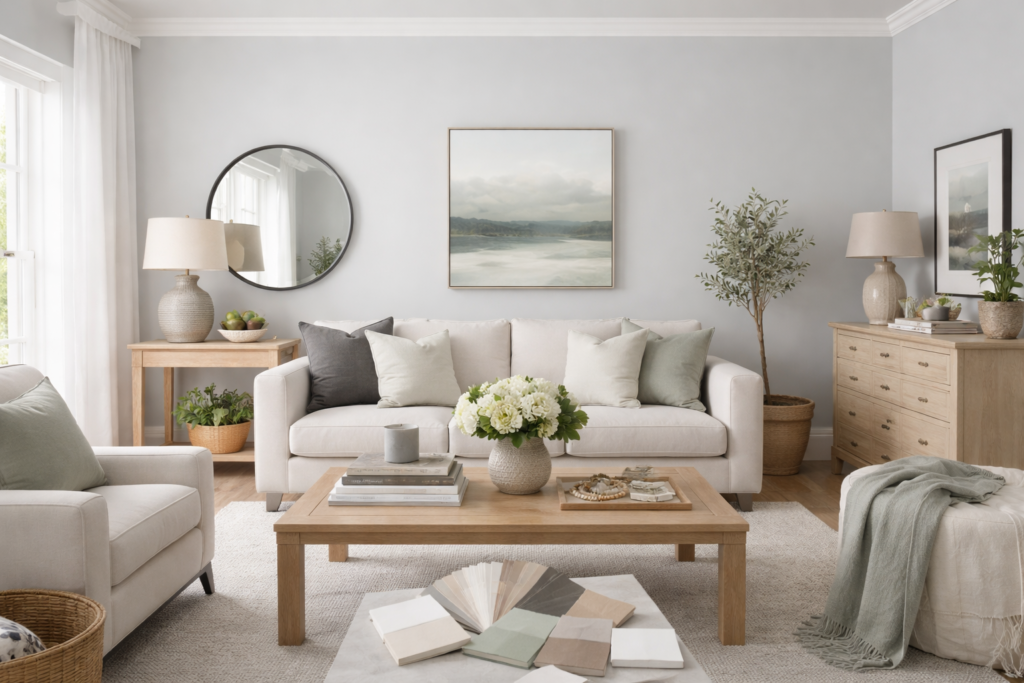
On a paint chip it looks like a simple pale gray, but Behr Light French Gray often surprises people once it covers four walls. This color, number 720E-2 in the Behr gray color family, is a light, cool gray with a noticeable blue cast and a faint green tint that shows up in some lighting. In a bright south-facing room it reads as a soft, airy gray. In a north-facing room or under cool white bulbs it can lean clearly blue.
That shift is not a flaw. It is what gives the color more depth than a flat neutral gray, and it is why the color works so well with crisp white trim, cool blues and natural wood. In numbers: its hex value is #C9CFCC, it sits in the light range for reflectance, and independent color databases measure its light reflectance value (LRV) at roughly 60 to 61. Behr’s own color page lists the code and color family, so check the current chip or color page for the official reflectance figure before you finalize a choice.
One name warning: another major paint company sells a different color also called Light French Gray. The two are not the same, so make sure the code 720E-2 is on the sample and on the order.
Behr Light French Gray Specs
Here is a quick reference for the color. Values marked “approximate” come from independent color-matching databases rather than the manufacturer, so treat them as a guide.
| Spec | Value | What it means |
|---|---|---|
| Color name | Light French Gray | Check the code too, since another brand uses the same name |
| Color number | 720E-2 | The code to give the paint counter |
| Color family | Gray | Listed in Behr’s gray family |
| Hex value | #C9CFCC | Useful for digital mockups, not exact on screens |
| LRV | About 60 to 61 (approximate) | Light color that reflects a good share of light |
| Undertone | Cool, blue with a slight green cast | Reads bluer in north light and cool bulbs |
| Best trim whites | Clean, cool or neutral whites | Creamy whites can make it look dull |
Undertones: Blue, Green or Gray?
Most descriptions call this color a light blue-gray, and that matches what you see in most rooms. Look at the hex value and you will notice the green channel is slightly higher than the red and blue, which explains the faint green-gray cast some people notice on a large wall, especially next to green plants or warm wood.
A few reviewers describe it as a greige with warm undertones, but that view is in the minority and does not match its cool hex value. In real rooms the blue lean is far more common.
To check the undertone yourself:
- Put a large sample next to a sheet of plain white printer paper. The gray will look bluer or greener next to pure white.
- Compare it with a true neutral gray sample. Any blue or green cast becomes obvious side by side.
- Look at the sample at morning, midday and evening, with the lights on and off.
- Hold it next to your flooring, countertops and fabric. Warm tan or orange-toned wood will push it bluer by contrast.
Peel-and-stick paint sample swatches make this easy, since you can move them around the room without painting test patches on the wall.
How It Looks in Different Room Lighting
Light changes this color more than most grays, so plan by exposure.
North-facing rooms
Cool, indirect north light brings out the blue. The color can feel calm and crisp, but in a dim room it may feel chilly. Warm white bulbs (around 2700K to 3000K) help balance it.
South-facing rooms
Warm, strong light softens the blue, and the color reads as a light, fresh gray. This is where it looks closest to a neutral.
East- and west-facing rooms
Expect it to change through the day: warmer and softer when the sun is coming in, cooler and bluer when the light is indirect.
Artificial light
Cool daylight bulbs (5000K and up) make it noticeably blue. Warm white bulbs keep it softer. Test your sample under the bulbs you actually use.
Coordinating Trim, Ceiling and Accent Colors
Because this gray is cool, it pairs best with whites that are clean or slightly cool. A creamy, yellow-based white can make the gray look dirty by comparison.
- Trim and doors: Behr’s bright Ultra Pure White or another crisp white without a yellow tint works well. Use a semi-gloss or satin sheen on trim for durability.
- Ceilings: A flat bright white keeps the room open. For a softer look, some painters tint ceiling paint to a quarter or half strength of the wall color.
- Accent walls: Deep blues such as Behr’s Nocturne Blue (HDC-CL-28) create a strong, coordinated contrast. Charcoal and slate grays also suit it.
- Cabinets: Navy, deep green-gray or white cabinets all pair well in kitchens and baths.
- Colors to avoid: Tans, taupes and warm beiges tend to clash with its cool cast. Cooler blues and greens look better beside it.
Natural wood floors work, but very orange-toned oak can exaggerate the blue. Gray-washed, white oak, or medium brown floors usually look more balanced.
Best Rooms and Sheen Choices
The color suits bedrooms, bathrooms, home offices and living rooms where a calm, airy feel is the goal. It also works on exteriors as a soft siding color, where sunlight washes out much of the blue. Behr markets many of its colors for both interior and exterior use, so confirm that the product line you choose is rated for the surface.
Sheen guide:
- Flat or matte: ceilings and low-traffic rooms; hides wall flaws.
- Eggshell: living rooms and bedrooms; a soft glow and easier cleaning.
- Satin: hallways, kids’ rooms, kitchens and baths.
- Semi-gloss: trim, doors and cabinets.
How to Test and Apply the Color
Testing Behr Light French Gray properly saves you from repainting a whole room. Follow these steps:
- Order a sample or a peel-and-stick swatch at least 8 by 10 inches.
- Place samples on two or three walls, including the darkest wall and one beside a window.
- Leave them up for at least two days and check them morning, afternoon and night.
- Compare against your trim white, floor and largest furniture pieces.
- Once you commit, prepare walls by cleaning, patching and sanding glossy areas, then prime any repairs or stained spots.
- Apply two coats for even color, using a quality roller nap suited to your wall texture.
Light colors usually cover well over a similar light base. Going over a dark color may need a tinted primer first.
Plan the order of work as well. Paint the ceiling first, then the walls, then the trim, so any drips land on surfaces you have not finished yet. Keep a small labeled jar of leftover paint for future touch-ups, and write the color name, code and sheen on the lid so you can match it years later.
Troubleshooting Common Complaints
“It looks too blue.” Swap to warm white bulbs, add warm wood or brass accents, or consider a warmer gray from the same family for that room only.
“It looks green next to my trim.” Your trim white may be creamy or yellow-based. A cleaner white usually fixes it.
“It looks darker than the chip.” Large areas look more saturated, and dim rooms reduce reflectance. Try a lighter step on the same color strip.
“The touch-ups show.” Use paint from the same batch and the same sheen, and feather touch-ups out from the center.
Cost and When to Call a Pro
Paint costs vary by product line, but expect general ranges of roughly $30 to $70 per gallon for quality interior paint. An average 12 by 12-foot bedroom usually needs about 2 gallons for two coats on the walls. Professional painting for a room of that size typically runs a few hundred dollars and up depending on prep, ceiling height and trim.
Hire a painter for tall stairwells, vaulted ceilings, exterior siding above the first floor, or homes built before 1978 where old paint may contain lead. Lead-safe sanding and prep require special practices, so test before you scrape.
Frequently Asked Questions
What is the color number for Behr Light French Gray?
The color number is 720E-2. Always include the code when ordering, because another paint brand uses the same color name for a different shade.
What is the LRV of Behr Light French Gray?
Independent color databases measure it at roughly 60 to 61, which places it in the light range. Check Behr’s current color page or chip for the official figure.
Is Light French Gray warm or cool?
It is a cool gray with a blue undertone and a slight green cast in some lighting. It looks most neutral in warm, south-facing light.
What white trim goes with Light French Gray?
Clean or slightly cool whites work best, such as Behr’s Ultra Pure White or another crisp, untinted white. Avoid creamy whites, which can make the gray look dingy.
Is it the same as the other brand’s Light French Gray?
No. The other well-known Light French Gray is a separate color that reads more like a soft cement gray with less blue. They are not interchangeable.
Can I use Light French Gray on exterior siding?
Yes, as long as you buy an exterior-rated paint. Sunlight usually washes out some of the blue, so test a large swatch outdoors first.