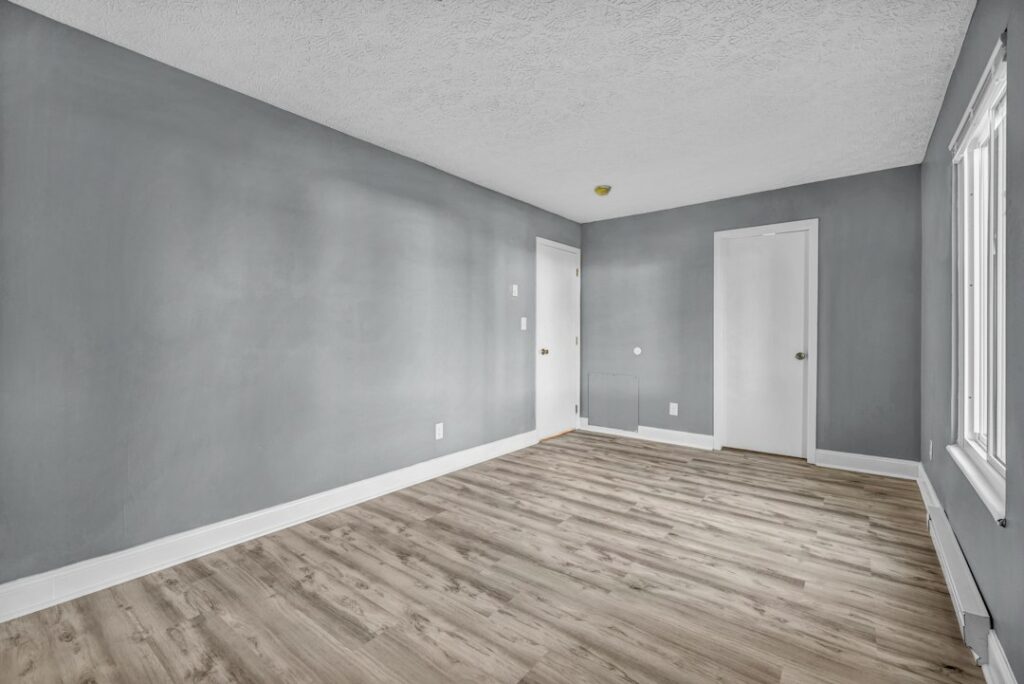
Trim is where the wrong white shows up fastest. A creamy trim next to cool gray walls looks yellow, and a stark white next to warm beige looks blue. Benjamin Moore Chantilly Lace (OC-65, also sold as 2121-70) solves that problem for many homes because it is a clean, bright white with very little visible undertone. Benjamin Moore lists its Light Reflectance Value (LRV) at 90.04, near the top of the white range.
For trim, that means crisp, fresh baseboards, casings and doors that read as white against almost any wall color. It is especially good with cool and neutral grays, deep blues and greens, and modern palettes. Against very warm, creamy walls it can look a bit stark, so sampling matters there.
- Benjamin Moore Chantilly Lace at a Glance
- Chantilly Lace Undertones Explained
- Why Chantilly Lace Works So Well on Trim
- Choosing a Sheen for Chantilly Lace Trim
- Wall Colors That Pair With Chantilly Lace Trim
- Chantilly Lace vs Other Trim Whites
- How to Paint Trim With Chantilly Lace
- Troubleshooting Trim Paint Problems
- Using Chantilly Lace on Walls, Ceilings and Doors Too
- General Cost to Paint Trim
- When to Hire a Professional
- Frequently Asked Questions
The two codes are the same color. OC-65 places it in the Off White Collection, and 2121-70 places it in the Color Preview family. Benjamin Moore describes it as a classic go-to white that suggests fresh cotton and pure silk.
Benjamin Moore Chantilly Lace at a Glance
The key numbers come from the manufacturer’s color page. Undertone and trim guidance reflect how the color typically behaves in homes.
| Spec | Value | What it means for trim |
|---|---|---|
| Color codes | OC-65 and 2121-70 | Same color under two collection codes |
| LRV | 90.04 | Very bright; reflects about 90 percent of light |
| Collection | Off White Collection | Also listed in the Color Preview range as 2121-70 |
| Undertone | Clean, near-neutral, slightly cool in shade | Reads white rather than cream or gray |
| Similar color | Ice Mist (2123-70) | Listed by the maker; LRV 88.84, with bright blue undertones |
| Best trim sheens | Semi-gloss or satin | Durable, washable and crisp |
| Best uses | Trim, doors, ceilings, cabinets, walls in bright rooms | Works as a whole-house trim white |
Chantilly Lace Undertones Explained
Chantilly Lace is often described as one of the cleanest whites in the Benjamin Moore range. It has very little yellow, beige or gray mixed in, so it rarely reads as cream or dingy. Next to warm colors, its clean character can come across as slightly cool; next to blue-leaning whites, it can look a touch warmer. That flexibility is why it works on trim in so many different palettes.
Lighting still matters. In north-facing rooms, it can pick up a faint cool cast. In south-facing rooms with warm sun, it reads as pure, bright white. Under warm 2700K bulbs, it softens; under 4000K and higher, it looks crisper and cooler.
Why Chantilly Lace Works So Well on Trim
- High LRV: At 90.04, trim pops against walls of almost any depth.
- Minimal undertone: It does not fight with warm or cool wall colors the way a creamy or blue-white can.
- Clean contrast: Moldings, window casings and doors look sharp and architectural.
- Whole-house consistency: One trim color throughout the home simplifies touch-ups and buying.
- Versatility: Works on ceilings, doors and cabinets, not just trim.
The main exception is a palette of very warm, creamy walls. If your walls are a buttery cream or warm beige, Chantilly Lace trim can look stark and slightly cool. In those rooms, a softer warm white may blend better, or you can paint walls and trim in the same color with a sheen change.
Choosing a Sheen for Chantilly Lace Trim
Sheen is just as important as color on trim. Baseboards and door casings take scuffs from shoes, vacuums and pets, so they need a hard, washable finish.
- Semi-gloss: The traditional trim choice. Very durable, easy to clean and gives crisp definition. Shows surface flaws more, so sand and fill carefully.
- Satin: A softer, more modern look with good washability. Hides imperfections better than semi-gloss.
- High-gloss: Dramatic and very durable, best on smooth, well-prepped doors and moldings.
Water-based alkyd or urethane-modified enamels level well and cure hard, giving a brush-mark-free finish that resists yellowing better than traditional oil paints. Oil-based enamels can yellow over time, which shows clearly on a clean white like Chantilly Lace.
Wall Colors That Pair With Chantilly Lace Trim
Benjamin Moore lists White (OC-151), Horizon (OC-53), Seapearl (OC-19) and Edgecomb Gray (HC-173) as color combinations for Chantilly Lace. The table expands on those and adds other common pairings by mood.
| Wall color | Mood | How Chantilly Lace trim looks |
|---|---|---|
| Edgecomb Gray (HC-173) | Soft, warm greige | Clean and crisp, with gentle contrast |
| Horizon (OC-53) | Pale, airy gray | Subtle contrast; fresh and light |
| Seapearl (OC-19) | Soft off-white with cool gray undertones | Light contrast; trim looks noticeably whiter |
| White (OC-151) | Soft white walls | Very low contrast; a near-monochrome look |
| Revere Pewter (HC-172) | Warm gray-beige | Classic, balanced contrast |
| Hale Navy (HC-154) | Deep, classic navy | Striking, high-contrast trim |
| Deep greens and charcoals | Moody, dramatic | Bright trim frames the room sharply |
The higher the contrast between wall and trim, the more your trim stands out. With dark walls, Chantilly Lace makes moldings look architectural. With pale walls, it reads soft and subtle.
Chantilly Lace vs Other Trim Whites
Benjamin Moore lists Ice Mist (2123-70) as a similar color. Other popular trim whites from the same maker include White Dove (OC-17), which is softer and warmer with a gentle gray-cream character, and Simply White (OC-117), which has a light warm glow. If your palette is warm and creamy, White Dove or Simply White may blend better. If your walls are cool or neutral grays, blues, greens or deep colors, Chantilly Lace usually gives cleaner results. For brightness, Benjamin Moore lists Simply White at an LRV of 89.52, Ice Mist at 88.84 and White Dove at 83.16, all below Chantilly Lace’s 90.04.
How to Paint Trim With Chantilly Lace
- Clean the trim. Wash with a degreasing cleaner and rinse; baseboards collect grime that blocks adhesion.
- Repair and sand. Fill nail holes and dents, caulk gaps, and scuff-sand glossy old paint with fine sandpaper.
- Prime when needed. Use a bonding primer over oil-based paint, bare wood, or stains. Knots in bare wood need a stain-blocking primer.
- Tape or cut in. Protect floors and walls with painter’s tape, or cut in freehand with a steady hand.
- Brush with the grain. Apply thin coats with an angled trim paint brush, laying off with long, light strokes.
- Apply two coats. Let the first coat dry fully and lightly sand between coats for a smoother finish.
A good 2 to 2 1/2 inch angled trim brush with fine synthetic bristles is the single most useful tool for crisp lines and smooth enamel on moldings.
Troubleshooting Trim Paint Problems
Brush marks: Use a self-leveling enamel, avoid overworking the paint and keep a wet edge.
Peeling: Usually latex over glossy oil paint without a bonding primer. Scrape, sand, prime and repaint.
Yellowing: Common with oil-based enamels in low light. Water-based enamels stay whiter.
Trim looks blue or stark: Walls may be very warm. Consider a softer warm white for trim.
Using Chantilly Lace on Walls, Ceilings and Doors Too
Many homeowners use Benjamin Moore Chantilly Lace beyond trim. On ceilings, its high LRV bounces light down into the room and keeps ceilings looking clean rather than dingy. Use a flat ceiling paint in the same color for a coordinated look with semi-gloss trim.
On walls, it works best in bright rooms with good daylight, where it looks crisp and gallery-like. In dim, north-facing rooms it can look slightly gray or flat, so sample it first. A popular approach is “color drenching” a room in white: walls in eggshell, trim and doors in semi-gloss, all in Chantilly Lace, so the sheen change alone defines the architecture.
Interior doors and kitchen cabinets are also strong candidates. On cabinets, pair it with a durable cabinet enamel and allow full cure time before heavy use, since fresh enamel can stick and mark for a couple of weeks.
General Cost to Paint Trim
A gallon of trim enamel often covers all the baseboards and casings in several rooms, and a quart may cover a single room. Professional trim painting is usually priced per linear foot or per door, and a whole-house trim repaint commonly runs from several hundred to a few thousand dollars depending on how much prep and caulking is needed. Painting interior doors adds cost per door.
When to Hire a Professional
Hire a pro for whole-house trim, staircases with spindles, high windows and anything requiring ladders on stairs. In homes built before 1978, test trim for lead before sanding, since old trim often has lead paint layers; use lead-safe practices or a certified contractor.
Frequently Asked Questions
Is Chantilly Lace a good trim color?
Yes. Its high LRV and clean, near-neutral undertone make it one of the most versatile whites for trim, especially with cool, neutral or deep wall colors.
What is the LRV of Benjamin Moore Chantilly Lace?
Benjamin Moore lists Chantilly Lace at an LRV of 90.04. Some third-party sources cite a slightly different figure, so rely on the maker’s page.
Are OC-65 and 2121-70 the same color?
Yes. Chantilly Lace appears in two collections with two codes, but both codes mix the same color.
What sheen should I use for Chantilly Lace trim?
Semi-gloss is the durable classic for trim. Satin gives a softer modern look and hides imperfections better.
Does Chantilly Lace look blue?
It can look slightly cool next to very warm walls or in north light, but it usually reads as a clean, bright white.