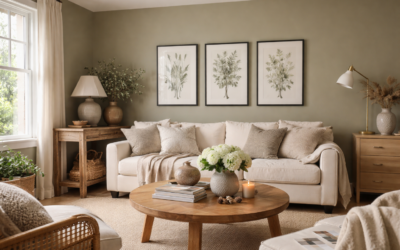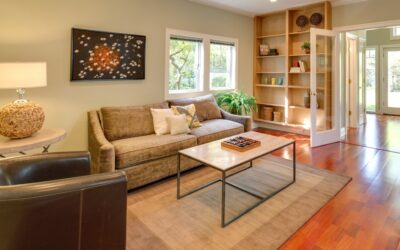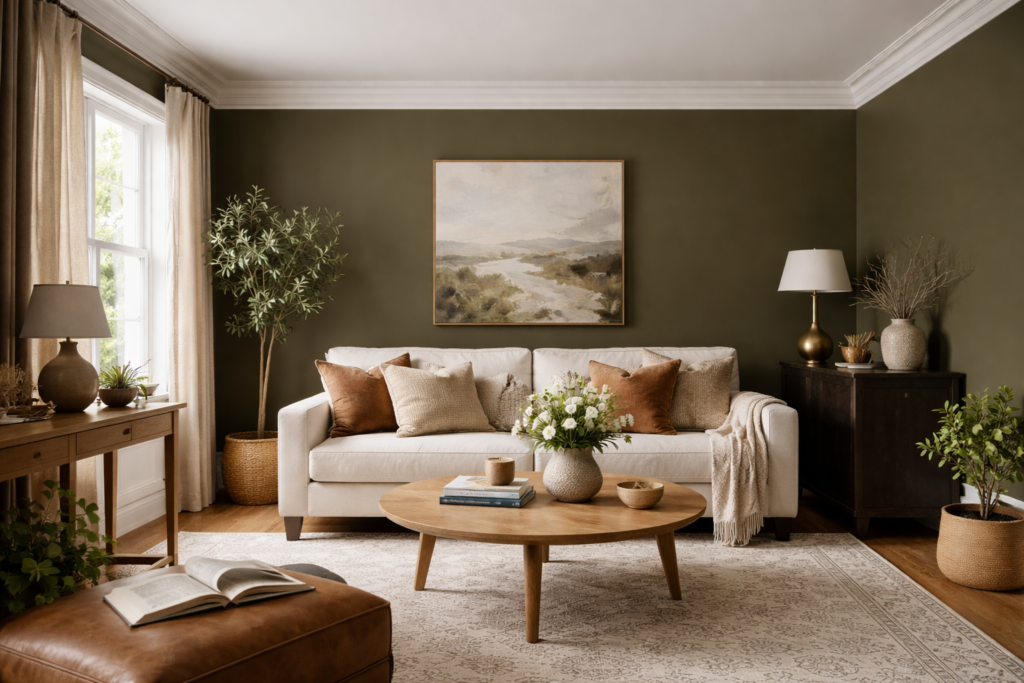
Benjamin Moore Dark Olive (2140-30) is a deep, muted green that sits comfortably between earthy and polished. The manufacturer’s own description promises equal amounts of earthiness and elegance from a dark, muted green, and that is a good summary of why it shows up on kitchen cabinets, library walls and front doors. It is green, clearly, but grayed and softened enough to act almost like a neutral.
Dark Olive has a light reflectance value (LRV) of 13.52, which makes it a dark color that still holds some visible depth and nuance. It is one step lighter than its darker sibling Tuscany Green (2140-20), which Benjamin Moore lists at LRV 9.57. Expect Dark Olive to look richer and moodier on four walls than on a small chip.
- Benjamin Moore Dark Olive Specs at a Glance
- Dark Olive Undertones in Different Light
- Rooms and Surfaces Where Dark Olive Works
- Coordinating Colors and Trim Whites
- Dark Olive vs Similar Colors
- How to Sample Dark Olive Before Committing
- Painting Tips and Troubleshooting
- Cost and When to Hire a Painter
- Frequently Asked Questions
The spec table brings together the confirmed manufacturer facts, then the sections on undertones, rooms, pairings and look-alikes explain how it behaves in real homes.
Benjamin Moore Dark Olive Specs at a Glance
The color number, LRV, family, coordinating colors and similar colors come from the Benjamin Moore color page for Dark Olive. Deep greens shift a lot on screens, so make the final decision from a physical sample.
| Spec | Value | What it means |
|---|---|---|
| Color number | 2140-30 | Use this exact code; third-party sites sometimes list wrong numbers |
| Color family | Neutral | Filed with neutrals because the green is so muted |
| LRV | 13.52 | Dark; absorbs most light, so it needs good lighting |
| Character | Dark, muted green | Earthy olive with gray softening |
| Manufacturer coordinating colors | White Wisp (OC-54), Sea Haze (2137-50), Swiss Coffee (OC-45), Winter Orchard (1555) | Suggested whites and soft partners |
| Similar colors listed | Mohegan Sage (2138-30), Forest Floor (1498), Castle Peak Gray (1561), Jade Romanesque (476) | Close alternatives to sample side by side |
| Darker neighbor on the same strip | Tuscany Green (2140-20), LRV 9.57 | A deeper olive if Dark Olive feels too light |
| Sheen picks | Matte or eggshell walls; satin or semi-gloss cabinets, doors and trim | Higher sheen adds durability and depth on woodwork |
Colors with LRVs in the low teens tend to look dramatic on walls and best when paired with lighter trim and plenty of layered lighting.
Dark Olive Undertones in Different Light
Benjamin Moore does not publish a formal undertone label for Dark Olive. In most rooms it reads as a grayed green with a warm, earthy base, the kind of olive that hints at brown in low light and at sage in bright light. That gray softening is why the brand files it with neutrals.
North-facing rooms
Cool light brings out the gray, and Dark Olive can look closer to a deep green-gray or even charcoal-green. It stays sophisticated but can feel heavy in a small, dim room. Warm bulbs in the 2700K to 3000K range help restore warmth.
South-facing rooms
Warm sunlight brings out the olive and earthy yellow-brown side. Here it looks richer and more clearly green, a good fit for living rooms and kitchens with lots of daylight.
East and west exposures
Morning sun in east rooms makes it look fresher and greener, while afternoons look darker. West rooms do the reverse, with a warm, glowing look at sunset. Sample in both conditions before choosing.
Artificial light
Warm LED lighting keeps Dark Olive cozy and rich. Very cool lighting can make it look flat and gray. Since dark colors depend on lamps in the evening, test under the bulbs you actually use.
Rooms and Surfaces Where Dark Olive Works
- Kitchen cabinets and islands: one of its most popular uses. It pairs well with brass, wood counters and warm white stone. Use a cabinet-grade enamel in satin or semi-gloss.
- Libraries, offices and dens: the classic setting for an olive green. Paint walls, trim and built-ins the same color for a cocooning effect.
- Dining rooms: looks rich under warm evening light and flatters wood furniture.
- Bedrooms: a calming, enveloping color if the room has decent light or several lamps.
- Bathrooms and powder rooms: works with natural stone, cream tile and aged brass fixtures.
- Front doors and exterior accents: a softer alternative to black on doors, shutters and garage doors, especially with warm brick, cream siding or natural stone. Use an exterior paint in satin or semi-gloss.
Small rooms with one window facing north are the toughest spot for any deep green. In those spaces consider Dark Olive on cabinetry, a vanity or lower wainscot paneling with a lighter color above.
Coordinating Colors and Trim Whites
Benjamin Moore suggests White Wisp (OC-54), Sea Haze (2137-50), Swiss Coffee (OC-45) and Winter Orchard (1555) as coordinating colors. The palette leans soft and light, which makes sense: a dark, muted green looks best next to gentle, slightly warm partners rather than stark contrasts.
Trim and ceiling whites
Warm, creamy whites such as Swiss Coffee make Dark Olive look cozy and traditional. Softer whites with a hint of gray or green keep the overall look calm and low contrast. Very bright, cool whites can make the green feel heavier by comparison, so sample your chosen trim white next to it.
Pairings by style
- Traditional: Dark Olive walls with cream trim, wood floors and brass lighting.
- Modern organic: Dark Olive cabinets with light oak, plaster-look walls and natural stone.
- Cottage: lighter sage or green-gray walls with a Dark Olive door or built-in.
- Moody: Dark Olive on walls, trim and ceiling in a den, with walnut furniture and warm lamps.
- Accent colors: rust, terracotta, mustard and deep plum all look good against muted olive.
Dark Olive vs Similar Colors
The colors Benjamin Moore lists as similar sit in the same deep, muted range but lean in different directions. Check each one’s current LRV on the manufacturer page and paint large samples side by side, because small differences in green, gray or brown matter a lot in a dark color.
| Color | Number | When to compare |
|---|---|---|
| Dark Olive | 2140-30 | Muted earthy green, LRV 13.52 |
| Tuscany Green | 2140-20 | Deeper, darker olive, LRV 9.57 |
| Mohegan Sage | 2138-30 | If you want a green with more sage character |
| Forest Floor | 1498 | If you want an earthier, woodsy alternative |
| Castle Peak Gray | 1561 | If you want the gray side to lead |
| Jade Romanesque | 476 | If you want a slightly different green cast |
If Dark Olive looks a little too light or too green in your room, Tuscany Green from the same color strip is the natural next step deeper.
How to Sample Dark Olive Before Committing
- Use large samples. Peel-and-stick paint swatches or sample boards at least 12 by 12 inches show depth far better than chips.
- Test several walls. Place one on the brightest wall and one on the darkest.
- Check through the day. Morning, afternoon and evening, plus under lamps.
- Hold it against fixed finishes. Countertops, flooring, tile and hardware that are staying.
- Pick your white at the same time. Trim, ceiling and adjoining rooms all affect how the green reads.
- Compare with one alternative. Sampling Dark Olive next to Tuscany Green or Mohegan Sage makes its undertone easier to see.
Painting Tips and Troubleshooting
Coverage is patchy. Deep colors usually need a tinted primer and two finish coats, especially over white or a contrasting color.
Cabinets show brush marks. Use a fine-finish roller or spray application with a self-leveling enamel, and lightly sand between coats.
Touch-ups show. Dark colors flash easily. Keep leftover paint from the same batch and repaint corner to corner when needed.
The room feels too dark. Add lamps at several heights, use warm bulbs and keep the ceiling a light color, or limit Dark Olive to cabinetry and lower walls.
Cost and When to Hire a Painter
Premium interior paint generally runs about $50 to $100 per gallon, with cabinet and exterior enamels often near the upper end. A 12 by 12 foot room with 8 foot ceilings usually needs about 2 gallons for two coats plus primer. Professional room painting commonly costs from a few hundred dollars to over a thousand, and cabinet painting costs considerably more because of the cleaning, sanding and priming involved.
Walls and doors are realistic DIY jobs. Hire a painter for kitchen cabinets, high stairwells and rooms with extensive trim, where dark colors make every flaw visible.
Frequently Asked Questions
What is the LRV of Benjamin Moore Dark Olive?
Benjamin Moore lists Dark Olive 2140-30 with an LRV of 13.52, which places it in the dark range.
Is Dark Olive warm or cool?
It leans warm and earthy, but gray softening keeps it muted. In cool light it looks more gray-green, and in warm light it looks richer and more olive.
What is the color number for Dark Olive?
The correct Benjamin Moore number is 2140-30. Some third-party sites list other numbers, so confirm the code before ordering.
Is Dark Olive good for kitchen cabinets?
Yes. It is a popular cabinet color that pairs well with brass, wood and warm white stone. Use a cabinet-grade enamel in satin or semi-gloss.
What white goes with Benjamin Moore Dark Olive?
Benjamin Moore suggests White Wisp and Swiss Coffee among its coordinating colors. Warm or softly grayed whites usually look better beside it than stark, cool whites.
What is darker than Dark Olive?
Tuscany Green 2140-20 sits on the same strip with an LRV of 9.57, making it a deeper olive green.