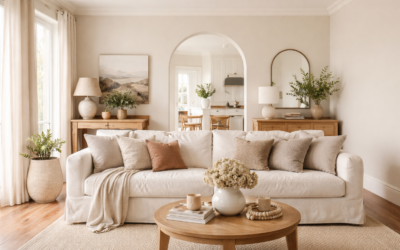
The name suggests a rich coffee brown, but the color is much lighter than most people expect. Benjamin Moore Mocha Cream is color number 995 in the Benjamin Moore Classics collection, a light neutral that the manufacturer describes as having dusty taupe undertones that soften its tone. Its light reflectance value (LRV) is 57.76, which puts it in the middle-light range: bright enough for main living spaces, but with enough body to look like a real color rather than an off-white.
In practice, Mocha Cream reads as a soft greige-leaning beige. The taupe undertone gives it a slightly smoky, grounded quality, so it avoids the yellow or peachy cast that older beiges are known for. It suits living rooms, bedrooms, hallways and open plans where you want warmth without a strong color statement.
- Benjamin Moore Mocha Cream at a Glance
- Understanding the Dusty Taupe Undertone
- Best Rooms for Mocha Cream
- Trim, Ceiling and Accent Pairings
- Mocha Cream vs Similar Beige and Taupe Shades
- How to Test and Paint a Light Neutral
- Troubleshooting Common Issues
- Cost and When to Hire a Painter
- Frequently Asked Questions
Benjamin Moore Mocha Cream at a Glance
These figures come from the manufacturer’s own color page at the time of writing. Collections and formulas are updated from time to time, so confirm the details on the current color page before buying several gallons.
| Spec | Value | What it means |
|---|---|---|
| Color number | 995 | Quote this number at the counter so the right formula is tinted |
| Collection | Benjamin Moore Classics | A core palette that is widely available |
| Color family | Neutral | A light, warm neutral rather than a white or a true brown |
| LRV | 57.76 | Mid-light: reflects a little over half the light, so it keeps rooms bright |
| Undertone | Dusty taupe (maker description) | Soft, slightly smoky warmth, not yellow or pink |
| Coordinating colors (maker list) | Cascade Mountains 862, Hemlock 719, Swiss Coffee OC-45, Jackson Tan HC-46 | A soft white, a deeper tan and accent options |
| Similar colors (maker list) | Desert Light 1004, Alphano Beige 989, Litchfield Gray HC-78, Smokey Taupe 983 | Nearby beiges and taupes to compare side by side |
Sheen is chosen separately from color. Most product lines let you have it mixed in matte, eggshell, satin, semi-gloss and more, so pick the product first and then confirm the sheen options.
Understanding the Dusty Taupe Undertone
Every beige has an undertone that shows up once it is on four walls. Some lean yellow, some pink, some green. Mocha Cream’s undertone is taupe, a gray-brown mix, which is why it looks calmer and more modern than a classic sandy beige. Next to a pure white sample it looks clearly warm. Next to a yellow-leaning beige, it looks grayer and more muted.
Light shifts it noticeably. In north-facing rooms the gray in the taupe comes forward and the color can look closer to a light greige. In south- and west-facing rooms warm sunlight brings out the beige and it reads cozier. Under warm white bulbs (around 2700K) it looks soft and inviting; under cool daylight bulbs it can look flatter and grayer.
With an LRV in the high 50s, it will not look washed out in a bright room the way very pale neutrals sometimes do, and it will not darken a room the way a mid-tone tan would. That balance is its main selling point.
Best Rooms for Mocha Cream
Light warm neutrals are workhorse colors. Mocha Cream fits especially well in:
- Living rooms and family rooms: it warms up large spaces without fighting with furniture, rugs or art.
- Open floor plans: as a whole-house color it ties kitchens, living areas and hallways together.
- Bedrooms: the taupe undertone feels restful, and it pairs well with linen and natural textiles.
- Hallways and stairwells: forgiving of scuffs and shadows compared with a stark white.
- Kitchens with warm wood or cream cabinets: it bridges warm wood tones and stone counters.
- Bathrooms with beige or travertine tile: the dusty undertone helps it blend with warm tile rather than clash.
Use more caution with tile, counters or carpet that have a strong pink or yellow cast. Hold the chip right against those surfaces; if the paint suddenly looks gray or green by comparison, try one of the similar colors instead.
Trim, Ceiling and Accent Pairings
The coordinating colors the manufacturer lists give a good sense of how to build a scheme around Mocha Cream.
Trim and ceilings
Swiss Coffee OC-45, a soft warm white on the coordinating list, is a natural choice for trim, doors and ceilings. It keeps contrast gentle and avoids the stark look a cool white can create next to a warm neutral. Use satin or semi-gloss on trim for durability.
Deeper accents
Jackson Tan HC-46 is a deeper warm tan that works for a dining room, a lower wall below a chair rail, or kitchen island cabinetry. It keeps the same warm family while adding depth.
Color accents
Cascade Mountains 862, a white softly shaded with cool gray, and Hemlock 719, a sleek blue with steely gray undertones, are listed as coordinating colors that can introduce a bit of contrast. Test them on a sample board next to Mocha Cream to see which suits your furnishings before committing to a feature wall or a front door.
Materials and decor
Medium and warm wood floors, woven rattan, linen, leather and aged brass all look at home with this color. Soft sage, dusty blue and terracotta textiles add color without fighting the taupe undertone. Black accents like window frames or lamp bases sharpen the look.
Mocha Cream vs Similar Beige and Taupe Shades
The manufacturer lists these as similar colors. Small differences in undertone and depth become clear on a full wall, so compare large samples in your own light.
| Color | Code | How it compares |
|---|---|---|
| Desert Light | 1004 | Almost the same depth (LRV 57.9) with soft mauve undertones |
| Alphano Beige | 989 | Slightly deeper (LRV 54.55); described as a warm, moody gray with a hint of taupe |
| Litchfield Gray | HC-78 | A Historical Colors option, slightly lighter (LRV 58.67) |
| Smokey Taupe | 983 | A touch deeper (LRV 54.53) with just a touch of warmth |
The LRVs come from each color’s Benjamin Moore page; compare them with Mocha Cream’s 57.76.
How to Test and Paint a Light Neutral
- Sample on more than one wall. Use peel-and-stick paint sample swatches or a 2 by 2 foot sample board, and look at it on the brightest and darkest walls of the room.
- Check at three times of day. Morning, midday and evening under lamps will show you the full range of the undertone.
- Compare against fixed finishes. Hold samples next to flooring, counters, tile and large furniture.
- Prep properly. Patch, sand, and clean walls. Spot prime patches so they do not flash through the finish.
- Prime if changing dramatically. Going from a dark or saturated color to Mocha Cream usually needs a primer coat first.
- Apply two finish coats. Light neutrals generally cover well, but two coats give an even, durable film.
- Keep extra paint labeled. Save a quart with the color number and sheen for future touch-ups.
Troubleshooting Common Issues
It looks too gray: usually north light or cool bulbs. Switch to warm white bulbs or consider a slightly warmer beige from the similar list.
It looks pink or purple: taupe undertones can pick up rosy reflections from red brick, cherry floors or pink tile. Test right next to those materials.
Trim looks dingy: an old, yellowed trim paint can make a fresh neutral look dull. Repaint trim in a clean warm white at the same time.
Touch-ups show: use the same sheen and batch, and feather touch-ups with a roller rather than dabbing with a brush.
Cost and When to Hire a Painter
A gallon of premium interior paint covers roughly 350 to 400 square feet per coat on smooth walls. A 12 by 14 foot bedroom with two coats usually needs two to three gallons. Premium lines cost more per gallon than budget paint, but light neutrals like Mocha Cream rarely need extra coats unless you are covering a dark color.
Professional interior painting typically runs about $2 to $6 per square foot of wall area depending on prep, ceiling height and region. Hiring a pro makes sense for whole-house repaints, tall foyers and stairwells, or when walls need significant drywall repair. In homes built before 1978, test existing paint for lead before sanding and follow lead-safe practices or use a certified contractor.
Frequently Asked Questions
What is the LRV of Benjamin Moore Mocha Cream?
The manufacturer lists Mocha Cream 995 with an LRV of 57.76. That makes it a mid-light neutral that keeps rooms bright while still showing visible color.
What undertone does Mocha Cream have?
The maker describes it as a light neutral with dusty taupe undertones. It reads as a soft beige with a slight gray-brown, smoky quality rather than yellow or pink.
Is Mocha Cream a beige or a greige?
It sits between the two. Most people would call it a warm beige, but its taupe undertone pushes it toward greige in north light or under cool bulbs.
What white trim goes with Mocha Cream?
Swiss Coffee OC-45, a soft warm white on the maker’s coordinating list, is a good fit. Very cool, stark whites can make the beige look dull by comparison.
Is Mocha Cream too dark for a small room?
No. With an LRV above 57 it is light enough for small rooms, hallways and bathrooms, especially with good lighting and a warm white trim.
What colors are similar to Mocha Cream?
The manufacturer lists Desert Light, Alphano Beige, Litchfield Gray and Smokey Taupe as similar colors. Test large samples side by side before deciding.