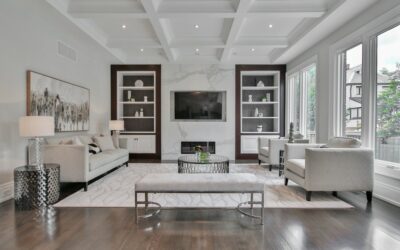
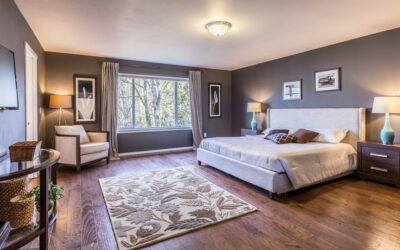
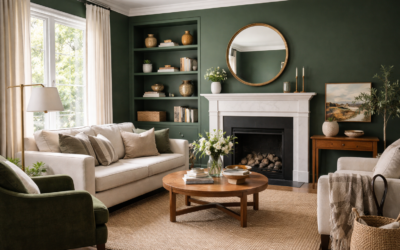
Plenty of beiges look great on a chip and then turn pink, orange or muddy on four walls. Benjamin Moore Muslin earns its following because it avoids the worst of that. Coded OC-12 in the brand’s Off-White Collection, it has a light reflectance value (LRV) of 66.54 on the maker’s color page, and Benjamin Moore describes it as a warm, welcoming neutral that captures the charm of organic materials such as linen and raw cotton.
In practice, Muslin reads as a soft, warm greige: lighter than a classic tan, deeper than an off-white, with enough gray to keep it from looking yellow. It was also one of the supporting shades in Benjamin Moore’s Color Trends 2021 palette built around Aegean Teal, so it has a track record as a companion to bolder colors.
- Benjamin Moore Muslin Specs at a Glance
- Undertones in Different Light
- Best Rooms and Uses
- Coordinating Trim and Accent Colors
- Muslin vs Near Greige and Beige Shades
- Tools for Testing and Painting a Neutral
- How to Test and Paint Muslin
- Troubleshooting Common Problems
- Using Muslin With Floors and Finishes
- Choosing a Sheen for Muslin
- Cost and When to Hire a Painter
- Frequently Asked Questions
Use it as a whole-house neutral, in living rooms and bedrooms, or as the quiet backdrop for colored cabinets. Then sample it, because mid-light neutrals shift with flooring and light more than people expect.
Benjamin Moore Muslin Specs at a Glance
The values in the spec table come from the Benjamin Moore color page for Muslin OC-12 and the brand’s 2021 color trends materials.
| Spec | Value | What it means |
|---|---|---|
| Color code | OC-12 | Ask for this code at the counter to get the right formula |
| Collection | Off-White Collection | A curated palette of soft whites and light neutrals |
| Color family | White (filed with the whites on the maker’s site) | Reads as a light, warm greige-beige neutral rather than a crisp white |
| LRV | 66.54 | Light to mid; reflects about two-thirds of the light that hits it |
| Undertone tendency | Warm, with gray softening | Earthy rather than pink or orange; can lean slightly green-gray in cool light |
| Maker’s similar color | Berber White 955 | A close cousin to sample side by side |
| Maker’s color combinations | Mayonnaise OC-85, Aegean Teal 2136-40, Fairway Oaks 1075, Lafayette Green HC-135 | Trim, accent and cabinet partners |
LRV runs from 0 (black) to 100 (white). Around 60 to 70 is a comfortable range for a wall neutral: light enough to keep most rooms bright, deep enough to show as a color against white trim. Benjamin Moore mixes Muslin in many interior and exterior products, so ask at the counter about the line and sheen that fit your surface.
Undertones in Different Light
Muslin’s warmth comes forward or steps back depending on light direction and the finishes around it. It is not a strongly opinionated color, which is part of its appeal.
North-facing rooms
Cool light pulls out the gray and can give it a faint green-gray cast. It still reads warm compared with true grays. Warm bulbs and warm wood tones keep it cozy.
South-facing rooms
Warm light brings out its beige, giving a sunny, linen-like feel. In strong late-afternoon sun it can read noticeably warmer than the chip.
East and west light
Expect it to move from a soft greige in indirect light to a warm beige in direct sun. Check samples at both times.
Under artificial light
Warm 2700K bulbs make it cozy and slightly golden; 3000K to 3500K keeps it balanced. Very cool bulbs flatten it toward gray.
Best Rooms and Uses
- Whole-house walls: a flexible neutral that ties together rooms with different flooring and furniture.
- Living rooms and family rooms: warm and relaxed without feeling dated.
- Bedrooms: soft and calming, especially with natural linens and wood furniture.
- Kitchens with colored cabinets: a quiet wall color that lets teal, green or navy cabinets lead.
- Exteriors: a soft warm body color for siding with white trim. Outdoors it will look lighter in full sun.
It works less well in rooms dominated by cool gray tile or blue-white marble, where its warmth can look muddy by comparison.
Coordinating Trim and Accent Colors
Benjamin Moore lists several pairings on the color page:
- Mayonnaise OC-85 (LRV 88.07): a bright white with a creamy touch, an easy trim and ceiling partner that keeps contrast soft.
- Aegean Teal 2136-40 (LRV 25.13): a gray-softened blue-green for cabinets, an island, a front door or an accent wall.
- Fairway Oaks 1075 (LRV 46.08): a warm tan for a deeper adjoining wall or tonal accent.
- Lafayette Green HC-135 (LRV 10.54): a dramatic dark green for doors, built-ins or a moody study.
For a classic look, Muslin walls with a soft white trim in semi-gloss is hard to beat. For contrast, add one deep color on cabinets or a door rather than painting several walls dark.
Muslin vs Near Greige and Beige Shades
These Benjamin Moore neutrals are close relatives. LRVs are from the maker’s color pages.
| Color | Code | LRV | How it differs |
|---|---|---|---|
| Muslin | OC-12 | 66.54 | Warm, organic neutral with gray softening |
| Pale Oak | OC-20 | 68.64 | Slightly lighter, with warm gray undertones |
| Berber White | 955 | 63.24 | Listed as similar by the maker; a sophisticated beige, a little deeper |
| Edgecomb Gray | HC-173 | 63.09 | A warm neutral at similar depth, usually seen as grayer |
| Revere Pewter | HC-172 | 55.05 | Noticeably deeper; bridges warm and cool tones |
If Muslin feels a little too beige on your sample, Pale Oak or Edgecomb Gray are the usual next tries. If it feels too light, Revere Pewter gives more depth with a similar balance.
Tools for Testing and Painting a Neutral
- Peel-and-stick paint sample swatches or painted sample boards, 12 by 12 inches or larger
- Plain white paper to judge undertones against a true white
- Painter’s tape, drop cloths, an angled sash brush and a 3/8 inch nap roller
- Spackle, a sanding sponge and caulk for trim joints
- Primer for patches, stains or a big color change
How to Test and Paint Muslin
- Sample next to fixed finishes. Place swatches beside flooring, counters, stone and large furniture. Undertone clashes show up fastest there.
- Test in two rooms with different exposures if you plan to use it through the house.
- Look over two or three days in morning, midday and evening light, with your lamps on and off.
- Choose sheens. Matte or eggshell for walls, satin or semi-gloss for trim, doors and cabinets.
- Prep the walls. Fill holes, sand patches smooth, clean greasy areas and dust thoroughly.
- Prime as needed over patches, stains or a much darker existing color.
- Apply two coats, keeping a wet edge, and let each coat dry per the label.
Troubleshooting Common Problems
- Looks too yellow or golden: warm bulbs or strong warm light. Try 3000K bulbs or compare Pale Oak.
- Looks green-gray: cool north light or green reflections from foliage outside. Warmer lighting and textiles help.
- Looks muddy: often next to cool gray tile or stone. Choose a cooler greige for that room.
- Flashing or uneven sheen: touch-ups with a different tool or sheen. Repaint the full wall section.
Using Muslin With Floors and Finishes
Mid-light neutrals pick up color from whatever sits next to them, and Muslin is no exception. Warm oak, hickory and walnut floors pair naturally with it, and the result feels calm and cohesive. Orange-toned red oak can make it look a little pinker or more beige, so test a swatch right at floor level in those rooms. Light gray or whitewashed floors push it toward its greige side, which works well in modern farmhouse and coastal schemes.
For kitchens and baths, creamy or warm-veined stone, natural travertine, terracotta tile and brushed brass hardware all complement Muslin. Stark white quartz is fine with a soft white trim to bridge the two. Very cool blue-gray tile is the hardest pairing; if you have it, consider a grayer neutral in that room and keep Muslin for adjoining spaces.
Textiles in linen, wool and cotton, along with natural fiber rugs, lean into the organic feel the maker describes. Sage, olive, rust, navy and deep teal accents give the scheme life without fighting the wall color.
Choosing a Sheen for Muslin
Matte or eggshell keeps Muslin soft and slightly deeper on walls and hides drywall flaws. Satin suits kitchens, baths and hallways where walls get wiped often. On trim, doors and cabinets, satin or semi-gloss adds durability, and the extra reflection will make the color look a shade lighter than the same color in matte.
Cost and When to Hire a Painter
Sample swatches typically cost a few dollars each. Premium interior paint usually falls in a moderate to high range per gallon, and an average bedroom needs about two gallons for two coats. Professional painters commonly charge a few hundred dollars for a small room and more for large open areas, high ceilings or heavy trim. Hire a pro for whole-house projects, two-story foyers, exterior body color on upper floors, or any job with extensive drywall repair.
Frequently Asked Questions
What is the LRV of Benjamin Moore Muslin?
Benjamin Moore lists Muslin OC-12 with an LRV of 66.54, a light-to-mid value that keeps rooms bright while still showing as a color.
Is Muslin beige or greige?
It sits between the two. It is a warm neutral with enough gray to read as greige in cool light and as soft beige in warm light.
Does Muslin have green undertones?
It can show a faint green-gray cast in cool north light or near green foliage. In most rooms it reads as a warm, earthy neutral.
What trim color goes with Benjamin Moore Muslin?
The maker pairs it with Mayonnaise, a bright white with a creamy touch. Softer warm whites also work well for a low-contrast look.
Is Muslin lighter than Revere Pewter?
Yes. Muslin has an LRV of 66.54 and Revere Pewter 55.05, so Muslin is noticeably lighter.
What colors go with Muslin for cabinets?
Aegean Teal and Lafayette Green are maker-suggested partners that work well on cabinets, islands or doors against Muslin walls.