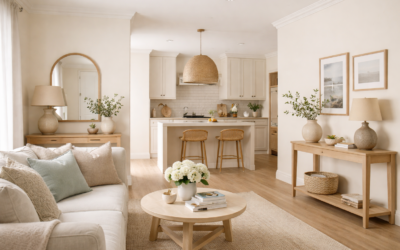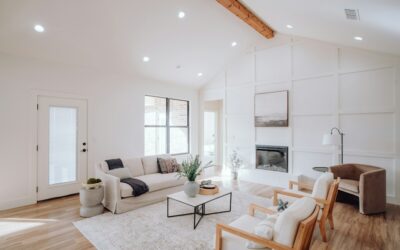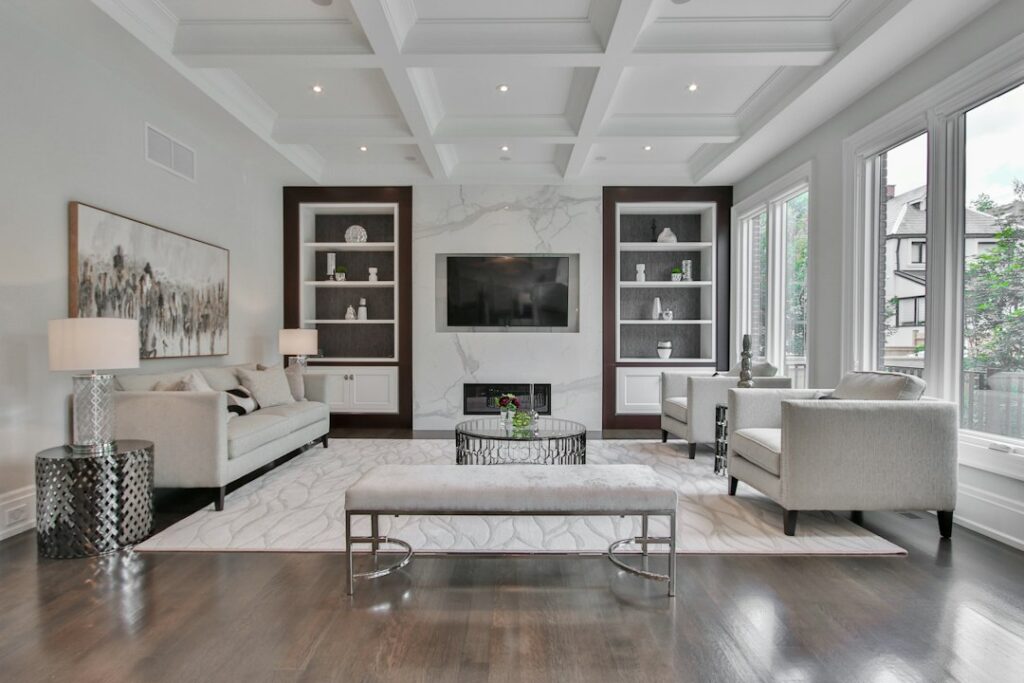
Pure white walls can feel sterile, yet many cream colors tip into yellow the moment the afternoon sun hits them. Benjamin Moore Ivory White sits in between. Coded 925 in the Benjamin Moore Classics collection, it has a light reflectance value (LRV) of 83.32 on the maker’s color page, and the brand describes it as a clean white warmed by crisp cream undertones.
In plain terms, it is a soft, warm white. It looks clearly white on a wall, but next to a bright, stark white you will see its gentle cream glow. It does not read as beige, and in most light it stays far from the heavy yellow that makes older ivory paints look dated.
- Benjamin Moore Ivory White Specs at a Glance
- Undertones in Different Light
- Best Rooms and Uses
- Coordinating Trim and Accent Colors
- Ivory White vs Near Warm White Shades
- Tools for Testing and Painting a Warm White
- How to Test and Paint Ivory White
- Troubleshooting Common Problems
- Using Ivory White With Floors and Finishes
- Cost and When to Hire a Painter
- Frequently Asked Questions
It suits whole-house walls, bedrooms, living rooms, kitchens with warm wood, and cabinets where you want white without a cold edge. As with every white, test it against your floors, counters and light before buying gallons.
Benjamin Moore Ivory White Specs at a Glance
The figures in the spec table come from the Benjamin Moore color page for Ivory White 925.
| Spec | Value | What it means |
|---|---|---|
| Color code | 925 | Give this number at the counter so the right color is mixed |
| Collection | Benjamin Moore Classics | The brand’s large core palette |
| Color family | White | Reads as a warm white, not a beige or cream |
| LRV | 83.32 | Light and bright; reflects most of the light that hits it |
| Undertone | Crisp cream | Gentle warmth with a faint yellow note in warm light |
| Maker’s color combinations | Barely Beige 1066, Northern Cliffs 1536, Cream Agate OC-144, Greenfield Pumpkin HC-40 | Ready-made companion and accent choices |
LRV runs from 0 (black) to 100 (white). At 83.32, Ivory White bounces plenty of light around a room but is not the brightest white in the fan deck, which is exactly why it feels softer than gallery whites in the high 80s and 90s. Benjamin Moore mixes it in many interior and exterior products; ask at the counter which lines and sheens fit your project.
Undertones in Different Light
Cream undertones respond strongly to light temperature, so Ivory White can look slightly different from room to room.
North-facing rooms
Cool north light tames the cream. Ivory White often looks like a soft, neutral white here and helps keep the room from feeling gray or chilly, which is one of its best uses.
South-facing rooms
Strong warm light intensifies the cream. In a sunny room it can glow buttery in late afternoon. If you want a cleaner look in very sunny spaces, compare it against a brighter white before deciding.
East and west light
Expect a cleaner white during cooler parts of the day and a warmer, creamier tone when direct sun hits the walls.
Under artificial light
Warm bulbs (2700K) emphasize the cream; 3000K to 3500K bulbs keep it closer to a soft white. Very cool daylight bulbs can make it look slightly flat.
Best Rooms and Uses
- Whole-house wall color: a warm, easy backdrop that flatters wood floors and most furniture.
- North-facing bedrooms and living rooms: adds warmth where cool light dominates.
- Kitchen cabinets: a soft white for traditional or farmhouse kitchens, especially with warm wood counters or brass hardware.
- Trim with warm wall colors: pairs naturally with beige, tan and warm greige walls, where a stark white trim would look harsh.
- Exteriors: a warm white for siding or trim on brick, stone and earth-toned homes. Sun will make it look lighter outdoors.
It is a weaker fit for rooms with cool marble, blue-gray tile or very modern, high-contrast schemes, where its warmth can make the cool finishes look dingy by comparison.
Coordinating Trim and Accent Colors
Benjamin Moore suggests several companions:
- Cream Agate OC-144 (LRV 73.21): an off-white with warm, flaxen undertones for subtle layering on an adjoining wall or ceiling.
- Barely Beige 1066 (LRV 71.32): a bisque beige for adjoining rooms, keeping a warm, tonal flow.
- Northern Cliffs 1536 (LRV 45.53): a soft mid-tone gray for contrast on an island, door or feature wall.
- Greenfield Pumpkin HC-40 (LRV 18.86): a deep hue with yellow and brown notes for doors, built-ins or a dramatic accent.
When Ivory White is the wall color, using the same shade on trim in a higher sheen gives a quiet, monochrome look. If you want more definition, use a slightly brighter white on trim, though be aware that a much cleaner white next to it will make Ivory White look creamier.
Ivory White vs Near Warm White Shades
These popular Benjamin Moore whites are often compared. LRVs are from the maker’s color pages.
| Color | Code | LRV | How it differs |
|---|---|---|---|
| Ivory White | 925 | 83.32 | Clean white with crisp cream undertones |
| White Dove | OC-17 | 83.16 | Nearly identical brightness; a soft classic white that many see as slightly less creamy |
| Swiss Coffee | OC-45 | 81.91 | A touch deeper and warmer |
| Mayonnaise | OC-85 | 88.07 | Brighter, with a creamy yellow touch |
| Simply White | OC-117 | 89.52 | Brighter and crisper, with only a subtle warm undertone |
| Chantilly Lace | 2121-70 | 90.04 | A clean, bright white; reads much cooler beside Ivory White |
The maker also lists Timid White 2148-60, Powder Sand 2151-70, Snow on the Mountain 1513 and White Chocolate 2149-70 as similar colors, so sample those if you want slight variations in warmth.
Tools for Testing and Painting a Warm White
- Peel-and-stick paint sample swatches or 12 by 12 inch painted sample boards
- A sheet of plain white printer paper to reveal undertones by comparison
- Painter’s tape, drop cloths, an angled sash brush and a 3/8 inch nap roller
- Stain-blocking primer for water marks, knots or smoke stains
- Spackle, sanding sponge and caulk for trim gaps
How to Test and Paint Ivory White
- Compare against your fixed finishes. Hold swatches beside flooring, counters, tile and fabrics. Warm whites can look dirty next to cool stone and lovely next to oak.
- Check at several times of day. Look in morning, midday and evening light, plus under your lamps.
- Choose sheens. Matte or eggshell for walls, satin or semi-gloss for trim and cabinets.
- Prep thoroughly. Light colors show every patch and dent, so fill, sand and wipe dust away.
- Spot prime stains. Water stains and wood knots bleed through light colors; seal them first.
- Apply two coats. Keep a wet edge to avoid lap marks and let each coat dry per the label.
Troubleshooting Common Problems
- Looks too yellow: strong warm light or warm bulbs. Switch to 3000K bulbs or try a cleaner white such as Simply White.
- Looks dingy: it may be next to a much brighter white trim or cool tile. Match trim more closely or warm up the surrounding finishes.
- Stains bleeding through: spot prime with a stain blocker and recoat.
- Uneven sheen: touch-ups with a different tool. Repaint full wall sections when possible.
Using Ivory White With Floors and Finishes
Because Ivory White carries a cream undertone, the materials around it decide whether it looks fresh or tired. Warm oak, hickory and walnut floors bring out its softness and make the room feel cohesive. Honey-toned wood can push it a little creamier, which many people like in traditional rooms. Gray-washed or cool-toned vinyl plank floors are the trickier match; with those, compare the swatch directly on the floor before deciding.
Counters and tile matter just as much. Creamy quartz, travertine, warm marble and handmade-look tile all sit comfortably beside it. Bright white quartz with cool gray veining can make Ivory White read slightly yellow by contrast. Fabrics and rugs in oatmeal, rust, sage, soft navy and terracotta suit the color, while icy blues and stark black-and-white patterns fight its warmth. If you have one fixed cool element, such as a gray tile backsplash, keep Ivory White on walls farther from it and use a cleaner white near the tile.
Cost and When to Hire a Painter
Sample swatches cost a few dollars each. Premium interior paint usually runs from moderate to high per gallon, and a typical 12 by 12 foot room needs about two gallons for two coats. Professional interior painters commonly charge a few hundred dollars for a small room and more for large rooms, high ceilings or extensive trim. Hire a pro for whole-house repaints, cabinets that need a sprayed finish, tall stairwells, or exterior work above one story.
Frequently Asked Questions
What is the LRV of Benjamin Moore Ivory White?
Benjamin Moore lists Ivory White 925 with an LRV of 83.32, which places it among the light whites while staying softer than the brightest options.
Does Ivory White look yellow?
It has crisp cream undertones, so it can look slightly creamy in warm, sunny light or under warm bulbs. In north light and next to warm finishes it usually reads as a soft white.
Is Ivory White warmer than White Dove?
They are almost the same brightness, with LRVs of 83.32 and 83.16. Sample them side by side, since many people see Ivory White as a little creamier.
Is Ivory White good for kitchen cabinets?
Yes, especially in traditional kitchens with warm wood, brass hardware or cream counters. Next to cool white quartz, compare it against a crisper white first.
What colors go with Benjamin Moore Ivory White?
The maker pairs it with Barely Beige, Cream Agate, the mid-tone gray Northern Cliffs and the deep Greenfield Pumpkin. Warm beiges, greiges, sage greens and wood tones also work well.
Can Ivory White be used on trim?
Yes. It works well as trim with warm wall colors, or on both walls and trim in different sheens for a soft monochrome look.