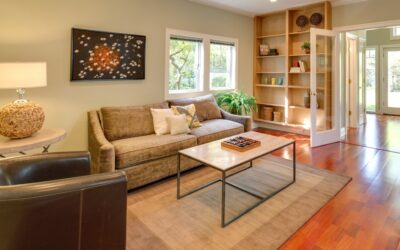
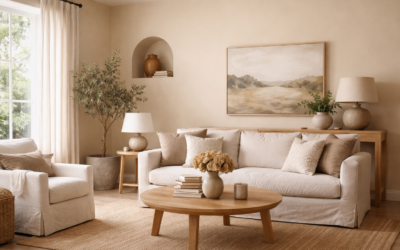
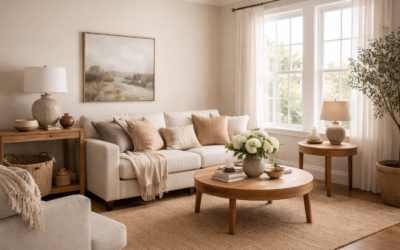
Beige got a bad reputation from flat, pinkish builder paint, but a well-chosen sandy neutral still does something gray never could: it makes a room feel warm without adding obvious color. Benjamin Moore Natural Linen is one of those shades. The maker describes it as a sandy neutral with rustic warmth and elegance, and it reads like unbleached linen fabric, a soft tan with enough depth to show against white trim.
Its code is 966 in the Benjamin Moore Classics collection, also listed as CC-90, its Designer Classics number. The light reflectance value (LRV) on the maker’s color page is 59.84, which puts it in the middle range: light enough for most living spaces, deep enough to read as a definite color rather than an off-white.
- Benjamin Moore Natural Linen Specs at a Glance
- Understanding the Undertone
- What an LRV of 59.84 Means
- Best Rooms for Natural Linen
- Trim and Coordinating Colors
- Natural Linen vs Similar Beige and Linen Shades
- How to Test Natural Linen at Home
- Painting Tips and Troubleshooting
- Costs and When to Hire a Painter
- Frequently Asked Questions
It suits living rooms, bedrooms, dens and hallways where you want warmth, and it pairs easily with wood floors, cream upholstery and natural textures. Like any beige, it can lean yellow or slightly green depending on the light, so test it at home before buying gallons.
Benjamin Moore Natural Linen Specs at a Glance
The color code, LRV, family and pairing suggestions come from the Benjamin Moore color page for Natural Linen 966. The undertone row reflects how the shade tends to behave in different light, so confirm it with a sample in your room.
| Spec | Value | What it means |
|---|---|---|
| Color code | 966 (also known as CC-90) | Give either number at the paint counter for the right formula |
| Collection | Benjamin Moore Classics | A long-standing line, widely available |
| Color family | Neutral | Works as a whole-house wall color |
| LRV | 59.84 | Mid-light; reflects about 60 percent of light |
| Undertone tendency | Warm, sandy, with a faint yellow-green cast in some light | Reads warm beige, not pink or gray |
| Maker’s color combinations | Dune White 968, White Heron OC-57, Ocean Floor 1630, Stormy Monday 2112-50 | Ready-made trim and accent options |
| Maker’s similar colors | Temporal Spirit 965, Berber White 955, Jute AF-80, Cream Fleece 233 | Shades to compare if Natural Linen is close but not right |
Understanding the Undertone
Natural Linen sits firmly in warm territory. Its base is a sandy tan with a yellow lean, and in some rooms a faint green note shows up, especially beside cool whites or under north light. That green hint is what keeps it from looking peachy or pink, which is the main complaint people have about older beiges.
Light changes it more than you might expect. Southern exposure makes it glow golden and cozy. Northern light cools it toward a soft greige with a slight green tint. Western light in late afternoon pushes it noticeably warmer. Warm 2700K bulbs make it feel like candlelight at night, while 3000K to 3500K bulbs keep it closer to its daytime look.
Surroundings matter too. Next to cherry or orange-toned oak floors it reads more yellow; next to gray-washed or white oak it looks more balanced and natural.
What an LRV of 59.84 Means
LRV runs from 0, black, to 100, pure white. At about 60, Natural Linen is a true midtone neutral: it will not brighten a dark room the way an off-white would, but it will not close in a space either. Rooms with good daylight wear it best. In a dim hallway or north-facing basement, it may look heavier and more muddy than the chip suggests, and a lighter shade from the same family could work better.
The midtone LRV also means white trim stands out clearly, so trim color choice has a strong effect on the finished look.
Best Rooms for Natural Linen
- Living rooms: a warm backdrop for leather, wood and woven textures; an eggshell finish hides minor wall flaws.
- Bedrooms: calm and enveloping, especially with crisp white bedding and natural wood.
- Dining rooms: looks rich under warm evening lighting.
- Hallways and open plans: a flexible whole-house neutral that ties together rooms with different floor tones, provided they get decent light.
- Kitchens: works on walls behind white or cream cabinets; avoid pairing with stark blue-white counters, which make it look yellow.
- Exteriors: some homeowners use it on siding; look at a large sample outdoors, since strong sun lightens any color.
Trim and Coordinating Colors
Benjamin Moore’s own combinations for Natural Linen point to the two easiest directions: a soft white for trim and a deep accent.
- Dune White 968: a soft, warm white in the same family. It gives gentle contrast on trim without stark edges.
- White Heron OC-57: a slightly cleaner white for crisper trim and ceilings.
- Ocean Floor 1630: a deep steel gray with a dark blue cast (LRV 14.13) that the maker pairs with it; consider it for an accent wall, cabinetry or a front door.
- Stormy Monday 2112-50: a moody mid gray (LRV 40.54) that can show violet undertones in some light, adding cool contrast to the warm walls.
As a rule, choose a warm or soft white for trim. A very bright, blue-leaning white can make Natural Linen look dingy or more yellow by comparison. Muted greens, dusty blues, deep olive and charcoal all work as accents.
Natural Linen vs Similar Beige and Linen Shades
The maker lists several near matches, and it helps to know how they differ before buying samples:
- Temporal Spirit 965: a muted, warm sandy shade, a touch lighter at LRV 61.61. Compare it side by side if you want a slight change in depth while keeping the same character.
- Berber White 955: a lighter, softer neutral; a good fallback if Natural Linen looks too heavy in a dim room.
- Jute AF-80: from the Affinity collection, a little lighter at LRV 63.3 with delicate green-brown notes; compare it if you want a slightly different take on a natural fiber tone.
- Cream Fleece 233: leans creamier; consider it if you want more yellow warmth.
Searches for a Benjamin Moore linen color sometimes mean other shades with linen in the name. Natural Linen 966 is the sandy tan described here, so order by number to avoid mix-ups.
How to Test Natural Linen at Home
- Use large samples. Peel-and-stick paint sample swatches or a sample board at least 12 by 12 inches give a much better read than a chip.
- Test on two or three walls. Include one facing the window and one in shadow.
- Put trim candidates beside it. Set a white sample against the edge of the Natural Linen sample to see the contrast you will live with.
- Check beside floors and furniture. Hold samples near flooring, counters and large pieces that are staying.
- View it across a full day. Look in morning, afternoon and evening under your normal bulbs before deciding.
Painting Tips and Troubleshooting
Prep decides the finish. Clean walls, fill holes, sand repairs smooth and spot-prime patches. Going over a darker or very different color, start with a tinted primer and plan on two finish coats. Eggshell or matte suits most walls; use satin in baths and kitchens for easier cleaning, and semi-gloss on trim.
- Looks too yellow: warm bulbs or orange wood floors are reflecting onto the walls. Try 3000K to 3500K bulbs, or switch to a cleaner trim white.
- Looks green: cool north light or a cool white trim nearby. A warmer trim white often fixes it.
- Looks muddy: the room lacks light. Consider a lighter shade such as Berber White.
- Flashing or patchy sheen: unprimed patches or touch-ups after the paint dried. Spot-prime and repaint the full wall.
Costs and When to Hire a Painter
Premium interior paint usually costs somewhere in the range of $50 to $95 per gallon, and a gallon covers roughly 250 to 400 sq ft per coat. A 12 by 14 foot room typically needs about 2 gallons for two coats on the walls. Professional painting often runs a few dollars per square foot of wall area, rising for high ceilings, heavy repairs or detailed trim.
Hire a painter for stairwells, vaulted ceilings or large open plans where a consistent finish matters. In homes built before 1978, test old paint for lead before sanding and use lead-safe practices or a certified contractor if it is present.
Frequently Asked Questions
What is the LRV of Benjamin Moore Natural Linen?
The maker’s color page lists 59.84, a mid-light value. It reads as a definite warm beige rather than an off-white.
Does Benjamin Moore Natural Linen have green undertones?
It is mainly a warm, sandy, yellow-leaning neutral, but a faint green note can show in cool north light or beside very cool whites.
What is the best trim color for Natural Linen?
The maker suggests Dune White 968 or White Heron OC-57. Soft warm whites give a gentle contrast; avoid stark blue-leaning whites.
Is Natural Linen 966 the same as CC-90?
Yes. The Benjamin Moore color page lists CC-90 as another code for Natural Linen 966.
Is Natural Linen too dark for a small room?
Not if the room gets good daylight. In a dim or north-facing small room, a lighter shade like Berber White 955 may feel more open.