The name sounds icy, so many people expect a cold, blue-leaning white. That is the most common misunderstanding about this color. Benjamin Moore Glacier White is OC-37 in the brand’s Off White Collection, and the manufacturer describes it as “a versatile off-white with hushed cream undertones.” Its light reflectance value (LRV) is 80.18, so it is bright, but noticeably softer than a gallery white.
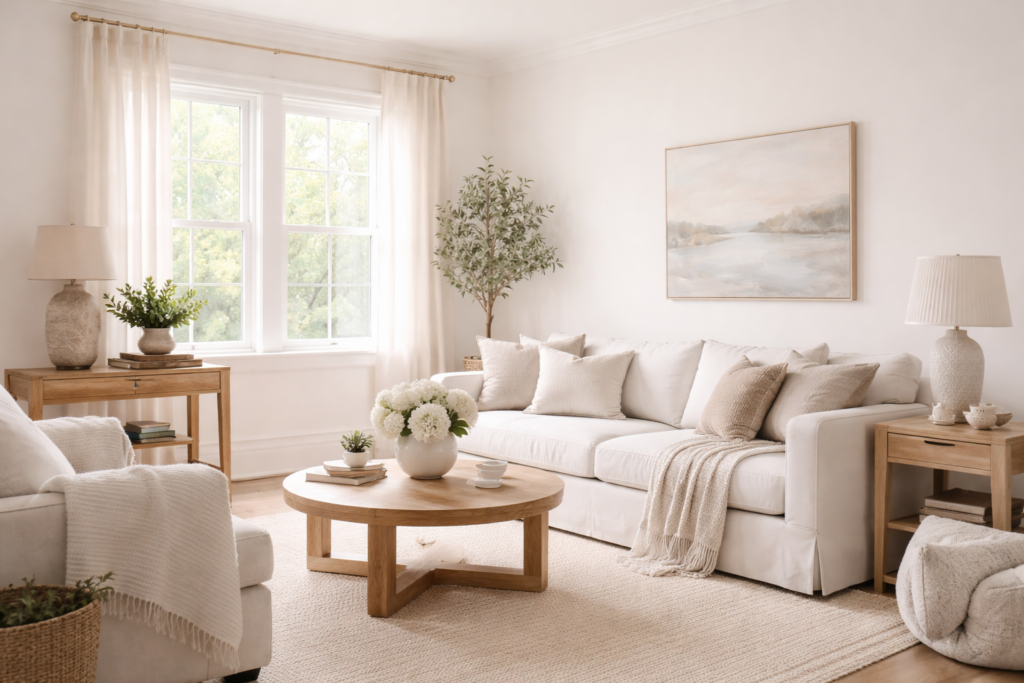
In practice, Glacier White reads as a quiet, slightly muted off-white. The cream is subtle rather than yellow, and because it is softened, the color can look faintly gray or cool in north light or next to a stark white trim. In warm or southern light the cream comes forward and it looks gentle and inviting. That flexibility is why it works on walls, cabinets and trim in homes with very different lighting.
- Benjamin Moore Glacier White Specs at a Glance
- Is Glacier White a Warm or Cool White?
- How Glacier White Behaves in Different Light
- Best Rooms and Surfaces for Glacier White
- Coordinating Trim and Wall Colors
- Glacier White vs Similar Whites
- Painting Tips for Off-White Walls
- Cost to Paint with Glacier White
- Frequently Asked Questions
Benjamin Moore Glacier White Specs at a Glance
The core values here come from the manufacturer’s color page. Screens shift color a lot with whites, so use the table to understand the paint, and use a physical sample to judge it.
| Spec | Value | What it means |
|---|---|---|
| Color name and code | Glacier White OC-37 | Use the code at the counter; several whites have similar names |
| Collection | Off White Collection | The brand’s curated group of whites and off-whites |
| LRV | 80.18 | Light and bright, but softer than whites in the high 80s and 90s |
| Undertone | Hushed cream | Warm-leaning but muted; not a clean, cool white |
| Similar color listed | Dove Wing 960 | A close white with silvery undertones, slightly darker |
| Manufacturer pairings | Tapestry Beige OC-32, Cromwell Gray HC-103, Frappé AF-85, Silhouette AF-655 | Tested neighbors for walls, cabinets and accents |
| Wall sheen picks | Matte or eggshell | Hides minor wall flaws and keeps whites soft |
| Trim and cabinet sheen picks | Satin or semi-gloss | Wipes clean and shows a subtle contrast with flatter walls |
Is Glacier White a Warm or Cool White?
On the manufacturer’s own description, it is a warm-leaning off-white, because the undertone is cream. But “hushed” is the key word. The cream is held back by a slight softness, so Glacier White never turns yellow or buttery the way some creamy whites do. That restraint is what leads some people to call it cool. Against a warm beige wall or wood floor it can look almost gray-white; against a bright, clean white it looks clearly creamy.
If you are specifically searching for a cool white with blue or gray undertones, this is probably not your color. Look instead at whites described with gray or silver undertones, such as Dove Wing, which the brand lists as a similar color but describes as having silvery undertones. If you want a white that sits in the middle, warm enough not to feel sterile but muted enough not to look yellow, Glacier White fits that brief well.
How Glacier White Behaves in Different Light
Whites are the most light-sensitive colors you can choose, and an off-white with a muted undertone moves around more than most.
- North-facing rooms: Cool, indirect light emphasizes the softened part of the color. Expect it to look a little gray, especially on overcast days.
- South-facing rooms: Warm, strong light brings out the cream. The color looks bright, soft and welcoming.
- East-facing rooms: Warm and bright in the morning, cooler and grayer by afternoon.
- West-facing rooms: Cooler in the morning, glowing and creamy in late afternoon sun.
- Warm bulbs (2700K to 3000K): Push it creamier. Good for bedrooms and living rooms.
- Daylight bulbs (4000K to 5000K): Keep it cleaner and more neutral. Good for kitchens and work areas.
Reflected color also matters. Green lawns, red brick next door, orange-toned floors and large wood cabinets all bounce color onto white walls. A sample that looks perfect in the store can pick up a pink or green cast at home, which is the main reason to test on site.
How to test it
Peel-and-stick paint sample sheets are the most reliable way to judge a white, because they are painted with real paint and are large enough to read properly. Place one on each wall, including one next to your trim and one near the floor, and check them in morning, midday and evening light over two or three days. Compare Glacier White to a sheet of plain printer paper; the paper is a neutral reference and makes the cream undertone easy to see.
Best Rooms and Surfaces for Glacier White
With an LRV around 80, Glacier White is bright enough for whole-house use and soft enough not to feel clinical.
- Living rooms and open plans: A good whole-floor wall color that bridges warm wood floors and cooler stone or tile.
- Kitchen cabinets: Soft enough that cabinets do not look stark against white or marble-look counters, and warm enough to sit well with brass or bronze hardware.
- Bedrooms: The muted cream gives a calm, restful feel, especially under warm bulbs.
- Trim against colored walls: Works as trim next to beiges, greiges and soft greens where a bright white would look too sharp.
- Exteriors: On siding, strong sun will wash it lighter. That softness helps prevent glare on large facades.
It is a less natural choice for very dim, north-facing rooms if you dislike any hint of gray. In that case a white with a slightly warmer, more obvious cream may look happier.
Coordinating Trim and Wall Colors
The manufacturer suggests Tapestry Beige OC-32, Cromwell Gray HC-103, Frappé AF-85 and Silhouette AF-655 as coordinating colors. In plain terms, that list spans a light greige (Tapestry Beige, LRV 66), a peach-tinged off-white (Frappé, LRV 69.46) and two deep accents: Cromwell Gray, a dark brown-green neutral (LRV 19.62), and Silhouette, an espresso-charcoal (LRV 10.18). The spread shows how flexible Glacier White is.
A few practical combinations:
- Same color on walls and trim: Walls in matte or eggshell, trim in semi-gloss. This creates a calm, unified look that is very popular in modern farmhouse and transitional homes.
- Glacier White walls with a brighter white trim: Trim stands out crisply, but the walls will look creamier by comparison. Test the pair together.
- Greige or soft gray walls with Glacier White trim: Softer than bright white trim and less jarring in older homes.
- Dark accents: A deep color such as the manufacturer’s suggested Silhouette on an island, front door or built-in gives contrast against Glacier White walls.
Glacier White vs Similar Whites
Comparing it with other well-known whites from the same manufacturer clarifies where it sits.
| Color | Code | LRV | Manufacturer description |
|---|---|---|---|
| Glacier White | OC-37 | 80.18 | Versatile off-white with hushed cream undertones |
| Dove Wing | 960 | 77.52 | White with silvery undertones (listed as similar) |
| Swiss Coffee | OC-45 | 81.91 | Essential white with just the right amount of warmth |
| White Dove | OC-17 | 83.16 | Clean and classic white |
| Chantilly Lace | OC-65 | 90.04 | Classic go-to white |
Dove Wing is the closest match the brand lists. It is a touch darker and its silvery undertone makes it the cooler of the two. Swiss Coffee and White Dove are both slightly brighter and many designers consider them warm, popular wall and trim whites; side by side, Glacier White usually looks more subdued. Chantilly Lace, at 90.04, is much brighter and cleaner, and next to it Glacier White will clearly read as off-white.
Painting Tips for Off-White Walls
- Prime patched spots and new drywall. Whites show flashing (shiny or dull patches) over unprimed repairs more than most colors.
- Use two coats. Even light colors look uneven with a single coat over a different existing color.
- Keep sheen consistent on each surface. Mixing matte and eggshell on the same wall shows clearly in raking light.
- Buy enough for the whole project and box the cans together to keep the color even.
- Paint sample sheets before buying gallons. A 9 by 13 inch sample tells you more than a 2 inch chip.
Cost to Paint with Glacier White
Premium interior paint from this manufacturer generally falls in the $60 to $100 per gallon range depending on the product line. A gallon covers about 350 to 400 sq ft per coat, so a typical 12 x 14 foot room with 8 foot ceilings takes around 2 gallons for two coats on the walls. Hiring a painter typically runs $2 to $6 per sq ft of wall area, with trim, doors and cabinets priced separately. Cabinet painting is a specialty job and often costs several thousand dollars for an average kitchen.
Frequently Asked Questions
Is Benjamin Moore Glacier White a cool white?
Not by the manufacturer’s description, which calls it an off-white with hushed cream undertones. Because the cream is muted, it can look slightly gray or cool in north light, but it is not a blue- or gray-based white.
What is the LRV of Glacier White?
Glacier White OC-37 has an LRV of 80.18 on the manufacturer’s color page, which makes it a bright off-white that is softer than whites in the high 80s and 90s.
Is Glacier White good for kitchen cabinets?
Yes. It is soft enough not to look stark and works with white or marble-look counters and warm metal hardware. Use a cabinet enamel in satin or semi-gloss for durability.
What white is similar to Glacier White but cooler?
Dove Wing 960 is listed by the manufacturer as a similar color and has silvery undertones, so it reads cooler and slightly darker.
Can Glacier White be used for trim?
It works well as trim, especially next to beige, greige or soft green walls where a bright white would look too sharp. It can also be used on walls and trim together with different sheens.