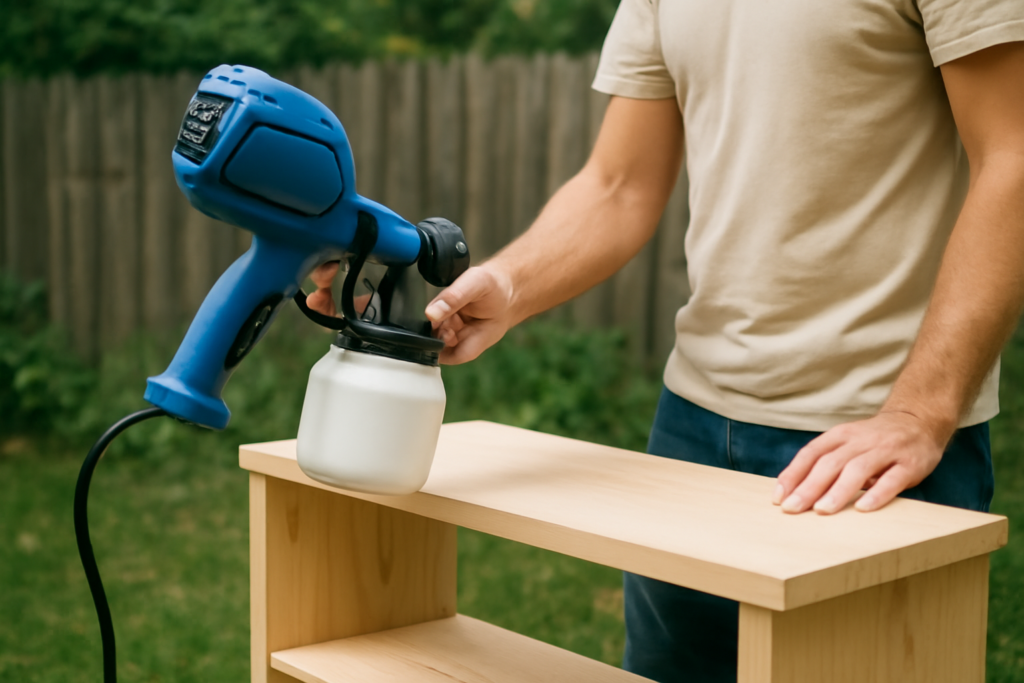
A paint sprayer turns a two-day brush-and-roller slog into an afternoon, but the pro-grade units cost more than the paint itself. The good news is that the best budget paint sprayer now delivers a genuinely smooth finish for under $200, enough to handle furniture, cabinets, fences, and even full rooms. This guide explains the two main sprayer types, names the models worth buying, and shares the technique tricks that prevent the runs and overspray beginners dread.
Part of our Paint & Walls guide — explore the full guide →
- Top Picks: Budget Paint Sprayers
- 1. HomeRight Finish Max C800766 HVLP Electric Paint Sprayer, Brass Tip, 3 Spray Patterns: Best Overall
- 2. Wagner Spraytech Control Spray Max Corded HVLP Paint Sprayer, 0518080: Best for Cabinets and Fine Finishes
- 3. Wagner Spraytech FLEXiO 1500 HVLP Paint and Stain Sprayer, iSpray Nozzle: Best for Walls and Fences
- 4. Graco Magnum 257025 Project Painter Plus Airless Paint Sprayer: Best Budget Airless
- 5. Wagner Spraytech Control Pro 130 HEA Power Tank Airless Paint and Stain Sprayer: Best Low-Overspray Airless
- HVLP vs. Airless: Which Budget Type Fits Your Project
- Top Budget HVLP Picks
- Budget Airless Sprayers for Big Jobs
- Key Features to Compare Before Buying
- Technique: How to Get a Pro Finish on a Budget
- Masking, Cleanup, and Safety
- Best Projects for a Budget Sprayer
- Common Mistakes Beginners Make
Top Picks: Budget Paint Sprayers
The picks are entry-level HVLP and airless sprayers from established brands, with each listing checked for spray type, adjustability, what paints it handles unthinned, cup or hopper size, and warranty. These picks are based on published Amazon listings, not hands-on tests.
| Product | Best for | Type | |
|---|---|---|---|
| 1. HomeRight Finish Max C800766 | Best Overall | Handheld HVLP | Check price |
| 2. Wagner Control Spray Max | Best for Cabinets and Fine Finishes | Stationary HVLP | Check price |
| 3. Wagner FLEXiO 1500 | Best for Walls and Fences | Handheld HVLP | Check price |
| 4. Graco Magnum Project Painter Plus | Best Budget Airless | Airless | Check price |
| 5. Wagner Control Pro 130 | Best Low-Overspray Airless | Airless (HEA) | Check price |
1. HomeRight Finish Max C800766 HVLP Electric Paint Sprayer, Brass Tip, 3 Spray Patterns: Best Overall

For a dresser, a set of cabinet doors or trim, a small handheld HVLP is the sensible first sprayer, and the Finish Max is the simple, light option named above. It holds the paint in a cup on the gun, which is ideal for furniture-sized jobs.
HomeRight lists a 2 mm precision brass tip, an air cap that turns for horizontal, vertical and round patterns, and a flow control knob. It is rated for thinned chalk-type paint, milk paint, latex, enamels, primers, clear sealer, polyurethane, stain and varnish, and it ships with a viscosity cup for measuring thinning. The warranty is 2 years.
It has a single nozzle size, so you control finish through thinning and flow rather than tip changes. The cup on the gun needs frequent refills on big surfaces, and the listing gives no cup volume or hose length.
| Model | C800766 |
|---|---|
| Type | Handheld HVLP |
| Tip | 2 mm brass |
| Patterns | Horizontal, vertical, round |
| Extras | Viscosity cup |
| Warranty | 2-year limited |
Why It Stands Out
- Brass tip rather than plastic
- Wide range of finishes listed
- Viscosity cup included
Pros and Cons
Pros
- Strongest sales rank of the picks
- Longest warranty of the picks
Cons
- One nozzle size only
- Cup size not listed
- Latex needs thinning
2. Wagner Spraytech Control Spray Max Corded HVLP Paint Sprayer, 0518080: Best for Cabinets and Fine Finishes

When the finish quality on cabinets, doors and furniture matters most, a stationary HVLP with a separate turbine beats a handheld unit. The Control Spray Max keeps the motor on the floor and puts only a light gun in your hand, which also cuts fatigue over a long session.
Wagner lists a two-stage turbine, a pressure control dial plus a material flow adjuster, and an air cap that turns for round, horizontal or vertical spray. A 20 foot hose links the base and gun, and it comes with a 1.5 quart cup and a metal 1 quart cup. Wagner says it handles thinned latex, stains and poly.
Latex must be thinned, so it is slower on full walls than an airless unit. The warranty is 1 year, and the listing’s sales rank is weak, so check availability before you plan the project around it.
| Model | 0518080 |
|---|---|
| Type | Stationary HVLP, two-stage turbine |
| Hose | 20 ft. |
| Cups | 1.5 qt. and metal 1 qt. |
| Controls | Pressure dial and flow adjuster |
| Warranty | 1 year |
Why It Stands Out
- Separate pressure and flow controls
- Long hose keeps the turbine out of the way
- Two cups included
Pros and Cons
Pros
- Fine HVLP finish for trim and furniture
- Lighter gun than an all-in-one handheld
Cons
- Latex must be thinned
- Weak sales rank
- 1-year warranty
3. Wagner Spraytech FLEXiO 1500 HVLP Paint and Stain Sprayer, iSpray Nozzle: Best for Walls and Fences

Most handheld HVLP sprayers need latex thinned, which slows larger jobs. The FLEXiO 1500 is Wagner’s current entry FLEXiO, built to push heavier material, which makes it the better HVLP pick for an accent wall, a shed or a fence.
Wagner says its single-speed X-Boost turbine sprays unthinned paints and solid stains, and the iSpray nozzle is tuned for broad surfaces like walls, sheds and fences. The maker claims it sprays 7 times faster than a brush, covering an 8 by 10 foot wall in 5 minutes, and that it is 20 percent lighter than earlier FLEXiO models.
The iSpray nozzle favors broad surfaces, so it is less suited to fine furniture work than the two picks above. The listing gives no warranty, cup size or hose details, and the speed figures are the maker’s own claims.
| Model | 2476838 |
|---|---|
| Type | Handheld HVLP |
| Turbine | Single-speed X-Boost |
| Nozzle | iSpray |
| Best for | Small to medium interior and exterior jobs |
Why It Stands Out
- Sprays unthinned paint per Wagner
- Lighter than older FLEXiO units
- Good fit for walls and fences
Pros and Cons
Pros
- Saves thinning time
- Good sales rank
Cons
- Not aimed at fine furniture finishes
- No warranty or cup size listed
- Speed claims are the maker's
4. Graco Magnum 257025 Project Painter Plus Airless Paint Sprayer: Best Budget Airless
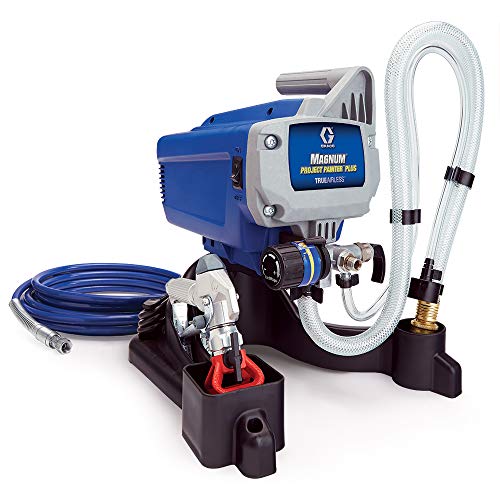
For fences, decks, siding or several rooms of walls, an airless sprayer lays down paint far faster than HVLP. The Project Painter Plus is Graco’s entry Magnum model, a step below the X5 named above and aimed at the same weekend DIY jobs.
Graco lists fully adjustable pressure for spraying unthinned paint or stain, and a flexible suction tube that draws straight from a 1 or 5 gallon bucket. It supports up to 50 feet of hose for reaching peaks or second stories, and Graco sizes it for projects up to 5 gallons. The warranty is 1 year limited.
Airless overspray drifts far, so plan to mask everything nearby and wear a respirator rated for paint. The listing does not give tip size or included hose length, and the 5 gallon project limit means it is not built for repeated whole-house jobs.
| Model | 257025 |
|---|---|
| Type | Airless |
| Feed | Suction tube from 1 or 5 gal. bucket |
| Max hose | 50 ft. |
| Project size | Up to 5 gal. |
| Warranty | 1-year limited |
Why It Stands Out
- No thinning needed
- Draws directly from the can
- Adjustable pressure
Pros and Cons
Pros
- Fast coverage for big surfaces
- Graco build at an entry level
Cons
- Heavy masking needed
- Tip size not listed
- Sized for occasional projects
5. Wagner Spraytech Control Pro 130 HEA Power Tank Airless Paint and Stain Sprayer: Best Low-Overspray Airless

If an airless sprayer’s overspray worries you, Wagner’s high efficiency airless design runs at lower pressure for a softer spray. The Control Pro 130 is the low-pressure option named above, a middle ground for siding, decks and large interior walls.
Wagner says HEA technology cuts overspray by up to 55 percent compared with traditional airless units and sprays unthinned paints and stains. It is a stationary Power Tank unit with a 1.5 gallon hopper, gravity fed for easy priming and cleaning, and a 25 foot hose. Wagner claims it applies coatings 3 times faster than a roller.
The hopper holds 1.5 gallons, so you refill it rather than drawing from a 5 gallon bucket. The listing gives no warranty or tip size, and the overspray reduction is the maker’s own figure, so masking is still needed.
| Model | 2435698 |
|---|---|
| Type | HEA airless, stationary |
| Hopper | 1.5 gal., gravity fed |
| Hose | 25 ft. |
| Gun | T2 gun |
Why It Stands Out
- Less overspray than standard airless per Wagner
- Unthinned paint and stain
- Gravity-fed priming and cleanup
Pros and Cons
Pros
- Softer spray is easier for beginners
- Long hose
Cons
- Hopper needs refilling on big jobs
- No warranty or tip size listed
Facts below come from Amazon listings as of October 2026 and can change, so check the listing and the included tips before buying.
HVLP vs. Airless: Which Budget Type Fits Your Project
Budget sprayers fall into two camps. HVLP (high volume, low pressure) units atomize paint with a turbine fan, producing a soft, controllable spray with minimal overspray. They excel at detail work, cabinets, trim, furniture, and doors, where finish quality matters most.
Airless sprayers force paint through a tip under high pressure, laying down a lot of material fast. They are the choice for big exterior jobs, fences, decks, siding, and full interior walls. Airless models create more overspray and need more masking, but they chew through gallons in minutes. For most homeowners doing furniture and trim, HVLP is the smarter budget buy; for fence-and-deck warriors, a budget airless wins.
Top Budget HVLP Picks
These handheld HVLP sprayers consistently earn praise for finish quality at low prices:
- Wagner Control Spray Max: A turbine-based HVLP with a long hose, adjustable flow, and three spray patterns. The fine finish makes it a favorite for cabinets and furniture.
- HomeRight Finish Max: The budget bestseller. Light, simple, and great for small projects, though thicker paints need thinning; use the included viscosity cup to check consistency.
- Wagner FLEXiO 1500: Wagner’s current entry FLEXiO, built to push heavier material, making it the best of the three for walls, sheds and fences.
The honest caveat: handheld HVLP units hold paint in a cup that grows heavy and needs frequent refilling on large jobs. For a single dresser or a set of kitchen cabinets, they are perfect. For a whole house exterior, they will exhaust your patience.
Budget Airless Sprayers for Big Jobs
When you need to coat fast, a budget airless sprayer earns its keep. The Graco Magnum X5 sits just above true budget territory but pays for itself on a single fence-and-deck weekend. For tighter budgets, the Wagner Control Pro 130 runs at lower pressure, reducing overspray, and is gravity fed from a 1.5-gallon hopper.
Airless units demand more setup, priming the pump, masking everything within 10 feet, and flushing thoroughly afterward, but they apply paint two to three times faster than HVLP. If your project list includes siding, fences, or multiple rooms of walls, the time savings justify the extra cost and cleanup.
Key Features to Compare Before Buying
Price is not the only number that matters. Weigh these specs against your projects:
- Adjustable pressure/flow: Lets you dial in coverage and minimize runs. Non-negotiable for a clean finish.
- Multiple spray patterns: Horizontal, vertical, and round patterns adapt to different surfaces.
- Tip size: Smaller tips (0.011 to 0.013) suit stains and thin paints; larger tips (0.015+) handle thick latex.
- Hose length: A longer hose means less moving the unit, important for airless models fed from a bucket.
- Cleanup ease: Fewer parts and tool-free disassembly save 20 minutes after every session.
Technique: How to Get a Pro Finish on a Budget
Even the best budget paint sprayer leaves a mess if you skip technique. Thin latex paint 10 to 20 percent with water (check the manual) so it atomizes cleanly through small tips. Hold the gun 6 to 10 inches from the surface, keep it perpendicular, and move at a steady walking pace, roughly one foot per second.
Overlap each pass by 50 percent and trigger the gun just before the stroke starts and release just after it ends, the so-called “feathering” that prevents heavy edges. Always do a test pass on cardboard to confirm pattern and flow before hitting your actual project. Two thin coats beat one thick coat every time, and they dry faster with no sags.
Masking, Cleanup, and Safety
Overspray drifts farther than beginners expect, especially with airless units, so mask generously. Cover floors with drop cloths, tape plastic over windows and fixtures, and work in a well-ventilated space or outdoors. A respirator rated for paint fumes (not just a dust mask) protects your lungs from atomized solvents.
Cleanup is where cheap sprayers punish neglect. Flush water-based paint immediately with warm soapy water until it runs clear, then run clean water through the nozzle. Dried paint inside the tip or filter is the number one killer of budget sprayers. Clean it right after every use and even an inexpensive sprayer will last for years of projects.
Best Projects for a Budget Sprayer
Knowing where a budget sprayer shines helps you set expectations. Furniture refinishing is the sweet spot, dressers, nightstands, and chairs get a factory-smooth finish that brushing can never match, and the small surface area suits a handheld HVLP cup perfectly. Kitchen and bathroom cabinets are another ideal job, since the flat doors and frames show every brush mark, and a sprayer eliminates them.
Larger jobs like interior walls, fences, decks, and shutters are doable but demand more masking and patience. For a single accent wall or a small room, even a budget handheld HVLP works fine. For a whole exterior, lean toward a budget airless. Match the tool to the job and you avoid the frustration of a tiny cup running dry mid-wall.
Common Mistakes Beginners Make
A few avoidable errors trip up first-timers. Spraying paint too thick, without thinning, leads to clogged tips and an orange-peel texture; always thin latex to the manufacturer’s spec. Holding the gun too close or moving too slowly causes runs and sags, while moving too fast leaves thin, streaky coverage. The fix is a steady, consistent pace at the right distance.
Another classic mistake is “arcing” the wrist, swinging the gun in an arc rather than moving your whole arm parallel to the surface. Arcing leaves the center of each pass heavier than the edges. Keep the gun perpendicular and travel in straight, parallel lines. Practice these basics on scrap cardboard for ten minutes before your real project, and even the cheapest sprayer will reward you with a clean, professional finish.