A thin black outline on the wall does more work than almost any other single item in a small bathroom. A black bathroom mirror draws a crisp line around the brightest surface in the room, frames your face at the sink, and ties together faucets, lights and hardware in one move. Picked carelessly, though, the same frame can look like a heavy box floating over the vanity or clash with a mix of chrome and brushed nickel that was already there.
Part of our Bathroom Remodeling & Flooring guide — explore the full guide →
The short answer for most homes: choose a frame between 1/2 inch and 1-1/2 inches wide, size the mirror a few inches narrower than the vanity top, repeat the black finish in at least two other places (faucet, light, cabinet pulls or a towel bar), and choose round for softness or rectangular for storage-heavy, linear layouts. The rest comes down to scale, wall color and how much natural light the room gets.
- Choosing a Black Bathroom Mirror That Fits the Vanity
- Round vs Rectangular in Black
- Pairing a Black Frame With Faucets, Lights and Hardware
- When Black Reads Too Heavy
- Frame Materials and Moisture
- Tools and Materials for Hanging
- Hanging Steps
- Safety Notes for Heavy Frames
- Troubleshooting Common Problems
- Cost Ranges
- When to Call a Pro
- Frequently Asked Questions
Choosing a Black Bathroom Mirror That Fits the Vanity
Start with width, because that is where most mistakes happen when shopping for a black bathroom mirror. A mirror that matches the vanity edge to edge tends to look crowded once a light fixture or sconces go in, and one that is too narrow looks like an afterthought. A reliable rule is to keep the mirror 2 to 6 inches narrower than the vanity top on a single-sink cabinet, centered over the faucet rather than the cabinet if the two are not aligned.
For common vanity sizes, these ranges work well:
- 24-inch vanity: 18 to 22 inches wide, or a 20 to 22 inch round
- 30-inch vanity: 24 to 26 inches wide; a 24 inch round is a safe pick, and a 30 inch black round mirror only works if there is open wall above and beside it
- 36-inch vanity: 28 to 32 inches wide, or a 30 inch round with sconces flanking it
- 48-inch vanity and up: 36 to 44 inches wide, or two mirrors on a double vanity
Height follows the room. In a standard 8-foot bathroom, the top of the mirror usually lands around 70 to 76 inches off the floor, with the bottom edge 5 to 10 inches above the backsplash or faucet spout. That leaves room for a light bar above or keeps sconces at roughly eye height, around 66 inches, on either side.
Frame width deserves its own check. A 1/2 inch metal frame reads as a fine line and suits small powder rooms. A 1 to 1-1/2 inch frame, often in wood or thicker metal, holds its own over a 36 inch or larger vanity. Frames wider than 2 inches look dramatic and work best in large rooms with plenty of white or light tile around them.
Round vs Rectangular in Black
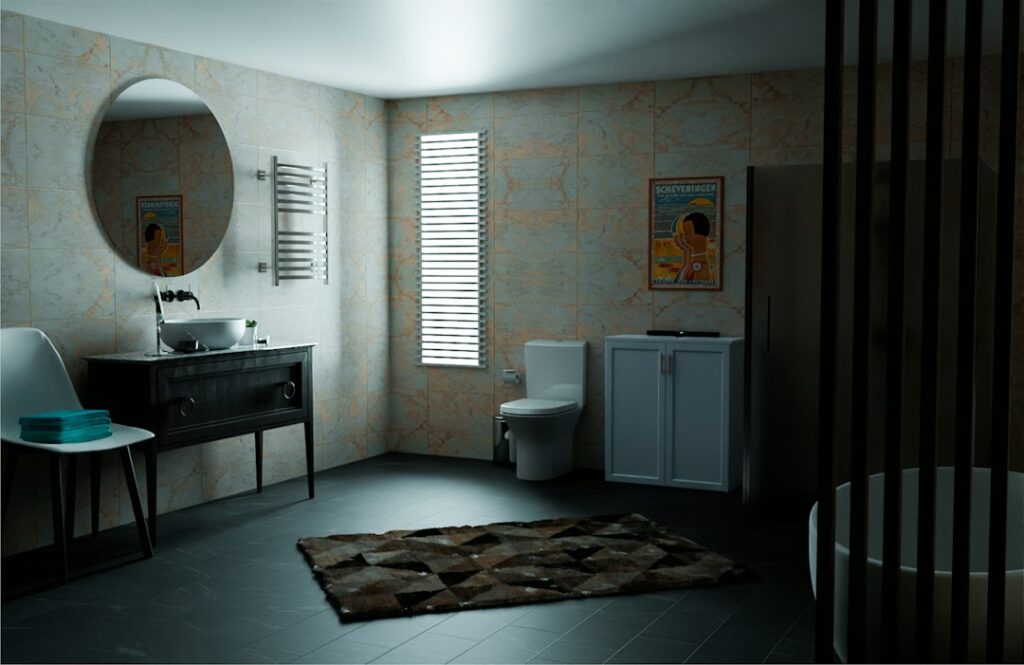
Shape changes the whole mood. Black round mirrors soften a room full of hard lines: square tile, a boxy vanity, a rectangular tub. They are forgiving on placement because a circle does not have to line up with grout joints or cabinet doors, and they leave pockets of wall on each side for sconces. The tradeoff is less usable reflection near the edges, which matters if two people share the mirror or if you need a full view for shaving or makeup.
Rectangular frames give the most reflective area per inch of wall and line up neatly with vanity edges, tile courses and light bars. They suit modern, farmhouse and industrial styles equally well. Hang them vertically over a narrow vanity to add height, or horizontally over a long one to stretch the room.
A few other shapes come up often:
- Arched or pill-shaped: a rectangle with rounded tops. Softer than a rectangle, more reflective area than a round. A strong middle ground.
- Oval: tall and slim, good for narrow walls between a window and a shower.
- Rounded-corner rectangle: keeps the clean edge alignment of a rectangle while softening the corners slightly.
- Irregular or organic: fun in a powder room, harder to center over a faucet.
Pairing a Black Frame With Faucets, Lights and Hardware
Black needs echoes. A black framed bathroom mirror is rarely the only dark element a room needs. One black object in an otherwise chrome bathroom looks like a mistake, while three or four black touches look intentional. The easiest pairing is a matte black faucet with the mirror frame, then black in a light fixture or sconce arms, then cabinet pulls or a towel bar. You do not need every finish to match. Keeping the faucet and shower trim in one finish and letting the mirror carry black alone can work, as long as something else in the room (a light, a shelf bracket, a window frame) repeats it.
Match sheen where you can. Most black fixtures are matte or satin. A glossy black frame next to a matte faucet looks slightly off, especially under bright light. If you cannot find an exact match, go flatter rather than shinier.
Mixing with warm metals is popular and works well: a black frame with brushed brass sconces, or a black vanity mirror with gold faucet handles. Limit the mix to two metal finishes, three at most if one is very small (like a drain cover).
Wood pairs naturally with black. A walnut or white oak vanity under a black frame looks warm and grounded. A black frame over a black vanity can work too, but give it relief with a white or light countertop and light wall tile, otherwise the lower half of the wall becomes one dark mass.
When Black Reads Too Heavy
Black is a strong color, and a few conditions make it overwhelming:
- Small, windowless rooms with dark tile or dark paint. A thick black frame here shrinks the space. Use a thin 1/2 inch frame or step down to a dark bronze.
- Dark walls behind the mirror. A black frame on charcoal or navy disappears at the edges and loses its outline. Either embrace that tonal look on purpose or add contrast with a lighter wall color.
- Too many black elements. Frame, vanity, floor tile, faucet, lights and towels all in black turns the room into a cave. Pick three or four.
- Wide frames on narrow vanities. A 2 inch frame on a 24 inch mirror leaves very little glass. Scale the frame to the mirror size.
If you are unsure, tape the mirror outline on the wall with painter’s tape, including the frame width, and live with it for a day. Black tape is a cheap preview of how the line will read in the room.
Frame Materials and Moisture
Bathrooms are humid, so the material behind a black mirror frame matters more than in a hallway. Powder-coated aluminum or steel frames hold up best: they resist peeling and do not swell. Painted solid wood is attractive but needs a sealed finish on all sides, including the back, and should not sit right next to a shower. MDF frames with a painted or wrapped finish are inexpensive but can swell at the corners if steam reaches them regularly.
Look for mirrors with a sealed or copper-free silver backing; edges that are not sealed can develop dark “black edge” corrosion over time in steamy rooms. Whatever the frame, a good exhaust fan running 15 to 20 minutes after each shower protects any frame and keeps the glass from fogging.
Tools and Materials for Hanging
Most framed mirrors in the 24 to 36 inch range weigh 15 to 40 pounds. Larger or wood-framed pieces can go heavier. Gather:
- Stud finder and a 4-foot or 2-foot level
- Tape measure and pencil
- Drill with bits sized for your fasteners
- Screws long enough to reach 1 to 1-1/4 inches into studs, or heavy-duty drywall anchors rated well above the mirror weight
- The hanging hardware supplied with the mirror (D-rings, French cleat or keyhole brackets)
- Painter’s tape and a helper
Hanging Steps
- Weigh the mirror on a bathroom scale (step on holding it, subtract your weight) and note the hanger type on the back.
- Mark the vanity centerline, or the faucet centerline if different, on the wall.
- Decide the bottom edge height, then measure from the bottom of the frame to the hanging point on the back and mark that height on the wall.
- Locate studs. If a stud falls near your mark, use it. If not, use anchors rated for at least twice the mirror’s weight per pair, or install a French cleat that spans to a stud.
- Check the wall for hidden plumbing or wiring before drilling: stay away from the area directly above the faucet supply lines and around any existing light box.
- Drill, set the fasteners, and level them with each other before hanging.
- Hang the mirror with a helper, check level, and add small clear bumpers to the lower corners to keep it from shifting or marking the wall.
Safety Notes for Heavy Frames
A mirror that falls in a bathroom lands on porcelain, tile and bare feet, so anchoring is not the place to save a few minutes. Fasten into framing whenever possible, and never rely on a single nail or a picture hook for anything over about 10 pounds. Two-point hanging (two D-rings or a cleat) is far more stable than a single wire. In older homes with plaster walls, drill slowly to avoid cracking, and use anchors made for plaster.
If you plan to move or add a light fixture as part of the mirror project, turn off the breaker and confirm power is off with a non-contact voltage tester before touching any wiring, and never work on wiring that is still powered. Adding a new outlet or circuit for a lighted mirror is a job for a licensed electrician, and any bathroom outlet must be GFCI protected.
Troubleshooting Common Problems
- Mirror tilts forward at the top: the hanging point is too low on the back, or the wire is loose. Switch to D-rings or a cleat and add bumpers at the bottom.
- Frame looks crooked against tile lines: level the mirror to the tile grout, not the bubble, if the tile itself is slightly off. Your eye will compare it to the tile.
- Black finish shows water spots: wipe with a soft cloth and diluted mild dish soap; avoid abrasive pads and acidic cleaners that can dull matte powder coat.
- Corners of the glass darkening: moisture is reaching the silver backing. Improve ventilation and seal edges with a mirror-safe edge sealer.
Cost Ranges
A basic metal-framed black mirror in the 24 to 30 inch range typically runs in the low to mid double digits. Larger, thicker or solid wood frames move into the low hundreds, and lighted or custom-sized pieces can cost several hundred dollars or more. Hanging hardware and anchors are inexpensive. A handyman will usually hang a standard mirror for a modest service-call fee, while adding wiring for a lighted mirror adds an electrician’s visit to the budget.
When to Call a Pro
Bring in help if the mirror weighs more than about 50 pounds, if no studs fall where you need them on tile or plaster, or if the mirror spans a wide wall and needs a custom cleat. Any new electrical work for a lighted mirror or relocated sconces belongs with a licensed electrician, who will handle permits where required. For everything else, a careful afternoon with a level and a helper gets a black frame hung straight and secure.
Frequently Asked Questions
What size black bathroom mirror should go over a 30 inch vanity?
A mirror 24 to 26 inches wide fits most 30 inch vanities. That leaves a few inches of wall on each side so the vanity still reads as the wider base, and it gives room for sconces if you want them.
Should my faucet match a black mirror frame?
It helps but is not required. The frame needs at least two or three other black touches in the room, such as a faucet, light fixture, towel bar or cabinet pulls, so it looks planned rather than random.
Is a round or rectangular black mirror better for a small bathroom?
Round softens a tight room and is easier to place, while a rectangle gives more reflective area. In a very small powder room, a slim round frame usually looks lighter; in a busy family bath, a rectangle is more practical.
Do black frames hold up in steamy bathrooms?
Powder-coated metal frames hold up best. Painted wood and MDF frames can swell or peel near a shower, so run the exhaust fan after each use and keep wood frames away from direct steam.
Can I mix a black mirror with brass or gold fixtures?
Yes. Black and warm brass is a classic pairing. Keep the mix to two finishes, and repeat each one at least twice in the room so the combination looks deliberate.