Two sinks raise a question a single vanity never asks: should the wall get one long sheet of glass or a pair of matching mirrors? The right double vanity mirror setup depends less on taste than on where the faucets sit, how much wall you have above the counter, and where the light fixtures need to go. Get those three things straight and either option can look great.
Part of our Bathroom Remodeling & Flooring guide — explore the full guide →
Here is the quick version. Choose two separate mirrors when the faucets are 30 inches or more apart, when you want sconces between or beside each sink, or when the vanity is 60 inches or wider. Choose one large mirror when the vanity is 60 inches or less, the sinks are close together, the room is small and needs the extra reflected light, or you plan a single long light bar across the top. Both work on a 60 to 72 inch vanity, so at that size the decision comes down to lighting and style.
Double Vanity Mirror Options Compared
Each layout solves a different problem, so it helps to see the tradeoffs side by side.
| Factor | One large mirror | Two separate mirrors |
|---|---|---|
| Best vanity width | 48 to 72 inches | 60 inches and up |
| Reflected light | Maximum | Good, slightly less |
| Lighting layout | One long bar or sconces at the ends | A fixture over each, or sconces between |
| Alignment with faucets | Forgiving | Must center on each faucet |
| Style | Clean, open, traditional or modern | Defined zones, more decorative |
A single wide mirror makes a small bathroom feel larger and bounces more daylight around. It also hides small misalignments, because nobody can tell if one faucet sits an inch off center under a 60 inch sheet of glass. The downside is weight and handling: a large frameless mirror is heavy, awkward to carry and usually needs two or three people to set.
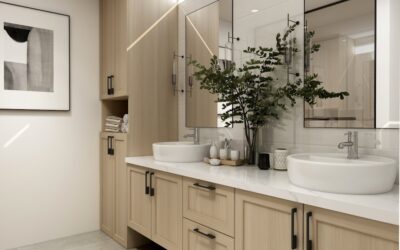
Two mirrors give each person a defined space and open up the wall between them for a sconce, a shelf or a medicine cabinet. They also let you use shapes a single mirror cannot, like a pair of round vanity mirrors or arched frames. The tradeoff is precision. Each mirror must be centered over its own faucet, and the gap between them must look intentional.
Measuring and Spacing Over Each Sink
Before choosing anything, measure three numbers: the overall vanity width, the distance from the left wall or vanity edge to each faucet centerline, and the distance between the two faucet centerlines. Faucet spacing on most double vanities falls between 30 and 40 inches.
For two mirrors, size each so that:
- Each mirror is centered on its faucet, not on half the cabinet.
- Each mirror is narrower than its sink basin zone, typically 20 to 30 inches wide.
- The gap between mirrors is at least 4 to 6 inches, or wide enough for a sconce (usually 10 to 16 inches total if a fixture goes there).
- The outer edges stop at least 2 to 4 inches inside the vanity ends, so the vanity still frames the mirrors.
For one mirror, a simple guide is to make it 4 to 8 inches narrower than the vanity top, centered on the vanity. On a 60 inch vanity that means a 52 to 56 inch mirror. On a 72 inch vanity, 64 to 68 inches. Run the mirror the full vanity width only when it sits between two side walls and you want a wall-to-wall built-in look.
Height
Set the bottom edge 5 to 10 inches above the countertop or backsplash, high enough to clear the faucet spout. The top usually lands between 70 and 78 inches off the floor in an 8-foot room. Taller mirrors suit taller households; if heights in the home vary a lot, a tall mirror works better than a short one hung at a compromise height.
Centering on Faucets When the Plumbing Is Off
Plumbing does not always land where it should. If one faucet is a couple of inches off center from its basin, or the two faucets are not symmetrical on the cabinet, two separate mirrors will make that obvious. Center each mirror on its faucet, since that is where people stand and what the eye compares the mirror to. If the offset is large (more than 2 inches), a single wide mirror hides it better.
Off-center vanities, such as one tucked against a side wall, also favor a single mirror centered on the vanity itself. If the vanity is centered but one wall has a door or window that crowds the side, two mirrors can be nudged a little inward as long as each still lines up reasonably with its faucet.
Lighting Placement With Each Layout
Lighting is often the deciding factor. Side lighting at face height gives the most flattering, shadow-free light, while a fixture above the mirror is simpler to wire and works when wall space is tight.
- One mirror, one long bar: a light bar 36 to 48 inches long mounted 75 to 80 inches off the floor, centered over the mirror. Simple, but can cast shadows under the eyes.
- One mirror, end sconces: a sconce at each outer edge about 60 to 66 inches off the floor. Good for a 60 inch vanity; on longer vanities, the center of the mirror can feel dim.
- Two mirrors, fixture over each: an 18 to 24 inch light centered over each mirror. Easy to balance and matches each sink.
- Two mirrors, three sconces: one at each end and one between the mirrors. The most even light and the best for grooming.
Wiring locations are hard to move once tile goes up, so settle the mirror layout before the electrician roughs in boxes. If you are working with existing boxes, choose the mirror layout that fits them.
Style and Frame Choices
Matching finish to the vanity is the usual starting point. A white vanity with mirror frames in white or light wood looks soft and coastal. A wood vanity mirror frame over a painted cabinet adds warmth. Black or brushed metal frames echo faucets and lights.
Shapes to consider:
- Rectangular pairs: classic and the most usable reflection.
- Round pairs: soften a long run of cabinetry; leave enough wall around them so they do not look cramped.
- Arched or pill shapes: a current favorite with defined zones and a soft top line.
- Single frameless mirror with polished or beveled edge: timeless and suits nearly any style.
Medicine cabinets are another route. Two recessed cabinets with mirrored doors give each person storage plus a mirror, though they require open stud bays with no plumbing or wiring inside.
Hanging Steps and Safety
- Mark the vanity centerline and both faucet centerlines on the wall.
- Mark the bottom edge height, then transfer the hanging point height from the back of each mirror.
- Find studs. Fasten into framing whenever possible, and use heavy-duty anchors rated well above the mirror weight where studs do not line up.
- For large frameless glass, use mirror clips or a J-channel along the bottom with clips at the top, plus mirror mastic only if the wall is suitable.
- Hang one mirror, check level and measurements, then hang the second using the first as a reference.
Large mirrors are heavy and sharp at the edges. Carry them vertically with two people, wear gloves, and never flex the glass. Before drilling, check for pipes and wires behind the wall, especially above supply lines. If moving or adding light fixtures, turn off the breaker and confirm power is off with a non-contact voltage tester, and never work on wiring that is still powered. New circuits or boxes are work for a licensed electrician, and bathroom receptacles must be GFCI protected.
Troubleshooting
- Mirrors look uneven: measure from the countertop, not the floor, since floors and counters are rarely perfectly parallel.
- Gap between mirrors looks awkward: fill it with a sconce or a narrow shelf, or widen the mirrors slightly to tighten the gap.
- Glare from overhead lights: move to side sconces or use frosted shades.
- Mirror too heavy for anchors: add a French cleat screwed into two or more studs.
Cost Ranges
Framed mirrors for a double vanity run from the low double digits each for basic styles to several hundred dollars for solid wood or custom sizes. A custom-cut single frameless mirror is priced by size and edge work and often falls in the low to mid hundreds. Professional installation for a large frameless mirror usually costs a few hundred dollars, and moving light boxes adds electrician time.
When to Call a Pro
Call a glass company for any frameless mirror over about 40 inches wide, since they cut to size, handle the glass safely and install clips or channel properly. Any lighting changes should go to a licensed electrician. For framed mirrors under 30 pounds each, most homeowners can handle the job with a level, a stud finder and a second set of hands, and a well-placed double vanity mirror will make the whole bathroom feel finished.
Frequently Asked Questions
Should a 60 inch double vanity get one mirror or two?
Either works. One mirror about 52 to 56 inches wide maximizes light, while two mirrors around 22 to 24 inches wide each give separate zones. Let the lighting plan and faucet spacing decide.
How far apart should two vanity mirrors be?
Leave at least 4 to 6 inches between them. If a sconce goes between the mirrors, the gap usually needs to be 10 to 16 inches so the fixture has breathing room.
Should mirrors be centered on the sink or the cabinet?
Center each mirror on its faucet. People stand in front of the faucet, so that is the line the eye uses to judge whether a mirror looks straight.
Can I use round vanity mirrors over a double vanity?
Yes. A pair of round mirrors softens a long vanity. Size them so each is a bit narrower than its basin zone and leave enough wall around them so they do not look crowded.
What height should a double vanity mirror hang?
Set the bottom edge 5 to 10 inches above the counter or backsplash, which usually puts the top between 70 and 78 inches off the floor in a standard 8 foot bathroom.