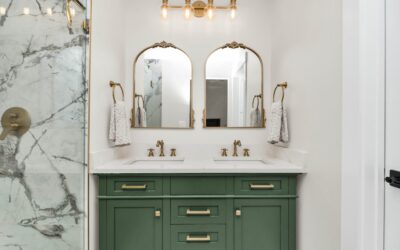
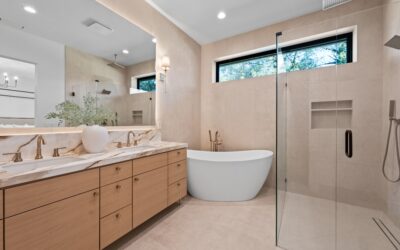
Two sinks mean two people getting ready at once, and nothing sabotages a beautiful bathroom faster than lighting that throws shadows across their faces. Double vanity lighting has to work harder than a single-sink setup, illuminating a wider surface evenly while flattering everyone who leans in for grooming. This guide covers the layouts that actually eliminate shadows, the mounting heights and spacing that professionals use, the bulb specs that render skin accurately, and design ideas that make a two-sink vanity look as good as it functions.
Part of our Bathroom Remodeling & Flooring guide — explore the full guide →
- Why Double Vanities Need a Different Approach
- The Best Layout Options
- Ideal Mounting Heights and Spacing
- Bulb Specs That Flatter
- Design Ideas for a Polished Look
- Layering With Other Light Sources
- Common Mistakes to Avoid
- Matching the Fixture Scale to the Vanity
- Wiring and Switching a Double Vanity
- Coordinating Lighting With Mirrors and Storage
Why Double Vanities Need a Different Approach
A single vanity light centered over one mirror is straightforward. Stretch that same idea across a 60- or 72-inch double vanity and a single central fixture leaves the outer edges dim and casts unflattering shadows under the eyes and chin. The width is the challenge, because light must reach both stations evenly.
The goal of good vanity lighting is cross-illumination, light coming from both sides of the face rather than only above. Overhead-only lighting creates raccoon-eye shadows, which is exactly the effect you are trying to avoid when applying makeup or shaving. Solving that across two sinks drives every layout decision.
The Best Layout Options
Several proven layouts light a double vanity well, and the right one depends on your mirror configuration and wall space.
- Sconces flanking each mirror: the gold standard. A pair of sconces on either side of each sink station puts light directly on both sides of the face, eliminating shadows. This works best with two separate mirrors.
- A pair of vanity bars, one over each sink: two matching horizontal fixtures, each centered over its own sink, spread light evenly across the full vanity.
- One long linear fixture: a single continuous bar spanning the whole vanity gives a clean modern look and even wash, though it lacks the side-lighting benefit of sconces.
- Sconces plus overhead: combining flanking sconces with recessed or a central fixture layers the light for the most flattering, shadow-free result.
If you can swing it, side sconces at each station deliver the most flattering face lighting, which is why hotels and salons rely on them.
Ideal Mounting Heights and Spacing
Precise placement is what makes the difference between a vanity that flatters and one that casts shadows. Follow these professional guidelines as your starting point.
- Side sconces: mount at roughly eye level, about 60 to 66 inches from the floor to center, and space them 28 to 40 inches apart to bracket the face.
- Fixtures above the mirror: mount the bottom of the fixture about 75 to 80 inches from the floor, or 3 to 6 inches above the top of the mirror.
- Two bars over sinks: center each fixture over its sink basin, not over the gap between them.
- Linear fixture width: a top-mounted bar looks best at roughly two-thirds to three-quarters the width of the vanity or mirror.
Adjust for the heights of the people using the space, but these numbers give a reliable, shadow-minimizing baseline.
Bulb Specs That Flatter
Even a perfect layout falls flat with the wrong bulbs, so pay attention to color temperature, brightness, and color rendering. For a bathroom, aim for a color temperature between 2700K and 3000K for a warm, inviting tone, or up to 3500K for a slightly crisper light that some prefer for detailed grooming. Avoid cold, bluish bulbs above 4000K, which make skin look washed out.
Brightness matters too. Target roughly 1,600 to 2,000 lumens total across the vanity for comfortable task light. Most important, choose bulbs with a high color rendering index, ideally CRI 90 or above, so makeup colors and skin tones look true. A high-CRI, warm-white bulb is the single biggest factor in whether the mirror shows you an accurate reflection.
Design Ideas for a Polished Look
Beyond function, double vanity lighting is a major style element in the bathroom. Match the fixture finish to your faucets and hardware for a cohesive look, whether that is brushed brass, matte black, polished nickel, or chrome. Symmetry reads as intentional, so mirror the fixtures on each side and center everything carefully.
Consider the mirror choice alongside the lights. Two separate framed mirrors pair naturally with flanking sconces, while a single large mirror suits a pair of top-mounted bars or a linear fixture. For a designer touch, add a dimmer so you can dial the light down for a relaxing bath and up for morning grooming, giving the room two moods from one fixture.
Layering With Other Light Sources
The best bathrooms never rely on the vanity fixtures alone. Layer in ambient and task lighting for a space that works at every hour. Recessed ceiling lights provide general illumination, a fixture or recessed light over the shower brightens that corner, and the vanity lights handle the critical grooming task.
Putting these on separate switches or dimmers gives you flexibility, so you can flood the room in the morning and drop to a soft glow at night. This layered approach also means the vanity lights are not straining to light the entire room, letting them focus on the faces where accuracy matters most.
Common Mistakes to Avoid
A few missteps show up again and again in double vanities. Do not rely on a single central fixture for a wide two-sink vanity, since it leaves the outer edges dim. Avoid mounting sconces too high, which recreates the overhead-shadow problem you were trying to solve. Steer clear of cold, low-CRI bulbs that distort skin tones. And do not forget a dimmer, which turns a functional fixture into a versatile one.
Get the layout, height, and bulbs right, and a double vanity becomes a genuinely pleasant place to start and end the day, with even, flattering light at both stations and no fighting over the one good mirror.
Matching the Fixture Scale to the Vanity
Proportion is a detail that separates a professionally designed vanity from a builder-grade one, and it is easy to get wrong on a wide double vanity. A single fixture that is too small looks stranded above an expansive counter, while an oversized fixture overwhelms the mirror. For a top-mounted linear light, aim for a fixture roughly two-thirds to three-quarters the width of the mirror or vanity below it.
When you use two separate fixtures, one over each sink, keep them identical and center each precisely over its basin so the symmetry reads as deliberate. For flanking sconces, choose a scale that suits the wall space between and beside the mirrors, favoring slim vertical fixtures on a narrow wall and fuller shapes where you have room. Bring the mirror dimensions and vanity width with you when shopping, and resist the temptation to size down to save money, since an undersized fixture is the most common reason a nice vanity still looks unfinished.
Wiring and Switching a Double Vanity
Two stations often benefit from more than one switch, giving each person control over their own light. During a remodel, plan whether the vanity lights share a single switch or split so each side operates independently, which is a thoughtful touch in a shared primary bathroom. Either way, put the vanity lighting on a dimmer so you can drop the brightness for a relaxing evening and raise it for detailed morning grooming.
If you are adding sconces where none existed, you will need to run a switched circuit to each sconce location and cut in the boxes at the correct height. This is straightforward in new construction but means opening the wall in a finished bathroom. Always shut off the breaker and verify with a tester before working, and confirm the boxes are rated for the fixture weight. For anyone uncomfortable running new circuits, an electrician typically charges $150 to $400 to add and wire a pair of vanity sconces, well worth it for the flattering side light they provide.
Coordinating Lighting With Mirrors and Storage
Vanity lighting never exists in isolation, so plan it alongside the mirrors and any medicine cabinets. Two separate framed mirrors pair naturally with sconces mounted on the wall between and outside them, while a single wide mirror suits top-mounted bars or a linear fixture. If you want mirrored storage, consider surface-mount medicine cabinets with integrated LED lighting, which combine storage and flattering illumination in one unit and free up wall space.
Think about how the light interacts with the mirror finish and the wall color, since a dark accent wall absorbs light and may call for higher lumen output, while a bright white wall bounces light and can get away with less. Coordinating the fixture finish with the faucets, drawer pulls, and mirror frames ties the entire vanity together into a cohesive, considered space rather than a collection of unrelated parts.