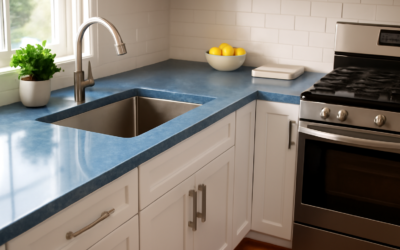
Color is having a moment in kitchen design, and few choices make a bolder, more affordable statement than blue laminate countertops. Once dismissed as dated, laminate has been reinvented with stone-look patterns, matte finishes, and rich saturated colors that let you add personality without the $4,000 price tag of a stone slab. Blue in particular, from soft powder to deep navy, brings a calm, coastal, or retro character depending on the shade. This guide covers the best blue tones, realistic pricing, leading brands, and how to design and care for a laminate counter that lasts.
Part of our Countertops guide — explore the full guide →
Why Choose Blue Laminate Countertops
Laminate is built from layers of kraft paper and a printed decorative sheet, fused under heat and pressure and bonded to a particleboard or MDF core. That construction makes it the most budget-friendly counter surface on the market, and it accepts virtually any color or pattern the manufacturer can print. Blue is a natural fit for kitchens because it reads as fresh and clean, pairs with white and wood cabinetry, and evokes water and sky.
Beyond looks, blue laminate is practical for renters, flip properties, laundry rooms, kids’ bathrooms, and any space where you want a strong color without a permanent, expensive commitment. If your taste changes in five years, replacing laminate costs a fraction of tearing out granite.
Popular Shades of Blue Laminate
Blue is a wide family, and the shade you pick sets the entire mood of the room. Manufacturers offer solids, speckled patterns, and stone-look prints in blue tones.
- Navy and deep blue: Dramatic and sophisticated, ideal against white or light gray cabinets for a high-contrast, modern look.
- Powder and sky blue: Soft and airy, perfect for cottage, coastal, and farmhouse kitchens.
- Teal and peacock: Bold and saturated, a statement color that works in eclectic or retro spaces.
- Blue-gray and slate: A muted, versatile neutral that mimics soapstone or honed stone.
- Blue stone-look: Patterns that imitate blue-gray granite or quartzite with veining, giving an upscale appearance at laminate prices.
Retro fans often gravitate toward the solid mid-century blues, while contemporary kitchens lean on navy or blue-gray stone-look patterns that feel current rather than dated.
Blue Laminate Countertops Cost
The headline reason people choose laminate is price. Blue laminate countertops typically cost $15 to $40 per square foot installed, including the material and basic fabrication. Compare that to $50 to $100 for granite or quartz, and the savings on an average 50-square-foot kitchen are substantial, often $2,000 or more.
- Basic post-form laminate: $10 to $25 per square foot installed, with a pre-formed integrated backsplash.
- Custom laminate with square edge: $25 to $40 per square foot for a more modern, seamless look.
- DIY sheet laminate: As low as $8 to $15 per square foot if you build and install yourself.
Premium finishes, specialty edges, and integrated sinks push the price toward the top of the range, but even a fully upgraded laminate counter rarely approaches the cost of entry-level stone.
Top Brands and Patterns
Three manufacturers dominate the laminate market, and each offers blue options worth knowing by name. Formica, Wilsonart, and Nevamar (along with the European brand Pfleiderer) produce hundreds of colorways, and they regularly refresh their palettes with on-trend blues.
- Formica: Known for its extensive solids and stone-look collection, including deep blues and blue-gray patterns with realistic veining.
- Wilsonart: Offers rich navy solids and its High Definition line that convincingly mimics blue-toned natural stone.
- Nevamar: A commercial-grade favorite with durable colored surfaces suitable for high-traffic kitchens.
When you shop, request physical samples rather than trusting a screen. Blue photographs differently under showroom lighting versus your own kitchen, and a chip you can hold next to your cabinets prevents an expensive mistake.
Pros and Cons to Weigh
Laminate is a smart choice for the right project, but it has genuine limitations you should understand before committing.
Advantages: It is the cheapest counter option, comes in nearly unlimited colors, installs quickly, requires no sealing, and resists stains and moisture reasonably well. A DIY-friendly homeowner can install post-form laminate over a weekend.
Drawbacks: Laminate is not heat-proof, a hot pan above roughly 275°F can scorch or blister the surface, so always use trivets. It can scratch and chip, and once the surface layer is damaged it cannot be refinished the way stone can be re-polished. Seams are visible, and standard laminate edges expose a dark brown line where layers meet, though color-through and edge-banded products minimize this.
Design Tips for Blue Countertops
A blue counter is a strong anchor, so let it lead and keep the rest of the palette supportive. White shaker cabinets are the safest and most popular pairing, they make navy or teal pop while keeping the kitchen bright. Natural wood cabinets in oak or walnut warm up cooler blues and create a balanced, organic feel.
For hardware and fixtures, brushed brass and gold flatter navy and teal beautifully, while chrome and stainless suit lighter blues. Keep the backsplash simple, a white subway tile or a soft neutral, so it does not compete with the counter. If you chose a bold peacock or teal, treat it as you would a piece of art: surround it with calm neutrals and let the color be the star.
Installation Options and Edge Choices
How your blue laminate is fabricated affects both its look and its price. Post-form laminate is the classic style: a single molded sheet that curves seamlessly up into an integrated 4-inch backsplash and rolls over the front edge with no visible seam. It is the most affordable, most water-resistant option, and installs fastest, but the rounded edge reads as traditional rather than modern.
For a more contemporary appearance, custom laminate uses a square edge with an applied edge band. This eliminates the dated rolled front and lets the blue color wrap crisply around the corner. Edge treatments to consider include:
- Rolled post-form edge: Included on standard tops, seamless and budget-friendly.
- Square edge with color band: Modern look, adds $3 to $8 per linear foot.
- Beveled edge: A slight angled cut for a refined finish.
- Wood or metal edge trim: A contrasting border that frames the blue surface.
Choosing a color-through laminate, where the blue runs all the way through instead of just the top layer, hides the dark seam line at the edge for a noticeably more upscale result, though it costs more than standard products.
Cleaning and Maintenance
One of the joys of laminate is how little upkeep it demands. Wipe blue laminate countertops with a soft cloth and mild dish soap or an all-purpose spray, and they stay clean with no sealing ever required. Avoid abrasive scrubbing pads and gritty cleansers, which can dull or scratch the finish, especially on darker blues where scratches show more readily.
Never cut directly on the surface, use a cutting board to protect against knife marks. Blot spills promptly, and while laminate resists most staining, prolonged contact with strong dyes or bleach can leave a mark on lighter shades. Keep hot pans off the surface entirely, and set a hot pad or trivet under slow cookers and electric kettles that radiate heat over time. To disguise the small nicks that inevitably appear over years of use, laminate seam-fill kits and color-matched touch-up markers are sold for a few dollars and blend minor chips into darker blue surfaces surprisingly well. With those simple habits, a quality blue laminate counter easily lasts 10 to 20 years, delivering bold color and reliable performance at a price that leaves room in your budget for the rest of the kitchen.