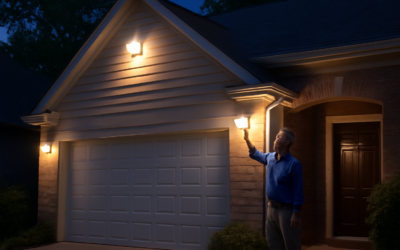
Standing in your backyard at night, squinting at a dim fixture that barely reaches the fence line, you start to wonder what it actually takes to flood a space with real light. The brightest outdoor flood lights can throw 5,000 to 20,000 lumens across a driveway, patio, or side yard, turning a black rectangle of lawn into something you can safely walk, work, and grill in after dark. After wiring hundreds of these fixtures on jobs, I can tell you the numbers on the box matter far more than the marketing.
Part of our Windows & Doors guide — explore the full guide →
This guide walks through how brightness is really measured, what wattage and beam spread mean for coverage, and how to match a fixture to your specific situation. Whether you are lighting a detached garage, deterring trespassers, or just want to see the steps down to the pool, the goal is the same: pick the right tool instead of the loudest label.
- What "Bright" Actually Means: Lumens Over Watts
- Beam Spread and Coverage: Brightness Is Nothing Without Aim
- Hardwired LED Floods: The Brightest Reliable Option
- Solar Flood Lights: How Bright Can They Really Get?
- Motion Activation and Smart Controls
- Matching Brightness to the Job
- Installation, Durability, and Running Costs
What “Bright” Actually Means: Lumens Over Watts
For decades homeowners judged bulbs by wattage, a habit that no longer serves you well. Wattage measures energy consumed, not light produced. A modern LED flood pulling 50 watts can outshine an old 150-watt halogen because LEDs convert far more electricity into visible light. The number that matters is lumens, the actual measure of light output.
For reference, a typical residential flood light in the 15-watt range produces roughly 1,500 lumens, enough for a small entry area. Step up to a 45- to 60-watt LED and you land in the 4,500 to 7,000 lumen zone, appropriate for a two-car driveway or a modest backyard. The truly bright commercial-grade fixtures, often built around multiple LED heads, push 10,000 to 20,000 lumens and draw 100 to 200 watts. Those flood a half-acre lot but can also blind a neighbor if aimed carelessly.
One more figure worth checking is efficacy, expressed as lumens per watt. Quality LED floods deliver 100 to 130 lumens per watt. If a fixture claims huge brightness but only manages 60 lumens per watt, you are paying for heat and inflated wattage rather than usable light.
Beam Spread and Coverage: Brightness Is Nothing Without Aim
Raw lumens tell only half the story. Two 8,000-lumen fixtures can perform completely differently depending on beam angle. A narrow 30-degree beam concentrates that light into a tight, intense pool, ideal for highlighting a flagpole or a distant gate. A wide 120-degree beam spreads the same lumens across a broad area, giving softer but far more even coverage for a patio or yard.
As a rough rule, a fixture mounted 9 to 10 feet high with a 120-degree spread will usefully light a circle roughly 20 to 30 feet across. Raise the mounting height and the coverage grows but the intensity at ground level drops. This is why security floods often use two or three adjustable heads: you can splay them to cover the driveway, the walkway, and the side gate from a single junction box.
Color temperature affects perceived brightness too. Measured in Kelvin, a 5,000K “daylight” flood reads as crisp and bright and shows colors accurately, which helps security cameras. A warmer 3,000K light feels more inviting for a deck or garden but can seem dimmer at the same lumen count. Most homeowners lighting large outdoor areas prefer 4,000K to 5,000K for the alertness and reach it provides.
Hardwired LED Floods: The Brightest Reliable Option
When you genuinely need the brightest outdoor flood lights and want them on every night without babysitting batteries, hardwired LED fixtures are the answer. A dual-head 60-watt LED flood wired to your home’s 120-volt circuit runs about 6,000 lumens and costs $35 to $70. Triple-head commercial units in the 100- to 150-watt range hit 12,000 to 18,000 lumens for $80 to $200.
The advantage of hardwiring is consistency. There is no solar panel to keep clean, no battery that fades in January, and no runtime limit. You do need a junction box and, ideally, a licensed electrician if you are running new cable, but replacing an existing flood fixture is usually a 30-minute swap. Look for a fixture rated IP65 or higher and an aluminum housing that sheds heat, because heat is the enemy of LED lifespan. A well-built unit should last 25,000 to 50,000 hours.
Solar Flood Lights: How Bright Can They Really Get?
Solar technology has improved dramatically, but expectations still need calibrating. The strongest consumer solar floods top out around 2,000 to 3,500 lumens on a full charge, and they only hold peak output for the first few hours after sunset. By 3 a.m. many have dimmed to conserve their remaining charge. That makes them excellent for dusk-to-late-evening coverage and motion bursts, but they are not a match for a hardwired 10,000-lumen unit.
Where solar shines is placement freedom. A shed at the back of the property with no nearby outlet is a perfect candidate. Choose a model with a separate panel on a 10- to 16-foot cable so you can mount the light in shade and the panel in full sun. Expect $30 to $90 for a capable dual-panel solar flood, and plan to wipe the panel clean every couple of months so it keeps charging efficiently.
Motion Activation and Smart Controls
Some of the most practical bright floods are the ones that only blaze when needed. A passive infrared motion sensor detects body heat and triggers the light, saving energy and startling anyone who should not be there. Good sensors offer a detection range of 40 to 70 feet and an adjustable arc up to 180 degrees, plus a timer so the light stays on for 30 seconds to 20 minutes after the last movement.
Smart floods add app control, scheduling, and integration with cameras. Many run a low ambient glow all evening, then jump to full 4,000-lumen output when they sense motion, giving you both gentle everyday lighting and a bright deterrent. If you go this route, confirm the fixture connects to 2.4 GHz Wi-Fi, since most outdoor smart devices do not support 5 GHz, and check that dusk-to-dawn and motion modes can run together.
Matching Brightness to the Job
Over-lighting is a real mistake. A wall of 18,000 lumens aimed at a small courtyard creates harsh glare, deep shadows, and irritated neighbors. Think in terms of purpose. For a front entry or small porch, 700 to 1,300 lumens is plenty. A single-car driveway or modest patio does well with 2,400 to 4,000 lumens. A large backyard, RV pad, or two-car driveway calls for 5,000 to 8,000 lumens. Only true security coverage of a big lot or the side of a barn justifies 10,000 lumens and up.
Aim matters as much as output. Point floods downward at 30 to 45 degrees so the light lands where feet and vehicles go, not into windows or the sky. Full-cutoff or shielded fixtures keep light pollution down and are required by some local dark-sky ordinances, so check your municipality before buying the biggest unit on the shelf.
Installation, Durability, and Running Costs
A bright fixture is only worth it if it survives the weather and does not spike your bill. Look for an IP65 or IP66 rating, which means the housing resists dust and heavy rain. In freezing climates, aluminum bodies and silicone gaskets outlast cheap plastic that cracks after a couple of winters. Mounting height between 8 and 12 feet gives the best balance of reach and control for residential lighting.
On operating cost, LEDs are gentle. A 60-watt LED flood running six hours a night uses about 11 kilowatt-hours a month, roughly $1.50 at average U.S. electricity rates. Even a big 150-watt commercial unit on a motion timer costs only a few dollars a month because it rarely runs at full tilt. That efficiency, combined with a lifespan measured in decades of typical use, is why LED has become the default for anyone chasing serious brightness outdoors.
Choosing the brightest outdoor flood lights comes down to reading lumens honestly, matching beam spread to your space, and picking a power source that fits your wiring reality. Get those three right and you will light your property cleanly, safely, and without paying for wattage you never needed.