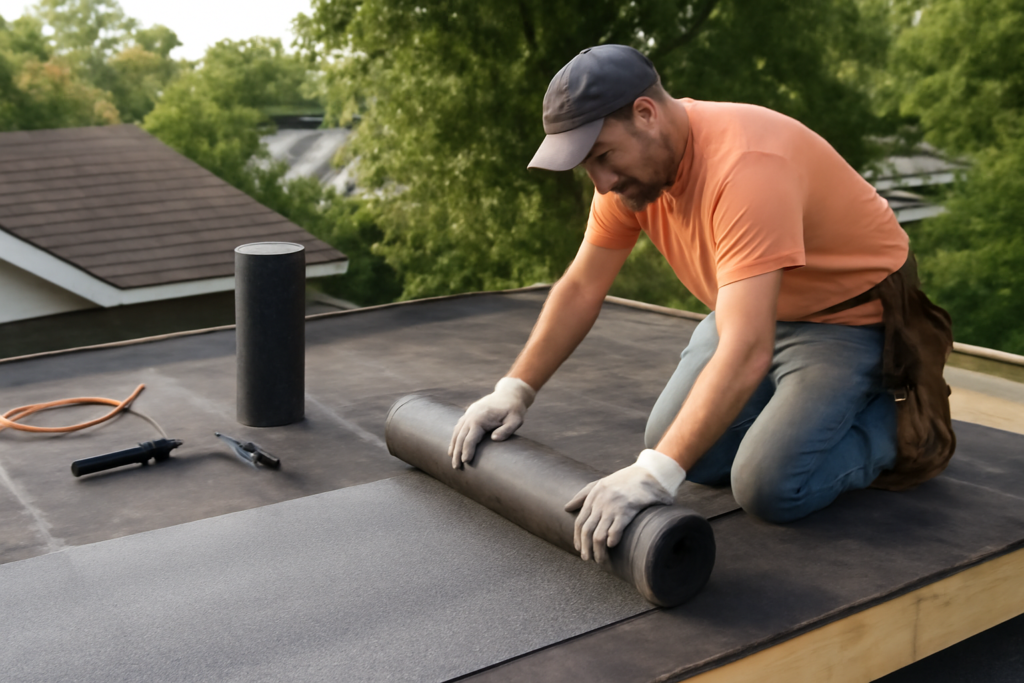
Look at almost any low-slope roof on a garage, porch addition, or small commercial building and the gritty, shingle-like surface you see is not shingles at all. Cap sheet roofing is the finished, granule-coated top layer of a built-up or modified bitumen roof system, and it does the same job a shingle’s granules do: shield the waterproofing asphalt underneath from sunlight, foot traffic, and weather. Homeowners run into cap sheets constantly, on flat-roofed additions, patio covers, and older ranch homes, yet very few know what they are looking at or how the layers underneath work. Understanding the system helps you buy the right repair, spot a lazy bid, and know when a roof labeled “20-year” is really a 12-year roof.
Part of our Roofing guide — explore the full guide →
What a Cap Sheet Actually Is
A cap sheet is a factory-made roll of asphalt roofing, usually 39 inches wide and about a square (100 sq ft of coverage after laps) per roll. It has three parts: a reinforcement mat of fiberglass or polyester in the middle, asphalt saturating and coating that mat, and ceramic mineral granules pressed into the top surface. The granules block UV radiation, which is what actually destroys asphalt over time, and they give the sheet its color and fire rating.
The cap sheet is never the whole roof. It is the top ply of a multi-layer system. Underneath there is always at least one base sheet mechanically fastened or adhered to the deck, and often one or two interply sheets between base and cap. When a contractor talks about a “two-ply mod bit roof,” they mean a base sheet plus a cap sheet. Three-ply adds an interply and buys meaningfully more redundancy.
Built-Up vs Modified Bitumen Systems
Cap sheets show up in two families of low-slope roofing. Traditional built-up roofing (BUR) alternates hot-mopped asphalt with plies of felt, then finishes with either flood-coated gravel or a granulated cap sheet. BUR is less common on homes today because it requires a hot asphalt kettle on site.
Modified bitumen is the modern version and the one you will most likely be sold. The asphalt is blended with polymers that make the sheet flexible and rubber-like. Two chemistries dominate:
- SBS (styrene-butadiene-styrene): rubbery, flexible in cold weather, installed with cold adhesive, self-adhesive backing, or hot asphalt. The most common residential choice.
- APP (atactic polypropylene): more plastic-like, higher softening point, traditionally torch-applied. Common in hot southern markets.
Common product names you will see on bids include GAF Liberty (self-adhering SBS), CertainTeed Flintlastic SA, Polyglass Elastoflex and Polyflex, and Malarkey Paragon. All are cap-sheet systems; the differences are chemistry and attachment method.
How Cap Sheet Roofs Are Installed
Attachment method matters for safety, warranty, and price. There are four ways a cap sheet goes down:
- Torch-applied: the installer melts the back of the sheet with a propane torch as it rolls out. Excellent adhesion, but open flame on a wood-framed house is a genuine fire risk, and many insurers and codes restrict it. Never let anyone torch directly to a wood deck; a fire-barrier base sheet is mandatory.
- Self-adhering (peel-and-stick): a release film peels off the back and the sheet bonds to the primed base sheet. This is the DIY-friendly and insurance-friendly option, and products like GAF Liberty SA are designed as complete systems. Needs temperatures above roughly 45-50°F to bond well.
- Cold-process adhesive: the sheet is set into troweled or squeegeed adhesive. No flame, strong bond, but messy and smelly for a day.
- Hot-mopped asphalt: the old BUR method, mostly commercial now.
Whatever the method, details make or break the roof: laps of 3 to 4 inches side and 6 inches at ends, granules embedded at seams where asphalt bleeds out, metal drip edge and flashings stripped in, and cap flashing carried 8 inches or more up any wall the roof meets.
Lifespan and What Kills a Cap Sheet Early
A two-ply modified bitumen roof with a granulated cap sheet realistically delivers 15 to 20 years; a three-ply system, 20 to 25. The failure sequence is predictable. First the granules loosen and wash toward the gutters, exposing black asphalt. Bare asphalt then oxidizes in the sun, gets brittle, and cracks in an alligator-skin pattern. Water finds the cracks and lap seams, and blisters form where moisture vaporizes between plies. Ponding water accelerates everything, so a roof with dead-level spots that hold water 48 hours after rain will not see its rated life. If you catch granule loss early, a reflective fibered aluminum or elastomeric coating applied around year 10 to 12, at roughly $1.50 to $3 per sq ft, can add 5 to 10 years.
What Cap Sheet Roofing Costs
Cap sheet systems are among the cheapest legitimate low-slope roofs, which is why they dominate additions and garages:
- Two-ply self-adhered mod bit, installed: $4.50 to $7.50 per sq ft
- Three-ply or torch-applied systems: $6 to $9 per sq ft
- Materials only, DIY: a roll of self-adhering cap sheet runs $90 to $130 per square, base sheet $40 to $70, plus primer, flashing cement, and drip edge, landing around $2 to $3 per sq ft
- Comparison: single-ply TPO or EPDM installed typically runs $5.50 to $9 per sq ft
On a 400 sq ft flat-roof addition, expect a professional two-ply job around $2,000 to $3,000. Tear-off of an old roof, rotten deck repair, and parapet or wall flashing work add from there.
Cap Sheet vs TPO and EPDM
Single-ply membranes have taken over commercial roofing, so is a cap sheet obsolete? Not on small residential roofs. Mod bit’s advantages are redundancy (two or three plies instead of one 45-mil membrane), granule surfacing that tolerates foot traffic and dropped tools far better than TPO, easy patchability with materials from any supply house, and a look that reads like shingles from the street. Its disadvantages are weight, black-surface heat gain unless you buy white or coated granules, and more seams. On a roof under 1,000 sq ft with normal foot traffic, a self-adhered SBS system is often the most practical, repairable choice. On a large, clean roof where energy reflectivity matters, white TPO usually wins.
Repairing a Cap Sheet Roof
Small repairs are honest DIY work. For a crack or open lap, clean the area, prime with asphalt primer, trowel modified flashing cement into the defect, embed polyester fabric, and top-coat, or peel-and-stick a patch of matching cap sheet extending 6 inches past the damage in every direction. Re-embed loose granules into a thin coat of flashing cement to protect exposed asphalt. Blisters that are dry and intact are usually best left alone; cut and patch only the ones that have broken open. If more than about 25 percent of the surface shows bare asphalt, cracking, or chronic ponding damage, put money toward replacement instead of chasing leaks.
Can You Install a Cap Sheet Yourself?
A self-adhering two-ply system on a small, low-slope roof is one of the more realistic DIY roofing projects, provided the deck is sound and the weather cooperates. The skills involved are measuring, snapping lines, rolling sheets straight, and pressing laps firmly, closer to installing flooring than to shingling a steep gable. Plan the work for a dry stretch with daytime temperatures between about 50°F and 90°F, prime the deck or base sheet with asphalt primer and let it flash off until tacky, and roll every finished course with a weighted lap roller, since adhesion pressure is what peel-and-stick systems live on. Dry-fit each sheet before pulling the release film; once a self-adhered sheet grabs, repositioning it is somewhere between difficult and impossible. Budget a full day for a 400 sq ft roof your first time, and leave the torch systems to professionals entirely, both for the fire risk and because most manufacturers restrict torch application to trained installers anyway.
Where DIYers get in trouble is the edges and penetrations rather than the field. Give yourself a cheat sheet: drip edge under the base sheet at eaves but over it at rakes, cap sheet trimmed flush to the drip edge hem, and every pipe collared with a boot set in flashing cement between the plies. If the roof has a wall on one side, buy the matching flashing membrane and carry it 8 inches up the wall behind the siding. An hour of studying the manufacturer’s install guide, GAF and CertainTeed both publish good ones free online, saves most of the classic first-timer leaks.
The Bottom Line
Cap sheet roofing is the workhorse finish layer of built-up and modified bitumen roofs: granule-armored asphalt over one or more base plies, delivering 15 to 25 years for $4.50 to $9 per sq ft installed. Choose self-adhering SBS systems for wood-framed homes, insist on proper laps and wall flashing heights, keep water from ponding, and recoat when granules thin. Do those four things and this humble roll roofing will quietly outlast its reputation.