Single-ply membranes get the marketing budget, but the flat roof that shrugs off the most foot traffic is still built from asphalt. A modified bitumen roof — “mod bit” on every jobsite — layers polymer-reinforced asphalt sheets into a redundant, granule-armored system that HVAC technicians can walk all over without punching holes in it. It is the direct descendant of hot tar-and-gravel roofing, engineered into rolls, and it remains the toughness pick for low-slope roofs at $4 to $8 per square foot installed. Here is how the layers work, the difference between SBS and APP chemistry, the three ways it goes down, and what it honestly lasts.
What “Modified” Means
Plain asphalt cracks in cold and flows in heat. Modified bitumen fixes both by blending polymers into the asphalt, and the polymer choice defines the two product families. SBS (styrene-butadiene-styrene) adds synthetic rubber, producing an elastic sheet that stretches up to 100 percent and stays flexible far below zero — the choice for cold climates and roofs with structural movement, usually installed with cold adhesive or self-adhered backing. APP (atactic polypropylene) adds plastic, producing a stiffer, more UV-resistant sheet that melts predictably — the classic torch-down membrane, favored in hot climates. Both come reinforced with a polyester or fiberglass scrim that gives the sheet its tear strength, in rolls roughly 3 feet wide.
The Layer System
Redundancy is mod bit’s defining advantage: it is a multi-ply roof, so a defect in one layer is backed up by another. A standard two-ply system stacks, from the deck up:
- Insulation and coverboard — polyiso to meet energy code, topped with a fiber or gypsum board for a firm substrate.
- Base sheet — a smooth-surfaced modified sheet, mechanically fastened or adhered, providing the first waterproofing ply.
- Cap sheet — the exposed layer, surfaced with ceramic granules like a shingle. Granules block UV, add fire rating, and come in colors including reflective white (many white cap sheets are Energy Star rated).
High-spec commercial jobs add a third ply. Total system thickness runs 160 – 250 mils — three to four times a 60-mil single-ply — which is exactly why dropped tools and constant service traffic that would puncture TPO barely scuff a mod bit cap sheet. The granulated surface also takes paint-on repairs and coatings more forgivingly than any slick membrane.
Three Installation Methods
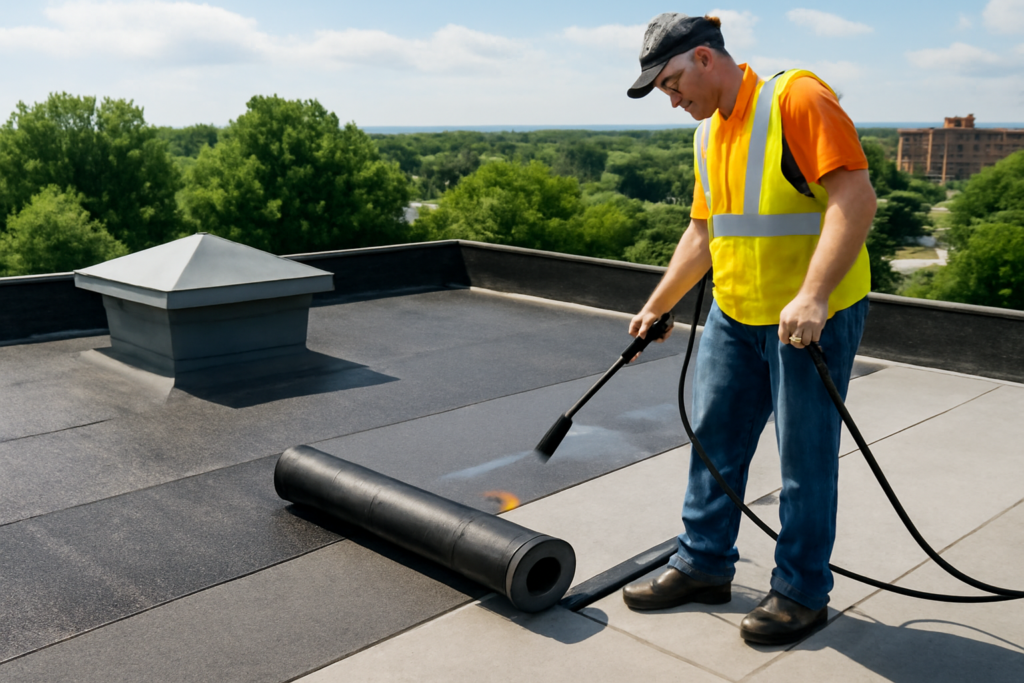
Torch-down is the iconic method: a roofer plays a propane torch across the roll’s underside, melting the bitumen as the sheet unrolls into the molten pool. It creates a superb monolithic bond — and it is an open flame on a building, which is why insurers and many contractors have moved away from it, why fire watches for an hour after torching are mandatory, and why it is absolutely not a DIY technique. Cold-applied systems trade the torch for solvent-based adhesive, flame-free but slower-curing and odorous. Self-adhered (SA) is the modern default for residential work: peel-and-stick sheets with factory adhesive backing, no flame, no fumes, and forgiving installation — products like GAF Liberty and CertainTeed Flintlastic SA are sold at big-box stores and are the one version a capable DIYer can install on a porch or garage roof. Whatever the method, quality lives in the details: laps rolled tight, granules embedded at seam lines, and metal drip edge stripped in with flashing membrane.
Lifespan: A Realistic 15 to 25 Years
A two-ply mod bit system typically delivers 15 – 25 years, with three-ply and well-maintained cold-climate roofs reaching toward 30. That trails PVC and quality EPDM slightly, and the aging pattern is asphalt-familiar: granule loss exposes the bitumen, exposed spots oxidize and craze-crack, and seams at laps open with thermal cycling. Ponding water accelerates all of it — mod bit tolerates occasional ponding better than acrylic-coated roofs but worse than silicone-coated or PVC systems, so drainage design matters. The redemption story is maintenance: mod bit is arguably the easiest membrane to repair (patches of the same material torch or stick over damage seamlessly), and an aging-but-dry system takes restoration coatings beautifully — an aluminum or silicone coating at year 15 buys another decade for $1 – $4 per square foot, a decision mapped in our roof coating guide. Leak triage for an existing roof is covered in our flat roof repair guide.
What a Modified Bitumen Roof Costs
Installed 2026 pricing, including tear-off and insulation:
- Two-ply self-adhered: $4 – $6.50 per sq ft
- Two-ply torch or cold-applied: $4.50 – $7 per sq ft
- Three-ply commercial systems: $6 – $8.50 per sq ft
A 1,000-square-foot flat roof lands around $4,500 – $7,000 — consistently $1 – $2 per square foot under comparable PVC and near the bottom of the flat-roof market with EPDM. DIY self-adhered material for a small porch roof runs roughly $1.50 – $2.50 per square foot including base sheet, cap sheet, primer, and drip edge.
Mod Bit vs. the Single-Ply Field
Choose modified bitumen when the roof sees regular foot traffic or rooftop equipment service, when you want redundancy of plies rather than one membrane between you and the sky, when repair simplicity over decades matters, or when a granulated surface suits a roof visible from upper windows (it reads as “roofing,” not pool liner). Choose a single-ply instead when maximum lifespan per dollar in a clean, low-traffic field is the goal — the EPDM, TPO, and PVC trade-offs are laid out in our rubber roofing comparison. And if your existing flat roof is at end of life and you are weighing every system side by side, including costs and tear-off decisions, our flat roof replacement guide walks the whole decision.
Repairing a Modified Bitumen Roof
Mod bit rewards owners at repair time. Small splits, blisters, and open laps fix with the same-family materials sold at any supply house: clean the area, trowel on modified flashing cement (Henry 208 Wet Patch or a polymer-modified equivalent), embed polyester reinforcing fabric, top with a second cement layer, and broadcast granules into the surface for UV protection. Torch-capable crews heat-fuse a patch of cap sheet over damage for a repair indistinguishable from the field. Blisters deserve a note: small, intact blisters between plies are often best left alone and monitored, since cutting them opens a waterproof (if ugly) roof — pros lance and re-adhere only the ones that have cracked or grown. Budget $300 to $800 for a professional repair visit, and inspect the usual suspects annually: lap seams facing prevailing weather, flashing terminations at walls, and any spot where granule loss has exposed black bitumen to sun.
Cold-Climate and Hot-Climate Spec Differences
Climate should steer the polymer and the surface. In northern states, SBS is the default — its rubberized flexibility tolerates deep-cold movement and ice, and self-adhered SBS installs safely in temperatures where torch work on a frosty deck gets dangerous (most SA products want 40 to 50°F minimum, with cold-weather primers extending the season). In the Sun Belt, APP’s plastic-modified UV resistance and white-granule or reflective-coated cap sheets counter the heat that ages asphalt fastest; a factory-white cap or a field-applied reflective coating knocks the surface temperature down 40 to 60°F and meaningfully slows oxidation. Everywhere, ponding is the spec to design out rather than tolerate: crickets behind curbs, tapered insulation to drains, and generous scupper counts cost little during installation and remove mod bit’s main aging accelerant for the life of the roof.
Hiring Notes
Ask bidders three things: SBS or APP and why for your climate; attachment method (and if torch-applied, proof of insurance that covers torch work plus a written fire-watch protocol); and the ply count with a system warranty from the manufacturer, not just the installer. A two-ply SBS self-adhered system from a certified crew is the sweet spot for most homes — flame-free installation, cold-weather flexibility, and a roof you can send the AC repairman across without holding your breath.