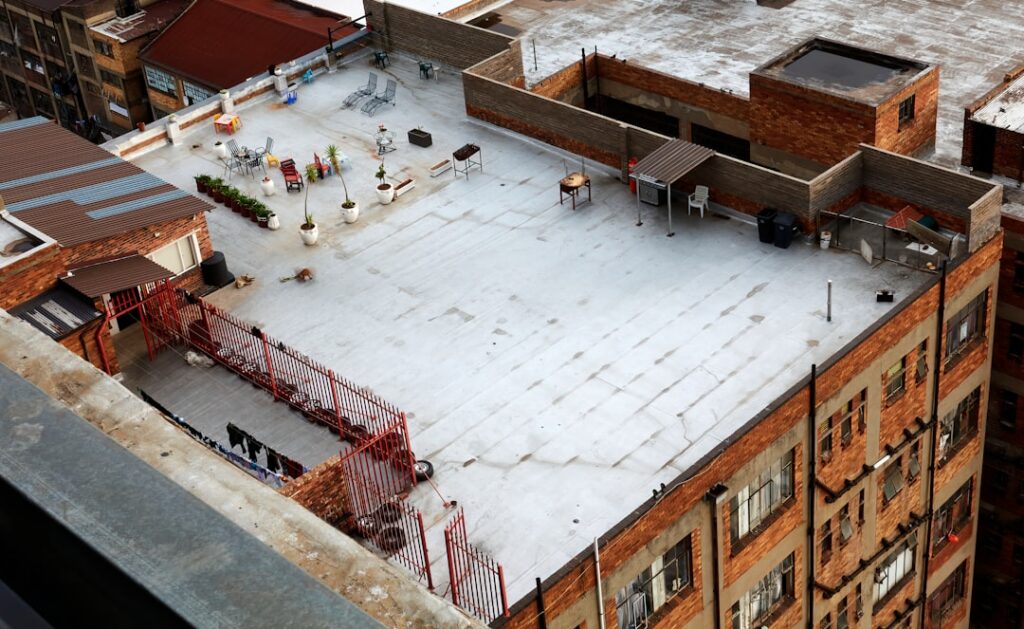
Flat roofs do not fail on the schedule shingle roofs do — they fail all at once, usually the winter after the third “one more patch” repair. When the moisture scan shows soaked insulation and the seams are opening faster than anyone can chase them, flat roof replacement becomes the only honest line item, and it is a bigger decision than a shingle reroof because you are choosing among four genuinely different membrane systems plus an insulation package that can dwarf the membrane cost. This guide walks the replace-or-rescue call, the material options with 2026 prices, and the specification details that separate a 12-year roof from a 25-year one.
Replace, Recover, or Coat?
Three paths exist for a failing flat roof, and moisture content picks between them. A restoration coating ($2 – $5 per square foot) rescues a roof that is weathered but dry — our roof coating guide covers when that bet pays. A recover lays a new membrane over the old one (code allows a maximum of two roof systems): it saves $1 – $2 per square foot in tear-off and disposal, but only over a substantially dry assembly, and it forfeits the chance to inspect the deck. A full tear-off replacement is mandatory when scans show widespread saturation, when two systems are already stacked, or when the deck itself is suspect. Insist on an infrared or capacitance moisture survey plus a core cut before anyone quotes — a $300 – $600 survey is the difference between an informed decision and an expensive guess. If you are not yet sure the roof is beyond patching, triage it first with our flat roof repair guide.
Your Membrane Options
Four systems cover nearly every residential and light-commercial flat roof:
- EPDM rubber — $5 – $9 per sq ft installed. The budget-and-cold-climate pick: huge seamless sheets, 20 – 30 years, easiest repairs. Black surface runs hot in southern sun. Details in our EPDM roofing guide.
- TPO — $6 – $10 per sq ft. The market leader: heat-welded seams, reflective white surface, strong value in cooling climates; 20 – 25 years. See our TPO roofing guide.
- PVC — $7 – $12 per sq ft. The premium thermoplastic: welded seams, best chemical and grease resistance, 25 – 30 years. The default over kitchens and under roof decks.
- Modified bitumen — $4 – $8 per sq ft. Multi-ply asphalt toughness for high-traffic roofs; 15 – 25 years, simplest to patch. Covered in our modified bitumen roof guide.
The full head-to-head on the three membranes marketed as rubber lives in our rubber roofing comparison. Quick matching: cold climate and simple roof, EPDM; hot climate, TPO or PVC; grease exhaust anywhere nearby, PVC only; rooftop equipment with regular service traffic, mod bit or 80-mil single-ply with walk pads.
The Insulation Package: The Hidden Half of the Bill
On a modern replacement, insulation and coverboard commonly account for 30 – 40 percent of the quote, because tear-off resets your energy-code obligation: most climate zones now require roughly R-25 to R-30 of continuous insulation, meaning 4 – 5+ inches of polyiso board. Budget $1.50 – $3.00 per square foot for the insulation layers alone. Two upgrades earn their cost. A coverboard (half-inch gypsum or high-density polyiso, ~$0.50 – $0.75 per square foot) between insulation and membrane dramatically improves hail and puncture resistance — most premature single-ply failures on foam-only substrates trace to its absence. Tapered insulation builds slope (typically 1/4 inch per foot) into a dead-flat deck so water actually reaches the drains; it adds $0.75 – $1.50 per square foot and eliminates the ponding that ages every membrane. If your existing roof holds birdbaths for days, buy the taper — it is cheaper than fighting ponding for 20 years.
What Flat Roof Replacement Costs in 2026
All-in tear-off replacement, including code insulation, membrane, flashings, and disposal:
- 500 sq ft (porch/garage): $4,000 – $8,000
- 1,000 sq ft (addition/small home): $7,000 – $13,000
- 2,000 sq ft (full residential flat roof): $13,000 – $24,000
Small roofs cost more per foot because mobilization, dumpsters, and minimums are fixed. Other movers: wet insulation disposal (soaked polyiso is heavy and dump fees are by the ton), parapet walls and their flashing details, rooftop units that must be lifted or disconnected, and deck repairs — flat roofs hide rot exactly the way pitched roofs do, so nail down a per-sheet decking price in the contract before tear-off.
Details That Decide the Roof’s Lifespan
Membrane brochures all promise decades; flashings decide who delivers. Walk every bid through these specifics: 60-mil membrane minimum (45-mil is builder-grade), factory-fabricated corners and pipe boots rather than field-cut improvisations, membrane turned up parapets and walls at least 8 inches with termination bar and counterflashing, new drip edge and gravel-stop metal (never reused), and drains fitted with new clamping rings and strainers plus overflow scuppers where code requires them. Ask how seams are verified — probe-tested welds on TPO/PVC, rolled and probed tape seams on EPDM. Then ask who stands behind it: a manufacturer-certified installer can register a 20-year no-dollar-limit (NDL) system warranty that survives the contractor’s retirement, and the modest premium for it is the best insurance in flat roofing.
Timing, Sequencing, and What Replacement Week Looks Like
Flat-roof replacement is more weather-sensitive than shingle work because the assembly is open to the sky in stages. Crews tear off only what they can dry-in the same day, so a 2,000-square-foot residential job typically runs two to five working days: day one for tear-off and deck repairs on the first section, subsequent days for insulation, membrane, and details, with flashings and metal last. Adhesives and self-adhered products have temperature floors (roughly 40 to 50°F), which makes late spring through fall the comfortable season and winter work a specialty. Expect solvent and adhesive odors indoors for a day or two on adhered systems, plan for rooftop HVAC to be disconnected and re-set (coordinate the mechanical contractor early — this is the most common scheduling failure), and ask where material staging and the crane or conveyor will sit. If the roof doubles as a deck, the wear surface — pavers, pedestals, or duckboard — comes off and back on, and that labor belongs in the quote, not in a change order.
Insurance, Permits, and Paper
Replacement triggers a permit in nearly all jurisdictions ($150 to $600), and the inspections that come with it are free quality control on work that will be covered within days. Loop in your insurer too: some carriers surcharge or decline flat roofs past a stated age, so a documented replacement with a registered warranty can directly cut premiums or preserve coverage — send the certificate and photos to your agent when the job closes. If storm damage contributed to the failure, have the adjuster out before tear-off destroys the evidence; hail-bruised membrane and wind-lifted seams are claimable, gradual saturation is not, and the two are distinguishable only while the old roof still exists. Keep the closing package — contract, permit final, moisture survey, warranty registration, and photos — in one folder. It is the first thing a future buyer’s inspector asks about, and a complete file adds credibility (and value) that outlasts your ownership.
Getting It Done Right
Collect three bids that specify — in writing — membrane type and thickness, attachment method, insulation R-value and taper plan, coverboard, flashing scope, and warranty registration. Reject any quote that reads “install new rubber roof” without those nouns. Schedule for a dry stretch (flat-roof assemblies must not be closed over damp substrate), expect two to five days of work, and hold 10 percent until you have the warranty certificate and photos of the finished flashings. A flat roof replaced to this standard is not the recurring headache flat roofs are famous for — it is a 25-year lid you will barely think about, which is exactly what you are paying for.