
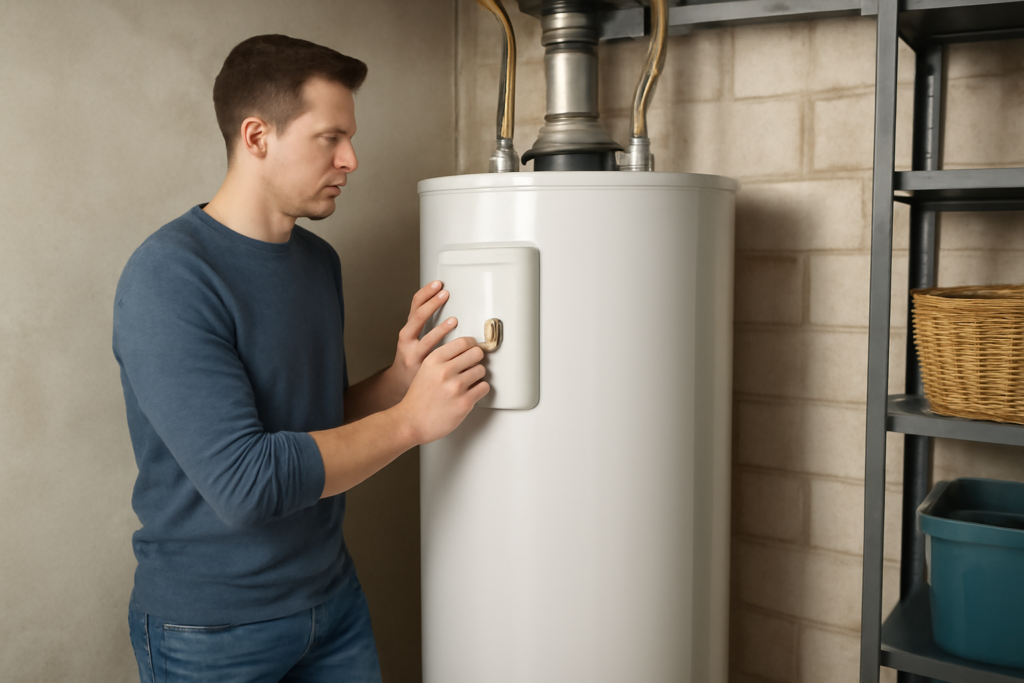
If you bought a house in the last twenty years, there’s a decent chance a Kenmore water heater is quietly heating your showers right now — Sears sold millions of them under the Kenmore name for decades. But with Sears largely gone from the retail landscape, owners are often left wondering who actually built their unit, where to get parts, and whether it’s worth repairing. The good news is that Kenmore water heaters were rebadged versions of tanks from major manufacturers, so they’re well-understood, serviceable, and use widely available parts.
Who Actually Makes Kenmore Water Heaters
Kenmore was never a manufacturer — it was Sears’ house brand. The water heaters sold under it were built by established tank makers, primarily State Industries and A.O. Smith (which are related companies), and at times Rheem. That’s actually reassuring for owners: your Kenmore is mechanically a State or A.O. Smith tank underneath the badge, using the same thermostats, elements, gas valves, and anode rods as those name-brand units. When you need a part, cross-referencing to the equivalent A.O. Smith or State component almost always works.
Gas vs Electric Models
Kenmore sold both fuel types, and identifying yours guides all maintenance and repair.
- Electric models heat water with two immersion elements controlled by upper and lower thermostats. They have the red reset button (ECO safety switch) behind the upper access panel and no venting.
- Gas models heat with a burner at the base, controlled by a gas control valve with a temperature dial, and vent exhaust through a flue. They have a pilot light or electronic ignition and a thermocouple.
Electric units are simpler and safer to service yourself; gas units involve combustion and venting, which raises the stakes on any repair.
Finding Your Model and Specs
Every Kenmore tank has a rating plate — a sticker on the side listing the model number, serial number, tank capacity, wattage or BTU rating, and manufacture date. The serial number typically encodes the build date, which tells you how old the unit is. Most residential Kenmore tanks are 40 or 50 gallons. Note this information down; you’ll need it to source the correct parts and to judge whether the unit is near the end of its life.
Common Problems and Fixes
Kenmore water heaters suffer the same age-related issues as any tank heater. The most frequent complaints and their causes:
- No hot water (electric): usually a tripped reset button, a failed heating element, or a bad thermostat.
- No hot water (gas): often a pilot that won’t stay lit, a failed thermocouple, or a faulty gas control valve.
- Not enough hot water: a failed lower element, sediment buildup reducing capacity, or a thermostat set too low.
- Rumbling or popping noises: sediment on the tank bottom overheating and creating steam — time to flush the tank.
- Rusty or discolored water: a depleted anode rod or the tank itself corroding, the latter being a sign of impending failure.
- Water around the base: could be a leaking valve or fitting (fixable) or a corroded tank (not fixable).
Sourcing Parts
The biggest worry for Kenmore owners is parts availability now that Sears has shrunk. In practice, parts are easy to find because the internals are standard. The upper and lower thermostats, heating elements, gas control valves, thermocouples, anode rods, drain valves, and T&P relief valves are all generic or cross-reference directly to A.O. Smith and State parts. Bring your model and serial number to any plumbing supply house or search by the internal part numbers stamped on the components, and you’ll find replacements without trouble.
Routine Maintenance
A Kenmore water heater rewards basic upkeep with years of extra life. Build these into your routine:
- Flush the tank annually to remove sediment. Drain a few gallons from the bottom drain valve until the water runs clear. This prevents the rumbling noise and preserves efficiency.
- Check the anode rod every 2 to 3 years. This sacrificial rod corrodes so the tank doesn’t; replacing a spent one can double the tank’s lifespan.
- Test the T&P relief valve yearly by lifting its lever briefly to confirm it releases water and reseats. This valve is a critical safety device.
- Set the thermostat to 120°F for safety, efficiency, and reduced sediment buildup.
Setting the Temperature Safely
The Department of Energy recommends 120°F, which prevents scalding, slows mineral buildup, and cuts standby heat loss. On electric Kenmore units you set this at the thermostats behind the access panels; on gas units you turn the dial on the control valve. Water above 130°F to 140°F significantly raises scald risk, especially for children and older adults, without meaningful benefit for most households.
How Long They Last and When to Replace
Kenmore tank water heaters last about 8 to 12 years, in line with the industry average. If yours is past a decade and showing rust-colored water, a leaking tank, or a string of failing parts, replacement makes more financial sense than continued repairs. A leaking tank is never repairable — the steel has corroded through — and should be replaced promptly to avoid water damage. A new water heater runs $500 to $1,500 for electric and $600 to $2,000 for gas, installed, with tankless upgrades costing more.
Should You Repair or Replace?
Use a simple rule: if the unit is under 8 years old and the failed part is a thermostat, element, thermocouple, or valve, repair it — those fixes cost $20 to $200 and restore full function. If the tank itself is leaking, or the unit is over 10 years old and facing a major repair, replace it. Because your Kenmore is really a State or A.O. Smith tank underneath, parts are cheap and available, making repairs worthwhile right up until the tank itself gives out.
Final Thoughts
A Kenmore water heater is a reliable, well-built tank hiding behind a discontinued retail badge, and owning one is no cause for concern. Identify whether yours is gas or electric, keep up with annual flushing and anode-rod checks, and cross-reference parts to A.O. Smith or State when repairs come up. Do that, and your Kenmore will deliver hot water dependably for its full service life — and when it finally wears out, you’ll know exactly when to make the swap.


