Figuring out the right kenmore refrigerator water filter trips up more people than any other appliance part I deal with, and it is entirely because Kenmore never made its own refrigerators. Kenmore is a Sears house brand — the actual fridges were built by Whirlpool, LG, Frigidaire, Samsung, and others. So your filter depends on who really built your box. Get that straight and the rest is a five-minute job.
- The Kenmore Model Number Decoder
- Why Kenmore Filters Confuse Everyone
- Common Kenmore Filter Part Numbers
- Filter Locations
- How to Replace It
- Replacement Interval
- OEM vs Generic
- Troubleshooting Slow or No Water
- What the Filter Removes
- Signs the Filter Is Overdue
- The Bypass Plug
- Buying Tips for Kenmore Owners
- Bottom Line
The Kenmore Model Number Decoder
The first three digits of your Kenmore model number (found on the sticker inside the fresh-food compartment, usually on the left wall near the crisper) tell you the manufacturer. This is the single most useful thing to know:
- 106.xxxxx = built by Whirlpool. Uses Whirlpool-family filters.
- 253.xxxxx = built by Frigidaire/Electrolux. Uses Frigidaire-style filters.
- 795.xxxxx = built by LG. Uses LG-style filters.
- 401.xxxxx = built by Samsung. Uses Samsung-style filters.
Once you know the maker, matching a filter is straightforward. A 106-prefix Kenmore, for example, uses the same physical cartridge as the equivalent Whirlpool.
Why Kenmore Filters Confuse Everyone
Here is the root of the confusion, and it is worth understanding so you never buy the wrong cartridge again. Sears sold Kenmore appliances for decades but never operated a single refrigerator factory. Every Kenmore fridge is a rebadged unit built by one of several manufacturers, sometimes on the exact same assembly line as that maker’s own branded models. So two Kenmore refrigerators sitting side by side in a showroom — same finish, same French door layout — can take completely different, non-interchangeable filters because one was built by Whirlpool and the other by LG. The Kenmore badge tells you nothing about the filter; the model-number prefix tells you everything. That is why decoding the prefix is the first and most important step, not an optional one.
Common Kenmore Filter Part Numbers
The cartridges you will run into most often:
- Kenmore 9081 / 46-9081 — Whirlpool-built (106 prefix), interchanges with Whirlpool Filter 1 (W10295370 / EDR1RXD1).
- Kenmore 9930 / 46-9930 — an older Whirlpool-built cartridge (Filter 3, 4396841).
- Kenmore 9690 / 46-9690 — another Whirlpool-family push-in filter.
- Kenmore 9083 — pull-out grille filter for certain side-by-side models.
- Kenmore Elite 9490 / 469490 — LG-built (795 prefix), interchanges with LG LT700P.
The surest method: pull your current filter and read the number printed on it. Failing that, decode the model prefix and match the equivalent manufacturer filter. Do not buy on the fridge’s appearance alone — two identical-looking Kenmores can take different cartridges.
Filter Locations
Where the filter hides depends on the builder:
- Whirlpool-built (106): Usually top-right ceiling of the fresh-food compartment, or in the base grille at the bottom front on older side-by-sides.
- LG-built (795): Typically upper-left interior wall or top-center of the fresh-food section.
- Frigidaire-built (253): Often top-right interior or in the upper-front housing.
How to Replace It
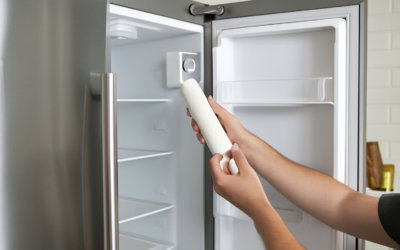
- Twist-in cartridges: turn a quarter-turn counterclockwise and pull straight out. Push-button models: press the release and the old filter pops out. Grille filters: turn a quarter-turn and slide out.
- No need to shut off the water — the housing self-seals during the swap. Keep a towel handy for drips.
- Remove the cap from the new filter, check the O-rings are seated, and insert. Twist clockwise a quarter-turn until snug.
- Flush 3 to 4 gallons through the dispenser to purge air and carbon fines. The first pours sputter and look cloudy — that is trapped air, not a defect.
- Reset the indicator: hold the filter-reset or dispenser-lock button about 3 seconds until the light clears.
Replacement Interval
Every 6 months or about 200 gallons is the standard across all the manufacturers Kenmore used. The dashboard light is a calendar timer, not a real sensor — it counts days, not gallons — so judge by taste and flow too. Hard-water homes and heavy dispenser users should lean toward the shorter interval. A filter left in a year is no longer filtering; it is a clogged flow restrictor.
OEM vs Generic
Genuine Kenmore-branded filters run $30 to $50; generics that fit the same housing cost $10 to $20. My guidance:
- Taste and odor only: A reputable generic that matches the correct manufacturer cartridge is fine.
- Contaminant reduction (lead, cysts, mercury): Buy a filter with genuine end-product NSF/ANSI 53 certification. “Made with NSF-certified materials” is a marketing dodge, not a certified filter.
- Fit matters most: Cheap generics sometimes seat loosely and leak into the compartment. Stick to well-reviewed brands.
Troubleshooting Slow or No Water
- Air not purged: run several more gallons after a new filter.
- Defective or old-stock filter: swap it and retest.
- Frozen water line in the door: water trickles but no ice — common if the fridge runs very cold.
- Low household pressure: dispensers want at least 30 psi; check the supply valve behind the fridge is fully open.
- Kinked line: the fridge pushed back against the wall pinched the 1/4-inch tube.
Quick diagnostic: install the bypass plug in place of the filter. If flow returns to normal, the filter was the restriction. If it is still slow, the problem is upstream in the valve or line.
What the Filter Removes
Whether your Kenmore was built by Whirlpool, LG, Frigidaire, or Samsung, the filter’s job and certifications are similar in principle. Look for these NSF/ANSI ratings on the cartridge:
- NSF/ANSI 42: Chlorine taste and odor plus particulates — the baseline every filter should meet.
- NSF/ANSI 53: Health contaminants like lead, mercury, and microbial cysts. This is the certification that matters for safety, not just taste.
A carbon-block fridge filter does not soften water or remove dissolved minerals, so it will not stop scale if you have hard water — that requires a whole-home softener. Setting that expectation correctly saves a lot of frustration.
Signs the Filter Is Overdue
Do not rely on the indicator light alone. Change the filter when you notice any of these, whatever the light says:
- Slower dispenser flow as the clogged block chokes water passage.
- A return of chlorine taste or odor as the carbon saturates.
- Cloudy or off-tasting ice.
- Black flecks in the water — loose carbon fines from a breaking-down cartridge.
The Bypass Plug
Every filtered Kenmore shipped with a bypass plug. If you cannot get a filter right away, install the bypass so you still get unfiltered water and ice — on some models, running the dispenser with an empty filter port and no bypass causes leaks. Keep that plug somewhere you will find it.
Buying Tips for Kenmore Owners
Because Kenmore filters ride on other manufacturers’ cartridges, a few habits keep you from wasting money:
- Read the number off the old filter first. It is the single most reliable way to reorder correctly, ahead of any model-lookup guess.
- Cross-reference to the base manufacturer part. A 106-prefix (Whirlpool-built) Kenmore often lets you buy the equivalent Whirlpool cartridge for less than the Kenmore-branded box — same physical filter, lower price.
- Buy multi-packs. On a six-month schedule you will use them, and per-filter cost drops significantly.
- Insist on genuine NSF 53 certification for health filtration. “Made with NSF-certified materials” is a marketing dodge, not a certified filter.
- Beware loose-fitting generics. A cartridge that does not seat firmly can leak into the compartment — stick to well-reviewed brands that match the correct base-manufacturer filter.
- Keep the old part number written down. Once you have identified the right cartridge, tape the number inside a cabinet so you never have to decode the model prefix again at reorder time.
One more thing that catches people: an older Sears Kenmore may use a discontinued cartridge, but because the fridge was built by a major manufacturer, an equivalent current filter almost always exists under the base brand. If the Kenmore number shows as unavailable, look up the manufacturer part it was built to and buy that instead — same filter, still in production.
Bottom Line
The whole trick to buying the right kenmore refrigerator water filter is decoding the model prefix to learn who actually built your fridge, then matching the equivalent Whirlpool, LG, Frigidaire, or Samsung cartridge. Change it every six months, flush a few gallons after each swap, and reset the indicator. Do that and you get clean water, full ice production, and zero service calls over the life of the appliance.