The Bosch refrigerator water filter is one of those parts nobody thinks about until the water tastes off or the ice slows to a trickle. It is a five-minute job that most owners can do without any tools, yet the wrong part number or a skipped replacement causes a surprising number of my service calls. Here is everything you need to change it right and keep your Bosch dispensing clean water for years.
Why the Filter Matters
Your Bosch runs incoming tap water through a carbon-block cartridge before it reaches the dispenser and ice maker. That cartridge captures chlorine taste and odor, sediment, and — depending on the model — certain contaminants like lead, mercury, and cysts, all certified to NSF/ANSI standards. As the carbon saturates and sediment clogs the block, two things happen: filtration performance falls off, and water flow physically slows because the block is choked. A filter left in for a year is not filtering anything; it is just a flow restrictor breeding bacteria.
Finding the Right Filter
Bosch uses a few filter families, and matching yours is critical because they are not interchangeable in fit.
- UltraClarity (older cartridge): Bosch part 644845 / 9000077104. A twist-in cylindrical filter used across many 2012-era and later French door and bottom-freezer models.
- UltraClarity Pro (current): Bosch part 11032518 / 12028325 (BORPLFTR50 / BORPLFTR55). The redesigned cartridge for newer 800 Series and Benchmark units. It does not fit older UltraClarity housings and vice versa.
The fastest way to be sure: pull your current filter and read the part number printed on it, or check the model number on the sticker inside the fresh-food compartment (usually on the left wall near the crisper) and look it up in the Bosch parts guide. Do not guess between UltraClarity and UltraClarity Pro — the housing keying is different.
How to Replace It — Step by Step
Most Bosch filters live in the upper-right rear of the fresh-food compartment or in the top-front ceiling. Here is the routine:
- You do not need to shut off the water supply for a twist-in cartridge — the housing self-seals when you turn it.
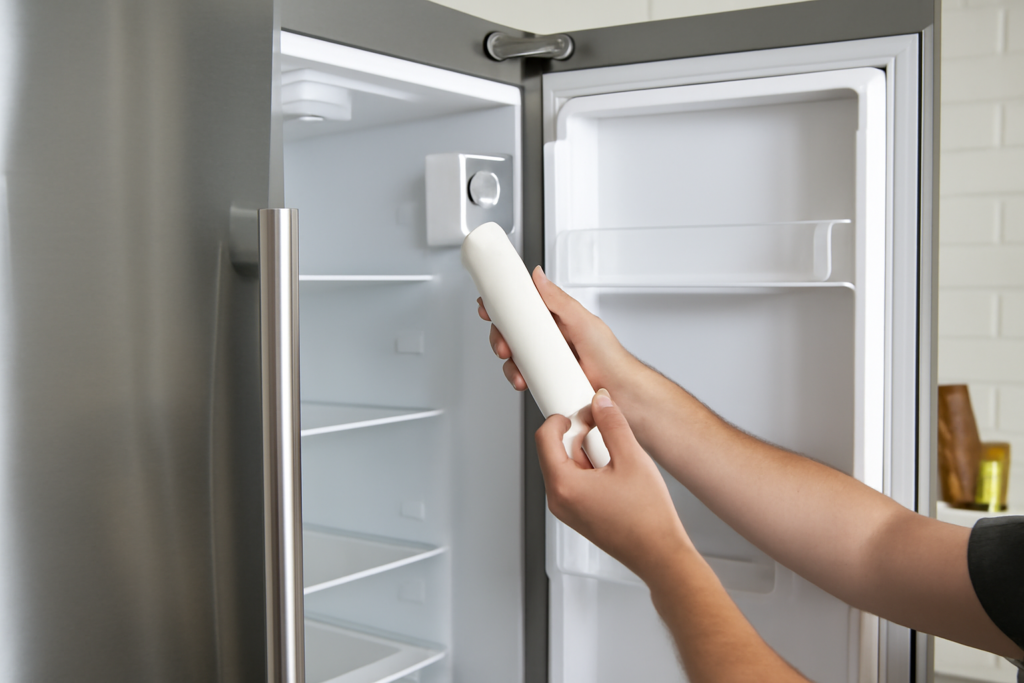
- Turn the old filter about a quarter-turn counterclockwise until it releases, then pull it straight out. Expect a little water to drip; keep a towel handy.
- Remove the protective cap from the new cartridge and check the O-rings are seated and lightly damp.
- Push the new filter in and turn clockwise a quarter-turn until it stops. It should feel snug, not forced.
- Dispense at least 3 to 4 gallons of water — a couple of full pitchers — to purge trapped air and carbon fines. The first pours will sputter and look cloudy; that is air, not a defect.
- Reset the filter indicator: press and hold the filter-reset button (or the water/dispenser lock button, per your model) for about 3 seconds until the light clears.
Replacement Interval
Bosch specs every 6 months or roughly 200 gallons, whichever comes first. If your household drinks a lot of dispensed water, or your incoming water carries heavy sediment, lean toward the shorter interval. The dashboard light is a calendar timer, not a real sensor — it does not know how much water you have actually used, so treat it as a reminder and judge by taste and flow too. Hard-water homes will see the filter slow sooner.
OEM vs Generic Filters
This is the question I get most. Third-party filters cost $10 to $20 versus $40 to $60 for genuine Bosch UltraClarity. My honest take:
- Fit: Good generics match the physical keying and seal fine. Cheap ones leak or fit loosely — a leaking filter head can dump water into the compartment.
- Certification: Genuine Bosch cartridges are independently NSF-certified for specific contaminant reductions. Many generics claim “NSF-certified materials,” which is not the same as the finished filter being certified for lead or cyst reduction. If you rely on the filter for contaminant removal beyond taste, buy OEM or a filter with genuine end-product NSF 53 certification.
- My rule: For taste and odor only, a reputable generic is fine. For health-related contaminant reduction, spend on genuine Bosch.
Troubleshooting Slow or No Water
When the dispenser slows after a filter change, the usual suspects, in order:
- Air not purged. Run several more gallons. New carbon needs flushing.
- Filter installed slightly clogged from the start — a defective or old-stock generic. Swap it and test.
- Frozen water line in the door, common if the fridge is set very cold. A trickle from the dispenser but no ice points here.
- Low household water pressure. Bosch dispensers want at least 30 psi. A partially closed supply valve behind the fridge is a frequent culprit.
- Kinked or pinched supply line where the fridge was pushed back against the wall.
If water flows fine with the filter removed and the bypass plug installed, the filter is the restriction. If it is still slow with the bypass in, the problem is upstream in the valve or line.
What the Filter Actually Removes
Understanding what your cartridge is certified to do helps you decide between OEM and generic. Genuine Bosch UltraClarity and UltraClarity Pro filters carry NSF/ANSI certifications for specific reductions:
- NSF/ANSI 42: Chlorine taste and odor, plus particulates. This is the baseline nearly every filter meets.
- NSF/ANSI 53: Health-related contaminants — the UltraClarity Pro is certified to reduce lead, mercury, certain pesticides, and microbial cysts like cryptosporidium and giardia. This is the certification that matters if you are filtering for safety, not just taste.
- NSF/ANSI 401: Certain “emerging contaminants” such as trace pharmaceuticals, which some newer cartridges address.
A carbon-block filter does not soften water or remove dissolved minerals, so it will not stop scale in a hard-water home — that is a job for a softener, not a fridge filter. Knowing this saves you from expecting the filter to fix problems it was never designed for.
Signs Your Filter Is Overdue
Do not wait for the dashboard light, which is only a calendar timer. Watch for these real symptoms:
- Slower dispenser flow as the clogged carbon block chokes water passage.
- A return of chlorine taste or odor — the carbon has saturated and stopped adsorbing.
- Cloudy or off-tasting ice from a starved, sediment-loaded filter.
- Black flecks in the water, which are loose carbon fines from an old, breaking-down cartridge.
Any of these means change the filter now, regardless of what the indicator says. A cartridge past its useful life is worse than no filter — the saturated carbon can harbor bacteria and release trapped contaminants back into your water.
The Bypass Plug
Every Bosch that uses a filter came with a bypass plug. If you cannot get a filter right away, install the bypass so you still have unfiltered water and ice — running the dispenser with the filter port empty and no bypass can cause leaks on some models. Keep that plug; people always lose it.
Buying Tips to Avoid Getting Burned
A few pointers from years of watching people buy the wrong cartridge or overpay:
- Buy in multi-packs. Genuine Bosch filters cost noticeably less per unit in two- or three-packs, and you use them on a fixed schedule anyway.
- Check the certification claim carefully. “Tested to NSF standards” and “made with NSF-certified materials” are not the same as the finished filter being NSF-certified for lead or cyst reduction. For health filtration, insist on genuine end-product NSF 53 certification.
- Confirm UltraClarity vs UltraClarity Pro before ordering. They look similar but the housing keying differs and they do not interchange.
- Beware counterfeit OEM filters sold cheaply through third-party marketplaces. A fake with a loose seal can leak into the compartment. Buy from the manufacturer or an authorized seller.
Bottom Line
Changing your Bosch refrigerator water filter on a six-month schedule with the correct UltraClarity or UltraClarity Pro cartridge is the cheapest maintenance you will ever do on the appliance. Match the part number exactly, flush a few gallons after every swap, reset the indicator, and you will get clean-tasting water and full ice production without a single service call.