A single stain, burn, or pet accident does not have to mean replacing 600 square feet of carpet. Carpet patches let you cut out the damaged section and drop in a clean piece sourced from a closet, hallway, or original waste roll — often invisibly if you match the pile direction and seam carefully. Done right, the repair lasts the life of the carpet for under $40 in materials.
When Patching Is the Right Call
Patching works on damage smaller than roughly 8 inches by 8 inches in plush, frieze, and most cut-pile carpets. Looped pile and patterned broadloom are harder because pattern matching adds difficulty and visible seams. Burn marks from cigarettes, irons, or curling wands, pet urine spots that have penetrated to the pad, paint or dye stains, and tears from a moving van wheel all qualify as patchable.
Whole-room or full-replacement is the better call when damage covers more than 15% of a room, when the carpet is over 10 years old and already showing traffic-pattern wear, or when the original carpet was installed without saving a donor remnant and you cannot find a matching SKU.
Sourcing a Donor Piece
- Original installer remnant — most installs leave 10% to 20% offcut; check garages, attics, and basement storage
- Hidden closet floor — cut a 12 inch by 12 inch square from a master closet that no one sees, replace with a vinyl tile or rubber mat
- Under a couch or large furniture piece — the donor area never sees foot traffic and is invisible if you ever move
- Original SKU from the retailer — if installed under 5 years ago, the dealer can often source a 2-by-2 foot offcut for $25 to $80
- Manufacturer dye-lot matching — Mohawk and Shaw can ship a single square yard from current stock when SKU and dye lot match within 2 to 3 years of original install
Tools You Need
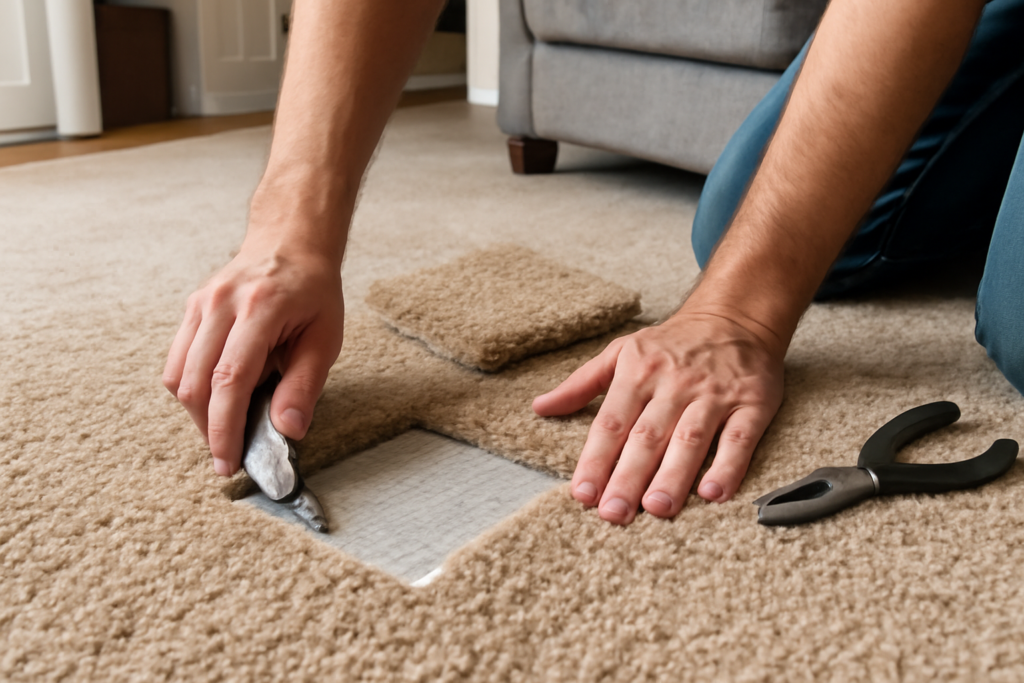
The patch kit is short. A double-cutter or carpet patching tool from Roberts at $35 to $55 cuts both the damaged section and the donor piece in a single motion. A sharp utility knife with fresh blades. A straight edge or carpet square. Carpet seam tape with hot-melt adhesive, sold in 12-foot rolls at $15 to $25. A seam iron rented for $15 to $25 per day from Home Depot or any flooring tool supplier. A clean white cloth and lukewarm water for cleanup.
If you do not own a double cutter, a sharp utility knife with a metal straightedge works on smaller patches but requires steadier hands. Cut from the back side of the donor piece for cleaner edges that do not show fraying at the seam.
Step-by-Step Patch Procedure
- Identify the pile direction on both the damaged carpet and the donor — run your hand across the surface and note which way the nap lies
- Cut a square shape around the damage 1 to 2 inches larger than the visible problem, going through the entire pile but not the secondary backing
- Cut the donor piece exactly the same size, matching pile direction so the nap lays the same way as the surrounding carpet
- Slide a strip of seam tape under the cut edges, hot-melt side facing up toward the carpet backing
- Press the donor piece into place and run a heated seam iron over the seam tape for 20 to 30 seconds per inch to activate the adhesive
- Weight the patch with a stack of books for 4 to 6 hours while the adhesive cools and bonds
Common Mistakes That Make Patches Visible
Mismatched pile direction is the most common error. Even with an exact color match, a patch installed with the nap running the opposite direction will catch light differently and read as a visible square from across the room. Always confirm pile direction with your hand before cutting.
Oversized cuts that go beyond the damage by more than 2 inches leave longer seams that telegraph more under foot traffic. Stick to the minimum size that captures the problem. Skipping seam tape and trying to glue the patch directly leaves a bumpy surface where the backing buckles at the edges. Use proper carpet seam tape every time, not duct tape or general-purpose adhesive.
Pet Urine and Pad Damage
If urine has penetrated to the pad and subfloor, patching the carpet alone leaves the smell and contamination intact. Lift the damaged carpet patch, cut out the matching pad section, clean the subfloor with an enzyme cleaner like Nature’s Miracle or Anti-Icky-Poo, let dry 24 hours, then install fresh pad cut from a remnant or purchased by the linear foot at $0.49 to $0.79 per square foot. Only then patch the carpet on top.
Severe urine damage that has soaked into the subfloor plywood may require sealing with Kilz or BIN shellac primer at $40 to $60 per gallon before laying fresh pad. Skipping this step lets odor bleed through to the new carpet within weeks.
When to Call a Pro
Pro carpet repair costs $150 to $400 per patch in most US metro markets in 2026, with a service call minimum often $125 to $175. For larger damages over 12 inches square, complex patterns, looped pile, or carpet older than 15 years where stretching and reseaming the patch is needed, a pro is the safer call. Companies like Stanley Steemer, Chem-Dry, and local independents typically deliver invisible repairs in 60 to 90 minutes per patch.
The break-even between DIY and pro is roughly the 4-inch by 4-inch mark. Below that, DIY almost always works. Above that, the pattern matching and tension control on a larger seam justify hiring help, especially on patterned and looped products.
Long-Term Maintenance to Avoid Future Patches
Walk-off mats at every exterior door reduce 60% to 80% of the dirt that grinds into carpet pile. Felt pads on furniture legs prevent the dragging that creates pile damage at edges. A no-shoes policy in carpeted areas cuts wear by roughly half over a 10-year period. Vacuum twice a week minimum with a properly maintained beater bar — replace the brush every 12 to 18 months as the bristles wear down. With those routines in place, carpet patches become a rare emergency rather than a regular task, and the original install holds up to its full 15 to 25 year warranty service life.