A 12-foot roll of broadloom weighs 250 to 400 pounds, and stacking it on the floor crushes the pile, traps moisture against the backing, and creates a tripping hazard around it. That is why every working flooring shop, installer’s garage, and serious DIY workshop benefits from purpose-built carpet roll storage racks. They keep rolls clean, organized by SKU, and easy to cut from without dragging 30 feet of nylon across a dusty floor.
- What a Carpet Roll Rack Actually Solves
- Types of Carpet Roll Storage Racks
- Sizing the Rack to the Roll
- Weight Ratings and Load Math
- Brand and Pricing Tiers
- Installation, Anchoring, and Code Notes
- Organizing Inventory on the Rack
- Loading, Unloading, and Safety
- DIY Versus Pre-Engineered
- Climate Control and Roll Protection
What a Carpet Roll Rack Actually Solves
Rolls stored on concrete absorb humidity through capillary action and develop a musty smell within 60 days. Stacked rolls flatten in oval cross-sections that show as memory creases for weeks after installation. A horizontal rack keeps each roll suspended on cradles, off the slab, and individually accessible without moving anything else.
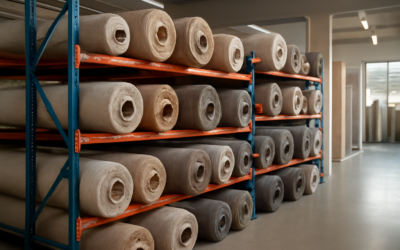
Beyond protection, racks reclaim floor space. A 10-foot section of standard pallet rack converted to roll storage holds eight to twelve 12-foot rolls in the same footprint a single roll would consume lying flat. For a flooring contractor, that means fitting an entire job in a 10-by-4 zone instead of half a garage.
Types of Carpet Roll Storage Racks
- Cantilever racks: Single-sided or double-sided arms in 12, 14, or 16-foot widths. Best for shops handling rolls daily.
- A-frame racks: Free-standing triangular frames with cradle slots. Affordable and movable, but limited to 4 to 8 rolls.
- Pallet-rack conversions: Standard teardrop uprights with cradle beams. Modular and inexpensive if you already own pallet rack.
- Vertical storage: Rolls stood on end in tubes. Saves floor space but pinches backing and is generally avoided for premium carpet.
Sizing the Rack to the Roll
Broadloom carpet ships in 12-foot widths almost universally in the US, with 15-foot rolls common from Shaw and Mohawk. Rolls run 90 to 120 feet long when delivered, but most installers store half-rolls of 30 to 60 feet. Plan rack widths of 13 feet minimum to clear the roll plus end caps, and 16 feet if you stock 15-foot product.
Roll diameters land between 14 and 22 inches depending on pile height and length. Space cradles at 22 to 26 inches vertically so a full roll loads without scraping the level above it.
Weight Ratings and Load Math
A full 12-foot by 100-foot roll of standard residential nylon weighs about 380 pounds. Commercial loop with action backing climbs to 600 pounds. Budget racks rated at 500 pounds per level fail when stacked with two rolls. Choose racks with a minimum 1,500-pound per-arm rating for safety margin and to satisfy OSHA general duty requirements in commercial settings.
Steel King Cantilever and Jracking offer 2,000 to 4,000-pound arm ratings. Husky industrial pallet rack with cradle conversions costs less but caps around 1,000 pounds per beam pair. Always derate by 25 percent for dynamic loads from forklifts or roll carts.
Brand and Pricing Tiers
Three tiers cover almost every situation:
- Entry tier ($200 to $500): Husky 4-tier A-frame racks at Home Depot, generic pallet rack from Uline. Good for installers storing 4 to 8 rolls.
- Mid tier ($800 to $2,500): Jracking single-sided cantilever in 8 or 12-foot heights, capacity 12 to 24 rolls. Standard shop choice.
- Pro tier ($3,000 to $8,000): Steel King double-sided cantilever, Republic Storage, or Meco-Omaha custom rolls. Capacity 30 plus rolls, designed for daily forklift use.
Add roll cradles or saddles at $25 to $75 each. A 40-roll system with cradles typically lands at $3,800 to $5,500 fully installed.
Installation, Anchoring, and Code Notes
Cantilever racks over 8 feet tall must be anchored to a concrete slab per OSHA 1910.176 and most local building codes. Use Hilti Kwik Bolt 3 or Simpson Strong-Bolt 2 in 1/2-inch by 4.5-inch sizes, four per base plate, into a slab thicker than 4 inches at 3,000 psi minimum. A torque wrench set to 40 ft-lb seats the wedge anchors properly.
Check ceiling clearance, sprinkler heights, and forklift turning radius before ordering. The biggest install mistake is buying 12-foot uprights for a 10-foot ceiling.
Organizing Inventory on the Rack
Label each cradle with SKU, color, and remaining length. A Brother P-touch label maker and clear vinyl sleeves keep labels readable for years. Stock heavy commercial rolls on lower levels and light pad or residential on the top to keep the center of gravity low.
Group by job rather than by product line when possible. Pulling four rolls for a single house in one trip beats hunting across three rack runs. For shops handling rolls weekly, a simple spreadsheet tied to rack location codes prevents the classic mistake of cutting from the wrong roll.
Loading, Unloading, and Safety
Two people can load a 6-foot remnant by hand, but full rolls demand a roll cart, a forklift with a carpet pole, or a boom attachment. Carpet poles like the Bishamon RT-30 or shop-built 1.5-inch schedule 80 pipe slide through the cardboard core, letting a forklift lift and place the entire roll on its cradle in 30 seconds.
Wear leather gloves and steel-toe boots whenever handling rolls. A roll slipping off a cradle has caused enough crushed feet that flooring trade groups list it as a leading shop injury.
DIY Versus Pre-Engineered
A capable welder can build an A-frame rack from 2-inch square tubing for under $200 in materials, suitable for 6 to 8 rolls. Beyond that, engineered cantilever rack is safer and almost always cheaper per roll once steel, time, and code compliance are tallied. For permanent shops, spend the money on Steel King or Jracking and forget the rack exists for the next 20 years.
Climate Control and Roll Protection
Carpet rolls absorb humidity over weeks of storage, which can show as latex backing tackiness or face-yarn discoloration. Maintain shop relative humidity between 40 and 55 percent year-round. A commercial dehumidifier like the Aprilaire E100 handles 1,500 to 3,000 sq ft of shop space and runs about $1,400 installed. For dusty conditions, wrap stored rolls in 4-mil polyethylene sheeting and secure with painter’s tape. Replace wrap if torn during cuts.
Avoid storing rolls near exterior walls in cold climates. Condensation forms when warm shop air meets cold steel siding, and rolls against the wall absorb that moisture through the cardboard core. Keep at least 24 inches of clearance between racks and exterior walls. This single placement detail extends roll life and stops the most common warranty-claim issue flooring contractors face.