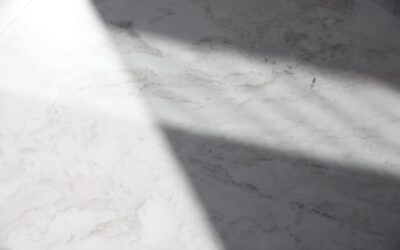
Few materials read as instantly luxurious as Carrara marble flooring, with its soft white-to-gray field and feathery, low-contrast veining quarried from the mountains above Carrara, Italy. It’s been underfoot in palaces and museums for centuries — but living with it day to day takes a clear-eyed look at what this stone can and can’t do.
Part of our Countertops guide — explore the full guide →
Having set plenty of marble over the years, I’ll walk you through honed versus polished, sealing and etching, real-world costs, and the rooms where Carrara thrives versus the ones where it’ll test your patience.
What Is Carrara Marble?
Carrara is a metamorphic stone — limestone recrystallized under heat and pressure — prized for its bright, cool background and subtle gray veining. Compared to bolder Calacatta or warmer Statuario, Carrara runs grayer and more uniform, which is exactly why designers love it for understated, timeless rooms. It’s softer than granite or porcelain, sitting around 3 to 4 on the Mohs scale, and it’s calcium-based, so it reacts to acids.
That chemistry is the headline. The same composition that gives Carrara its glow also makes it vulnerable to staining and etching. Understanding that trade-off up front is the difference between loving your floor for decades and regretting it after the first spilled glass of wine.
Honed vs. Polished Finish
Your finish choice shapes both the look and the upkeep more than anything else.
Polished
Buffed to a reflective, glassy sheen that deepens the veining and brightens a room. Stunning, but it shows etch marks — dull spots from acids — vividly, and it’s slick when wet. Best for formal, low-traffic, dry spaces.
Honed
Ground to a smooth matte with no shine. It hides etching far better because there’s no gloss to dull, and it offers more grip underfoot. Most pros recommend honed for any floor, especially kitchens, baths, and entries. The trade-off is that a matte surface absorbs spills a touch faster, so honed marble needs diligent sealing.
Sealing, Etching, and Staining
Two different problems get confused constantly, so let’s separate them. Staining is a color change from a liquid (coffee, oil, red wine) soaking into the porous stone. A quality penetrating sealer slows absorption and buys you time to wipe spills — plan to reseal every 6 to 12 months, and test by dripping water: if it darkens the stone, it’s time to reseal.
Etching is different and sealer won’t stop it. When an acid — lemon juice, vinegar, tomato, many cleaners — touches calcium-based marble, it chemically eats a dull, frosted mark into the surface, even through sealer. On polished marble it’s obvious; on honed it’s nearly invisible. The only real defenses are wiping acids immediately, using pH-neutral stone cleaners, and accepting that a marble floor develops a lived-in patina over time.
Pros of Carrara Marble Flooring
- Timeless, high-end look. The soft gray veining never goes out of style and signals quality to buyers.
- Naturally cool underfoot. Marble stays cool in summer and pairs beautifully with radiant heat in winter.
- Unique and natural. No two slabs or tiles match exactly; you get a one-of-a-kind floor.
- Long lifespan. Cared for properly, marble lasts generations and can be refinished by re-honing or re-polishing.
- Adds resale value. Genuine marble in the right rooms reads as a premium upgrade.
- Brightens spaces. Its light, reflective surface makes small or dim rooms feel larger.
Cons of Carrara Marble Flooring
- Etches from acids. Sealer can’t prevent it; spills must be wiped fast.
- Stains if unsealed. Its porosity demands regular sealing every 6 to 12 months.
- Relatively soft. Scratches and chips more easily than porcelain or granite.
- Slippery when polished and wet. A safety concern in bathrooms unless honed.
- Cold and hard. Less comfortable to stand on for long periods without rugs or radiant heat.
- Installation cost and skill. Heavy, brittle tiles need an experienced setter and a flat, well-prepped substrate.
What Carrara Marble Flooring Costs
Carrara is one of the more affordable natural marbles, which is part of its appeal. Expect material to run roughly $5 to $15 per square foot for standard 12-by-12 or 18-by-18 tile, with larger slabs and premium grades higher. Installed — including substrate prep, setting, grouting, and sealing — most projects land between $15 and $40 per square foot. Honing or polishing on site, intricate patterns, and heated-floor underlayment push the upper end. Budget another 7% to 12% in overage for cuts, breakage, and future repairs, since marble is brittle and exact dye-lot matches are hard to source later.
Where to Use It (and Where to Avoid)
Play to the stone’s strengths. Honed Carrara is gorgeous and practical in primary and guest bathrooms, formal entries, dining rooms, and as a statement floor in a powder room. Paired with radiant heat, it turns a cold-feeling material into a genuine comfort.
Be cautious in heavy-use kitchens, where acidic foods and dropped cookware are constant threats — if you must, go honed and commit to immediate spill cleanup. Steer clear of mudrooms and high-grit entries where sand acts like sandpaper, and think twice in homes with large dogs whose nails scratch soft stone. A practical compromise: use real Carrara in the showcase rooms and a high-quality marble-look porcelain in the punishing ones. You get the look where guests notice it and worry-free durability where life happens.
Day-to-Day Care Tips
Living with marble is easier when you build a few habits. Keep walk-off mats at exterior doors to trap grit before it reaches the stone. Sweep or dust-mop every few days so abrasive particles don’t grind into the surface underfoot. For washing, use only a damp mop and a pH-neutral stone cleaner — skip vinegar, lemon, bleach, and most general-purpose sprays, all of which etch or strip sealer.
Blot spills rather than wipe them, since wiping spreads an acidic liquid over more surface. Place felt pads under furniture legs and avoid dragging heavy pieces across the floor. If etch marks do appear over the years, a stone pro can re-hone the affected area or apply a marble polishing powder to restore the surface without replacing tile. Treated this way, a Carrara floor ages with grace instead of wearing out.
The Bottom Line
Carrara marble flooring rewards owners who value character and timeless beauty over a flawless, bulletproof surface. Choose a honed finish, seal it on schedule, wipe acidic spills fast, and accept a gentle patina as part of the charm. Do that, and you’ll have a floor that looks like it belongs in a villa and lasts for generations.
Prefer to explore on your own?
See how new flooring looks in your actual room in seconds — free, no signup.
Try the free Floor Studio →