The humble caulk tube is one of those objects everyone has held and almost nobody has thought about — until they’re standing in the aisle wondering why one tube is 10.1 ounces and another is 9.8, whether the big quart-size cartridge fits their gun, or what the foil sausage things at the contractor supply are. Packaging determines what gun you need, what the sealant costs per ounce, how much joint a package covers, and how well leftovers keep. So here’s the full anatomy-and-sizes tour of sealant packaging in the US market.
Part of our Paint & Walls guide — explore the full guide →
Anatomy of a Standard Cartridge
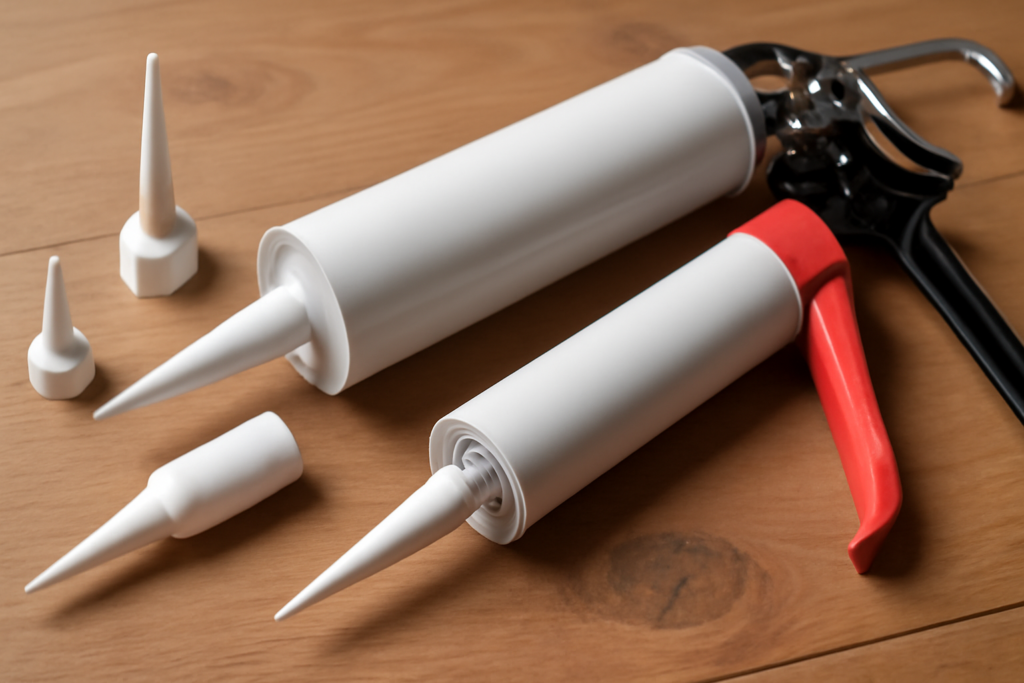
The familiar tube is properly called a cartridge, and it’s a small piece of clever engineering with five parts:
- Body. A rigid cylinder — spiral-wound cardboard with a moisture barrier on cheap acrylics, polyethylene plastic on silicones and premium sealants (silicone’s cure chemistry and shelf life demand plastic). Nominal 10-ounce size fits every standard gun.
- Nozzle (spout). The tapered plastic cone you cut to size. On many cartridges it’s molded or spun onto the body permanently; on others — most silicones — it threads on and off, which lets you replace clogged tips and cap the cartridge properly. Threaded nozzles are a small mark of a better package.
- Inner seal. A foil or plastic membrane at the nozzle base keeping the product airtight until you puncture it. Not universal, but assume it’s there.
- Plunger (piston). The sliding disc in the base that the gun’s rod pushes forward. Quality plungers seal tightly against the body wall; cheap ones let sealant blow past on thick product in cold weather — that gray ooze around your gun’s pusher plate.
- Shoulder and crimp. Where nozzle meets body. Blowouts here mean over-pressure, usually from an unpunctured seal or cured plug.
The Size Lineup
| Package | Volume | Gun Required | Typical Use |
|---|---|---|---|
| Squeeze tube | 2.8–6 oz | None — hand squeezed | Small repairs, touch-ups |
| Standard cartridge | 9–10.3 oz (nominal “10 oz”) | Standard gun ($5–$40) | Nearly everything residential |
| Quart cartridge | 28–29 oz | 29 oz large-barrel gun ($15–$60) | Subfloor adhesive, concrete joints, high volume |
| Sausage/chub | 10 or 20 oz | Sausage gun ($40–$120) | Commercial sealants, pro crews |
| Bulk pails | 2–5 gal | Bulk-loading gun | Industrial waterproofing |
About that “10-ounce” standard: actual fills range from 9.0 to 10.3 fluid ounces depending on brand and product — check the label, because shrinking fills are one of the quiet ways budget lines cut cost. All of them fit the same standard gun; the variation is purely how much is inside. The 29-ounce quart cartridge is the same design scaled up, and it does NOT fit a standard gun — you need a dedicated large-barrel model. Quarts dominate construction adhesives (subfloor glue lives here) and concrete/blacktop sealants, where the per-ounce savings and fewer reloads matter. Sausage packs — collapsible foil casings without built-in nozzles — are the commercial world’s standard and need their own gun; they earn a full article of their own, so it is enough to note here that they exist, they’re 20 ounces, and the premium polyurethanes and glazing silicones often cost less per ounce in that format.
Squeeze tubes deserve a fair word: for a single faucet base or an inch of gap, a $5 hand-squeezed tube beats opening a cartridge you’ll throw away half-used. Control is worse — thumb pressure is lumpier than a gun trigger — so keep them to short, forgiving joints.
How Far a Tube Goes
Coverage is simple geometry: bead volume per foot versus package volume. Working numbers for estimating:
- A 1/4-inch bead runs roughly 25 to 30 linear feet per 10-ounce cartridge (a 1/4″ x 1/4″ joint works out to about 30 feet at zero waste; real life eats some).
- A 3/16-inch bead stretches to roughly 45 to 55 feet.
- A 3/8-inch joint over backer rod drinks a cartridge in 12 to 15 feet.
Practical translations: one cartridge caulks a tub surround with plenty to spare; a bathroom (tub, floor perimeter, vanity backsplash) is one to two; a whole-house exterior re-caulk on fiber cement runs 15 to 25 cartridges — which is exactly the volume where quart cartridges or sausages start making financial sense. Sealant is cheap next to your time: buy one more tube than the estimate says, because a Sunday-afternoon run to the store for the last six feet of joint is the most expensive caulk you’ll ever purchase.
Reading the Tube Before You Buy
The cartridge label carries everything that matters, in small print:
- Chemistry — acrylic latex, siliconized acrylic, 100% silicone, polyurethane, or hybrid/SMP. This single line determines where the product can live.
- ASTM C920 rating and movement class (Class 25, 35, 50) on serious sealants — the higher the class, the more joint movement it tolerates.
- Paintability, cure time, and application temperature range. “Paint-ready in 30 minutes” versus “do not paint” is a label read, not a guess.
- Date code. Stamped on the crimp or base. Sealants have real shelf lives — roughly 12 to 18 months for silicone, about 2 years for acrylics — and expired product may never cure right. Slow-turnover stores absolutely sell stale tubes; check the stamp like you’d check milk.
- Fill volume. As above: 9.0 versus 10.3 ounces is a 14 percent price difference hiding in plain sight.
Storing Opened and Unopened Tubes
Unopened cartridges want a climate-controlled shelf — repeated freezing ruins latex acrylics, and heat accelerates every chemistry’s aging. The garage attic is the worst place in America to store caulk, and it’s where everyone stores it. Opened cartridges cure from the nozzle tip inward; how long they survive depends entirely on how well the tip is sealed. A taped-over tip buys days; a proper cap, a golf tee, or a purpose-made tube sealer buys weeks to months, especially on acrylics. Silicones are the worst keepers — moisture-cure chemistry means humid air in the nozzle keeps curing product regardless. When you return to a stored tube, probe the nozzle: a shallow cured plug pulls out with a screw and pliers; a body that squeezes rubbery instead of fluid is done. Budget accordingly — for silicone especially, treat a cartridge as a single-project consumable and consider anything usable later as a bonus.
Cartridge Problems and What They Mean
The package itself fails in recognizable ways. Sealant oozing around the gun’s pusher plate means the plunger blew by — usually thick product, cold weather, and a cheap cartridge body; warm the tube and slow down. A nozzle that launches off mid-squeeze means pressure had nowhere to go: unpunctured inner seal or a cured plug in the tip. A cardboard-bodied tube that feels soft or swollen took on moisture in storage and its plunger will jam or tear through — retire it. And a brand-new tube that guns out watery, separated liquid ahead of the sealant has sat past its date or through a freeze; stop and check the batch stamp before that separation ends up in a joint. None of these are mysterious once you know the anatomy — they’re the five parts of the cartridge each telling you which one gave up.
Recycling and Disposal
Fully cured residue is inert household waste. Empty plastic cartridges are technically recyclable polyethylene but sealant residue keeps them out of most curbside programs, so they’re trash in practice — one more argument for right-sizing your purchase and for sausage packs on big jobs, whose crushed foil pucks generate a fraction of the volume. Liquid unused sealant shouldn’t be poured out; cure it (squeeze onto cardboard, let it set) and toss it solid, or take intact stock to household hazardous-waste collection if the label directs.
The Buying Rules
Match the package to the volume of work: squeeze tube for a repair measured in inches, standard cartridges for rooms, quarts or sausages for whole-house and adhesive work — and confirm you own the gun the package needs before checkout. Prefer cartridges with threaded, removable nozzles when the brand offers them. Check the date code, check the actual fill, and buy the extra tube. None of this is complicated, but the packaging layer is where a lot of jobs quietly go sideways — the wrong size for the gun in the truck, a stale tube that never cures, or three half-used cartridges hardening on a shelf because each was opened for one small joint. Understand the tube and the sealant inside gets a fair chance to do its work.