Garage floors take more abuse than any other surface in the house — hot tires, dropped tools, road salt, oil leaks, and seasonal temperature swings from 40 below to 110 degrees F. Most homeowners want to cover the bare concrete cheaply without ending up with a worse-looking, faster-failing floor than what they started with. The cheapest garage flooring that still performs reliably comes down to four categories: porch and floor paint, DIY epoxy kits, roll-out vinyl mats, and interlocking PVC tiles. Each has a clear sweet spot.
Part of our Epoxy, Concrete & Garage Floors guide — explore the full guide →
Cost Comparison Across Options
Latex porch and floor paint runs $0.20 to $0.40 per sq ft in material — a 1-gallon Rust-Oleum or Behr porch paint covers 200 to 400 sq ft at $35 to $50. Single-part epoxy paint sits at $0.40 to $0.80 per sq ft. DIY two-part epoxy kits from Rust-Oleum EpoxyShield, Quikrete Epoxy Garage Floor Coating, or Behr Premium Granite Grip cost $1.20 to $2.50 per sq ft. Roll-out vinyl mats from G-Floor or BLT run $1.50 to $4 per sq ft. Interlocking PVC tiles from RaceDeck, Swisstrax, and SnapLock sit at $3 to $7 per sq ft.
Professional commercial-grade epoxy installation jumps to $5 to $12 per sq ft installed — out of scope for “cheapest” but the long-term durability winner.
If you’re running out of room even with a clean garage floor, a backyard shed takes the overflow — seasonal gear, tools, lawn equipment. And if you’re parking outside while the garage doubles as a workshop, a carport keeps your car covered without needing a second garage.
We may earn a commission when you purchase through our links.
Paint: The True Bargain Option
Two coats of quality porch and floor paint over properly prepped concrete delivers a clean finished look for under $100 in a single-car garage. Behr Premium 1-Part Epoxy Concrete and Garage Floor Paint covers 300 sq ft per gallon at $40. Expected life is 2 to 4 years before chipping starts at high-wear zones (where tires sit, in front of workbenches). Paint is the right choice if you want a quick refresh, you rent the property, or you’ll redo it every few years anyway.
Pros: cheapest material cost, easiest reapplication, widely available. Cons: poor chemical resistance, peels under hot tires, no impact protection.
DIY Epoxy Kits: The Best Value
For most owners, two-part epoxy kits hit the sweet spot. A Rust-Oleum EpoxyShield kit covers 250 to 500 sq ft depending on coverage rate and includes resin, hardener, concrete cleaner, and decorative chips. Material cost per sq ft is $1.20 to $2.50. Properly applied, expect 5 to 10 years of service before noticeable wear, much longer in low-traffic side bays.
The critical step is concrete prep. Etch the slab with the included muriatic acid wash or rent a concrete grinder for 4 to 6 hours — the kit fails on glossy or sealed concrete because the epoxy can’t bond mechanically. After prep, mix and apply within the kit’s pot life (typically 90 to 120 minutes) at 60 to 85 degrees F and below 75 percent humidity.
Roll-Out Vinyl: Zero Prep Required
G-Floor Garage Flooring is a polyvinyl chloride sheet 55 to 90 mil thick that rolls out over concrete without adhesive or prep. A 10-by-24-foot single-car coverage sheet costs $350 to $600. The vinyl resists oil, gasoline, and hot tires up to 200 degrees F, and the textured surface provides slip resistance even when wet.
Pros: install in under an hour, no curing time, no concrete prep, removable for rental properties. Cons: doesn’t fix cracks or stains underneath, edges can curl under hot tires if not weighted, vinyl smell off-gasses for the first week. Lifespan is 10-plus years with normal use.
Interlocking PVC Tiles: Premium Pricing
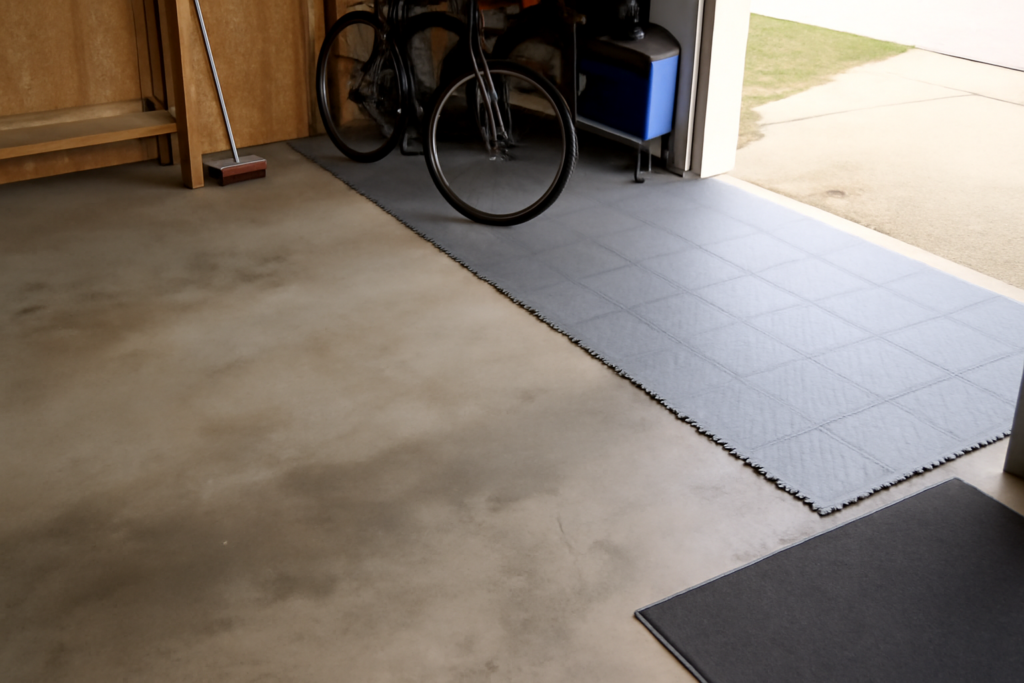
RaceDeck Diamond, Swisstrax Ribtrax, and SnapLock garage tiles snap together over uneven concrete and hide cracks or stains underneath. Material cost runs $3 to $7 per sq ft. A two-car garage at 400 sq ft costs $1,200 to $2,800. They’re not really “cheapest” but they install in two to four hours, handle hot tires, and survive in unheated garages where epoxy can fail in freeze-thaw cycles.
For owners with cracked or pitted slabs, tiles are often cheaper net than the concrete repair plus epoxy required to make a smooth slab usable.
Pros and Cons of Going Cheap
The cheap options all share three weaknesses. First, they don’t fix underlying concrete problems — cracks, spalling, or moisture issues need slab repair before any finish floor performs. Second, they offer minimal impact resistance — a dropped wrench dents vinyl and chips epoxy alike. Third, chemical resistance varies wildly. Brake fluid eats both vinyl and most paint within hours; transmission fluid stains epoxy permanently if not wiped immediately.
That said, for a $100 to $1,000 budget, all four options dramatically improve the look and cleanability of bare concrete.
Slab Prep Determines Success
Any garage floor coating fails fast on a poorly prepped slab. ASTM F2170 RH testing should show under 80 percent relative humidity in the slab before epoxy install — moisture vapor blows out cured epoxy from underneath. Etching with phosphoric or muriatic acid opens the surface for bonding; concrete grinding with a 30 to 60 grit metal-bonded diamond is the contractor-grade option. Patch cracks wider than 1/16 inch with concrete repair caulk like Sashco Slab or Sika Concrete Fix.
Realistic Recommendations by Budget
Under $200 for a two-car garage: Behr or Rust-Oleum porch paint. Acceptable for low-traffic spaces. Under $1,000: Rust-Oleum EpoxyShield kit with decorative chips and a topcoat — best value-per-year of any option. $1,000 to $1,500: roll-out G-Floor with edge trim. $1,500 to $3,000: interlocking PVC tiles like RaceDeck Diamond for spaces with cracked or stained concrete.
Choosing the Right Solution
Match the floor to the use case. A workshop garage with regular vehicle traffic and tool use benefits from the chemical resistance of epoxy. A finished man-cave or home gym with no vehicles inside is better off with vinyl roll-out or tiles for cushion. A rental property or short-term stay calls for paint because reapplication is cheap and quick. For most homeowners staying long-term in a daily-driver garage, a quality DIY epoxy kit remains the cheapest garage flooring choice that still delivers years of clean, easy-to-maintain service.