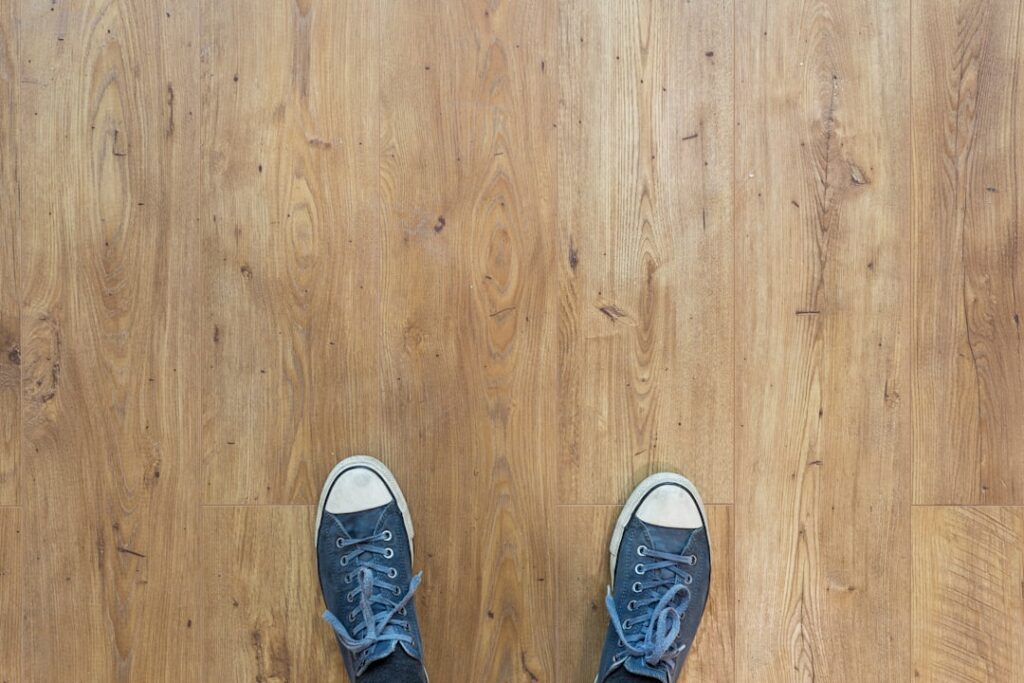
If you want the warmth of real wood without glue, nails, or a professional crew, a floating floor might be exactly what you need. Click lock engineered wood flooring snaps together plank to plank, sitting freely over your subfloor with no fasteners at all. That design has made it one of the most popular DIY flooring options in America, and for good reason: a weekend and a few basic tools are often all it takes. Still, not every click floor is built the same, and understanding the locking mechanism, the core, and the wear layer will save you from costly mistakes. Here is what you need to know before you buy.
- How the Click Lock System Works
- What Engineered Wood Actually Is
- Advantages of a Floating Click Floor
- What It Costs
- Choosing the Right Underlayment
- Installation Tips That Matter
- Where It Works Best and Where It Doesn’t
- Click Lock vs Glue-Down and Nail-Down
- Caring for Your Floor
- Making Your Final Decision
How the Click Lock System Works
Each plank has a machined tongue on two edges and a corresponding groove on the other two. Instead of sliding straight together like older tongue-and-groove wood, you set a plank at roughly a 20- to 30-degree angle, insert the tongue into the groove of the previous row, and drop it flat. The milled profile locks the joint both horizontally and vertically, so planks cannot pull apart or lift.
Two patented systems dominate the market: Unilin’s Uniclic and Valinge’s 5G. The 5G design adds a small plastic tab in the groove that clicks upward as you lower the plank, creating an audible snap and a tighter short-end joint. Both create a floating floor, meaning the whole surface expands and contracts as one unit rather than being anchored down.
What Engineered Wood Actually Is
Engineered wood is not laminate or vinyl. It uses a genuine hardwood veneer, called the wear layer, bonded over a multi-ply or HDF core. The wear layer might be oak, hickory, walnut, or maple, and it is what you see, sand, and live on. Typical wear layers run from 0.6mm on budget floors to 4mm or more on premium products.
The cross-layered core is the real advantage. Because the plies are oriented in alternating directions, the plank resists the seasonal swelling that causes solid wood to cup and gap. That dimensional stability is why engineered wood performs well over concrete slabs, in basements, and above radiant heat, places where solid hardwood is risky.
Advantages of a Floating Click Floor
The click lock approach carries some clear benefits worth weighing:
- No adhesive or nails: Faster installation and no fumes or drying time.
- DIY-friendly: Most homeowners can lay a room in a day with a tapping block, pull bar, and spacers.
- Removable: Floating floors can be lifted and reused if you move or need to replace a plank.
- Works over many subfloors: Plywood, concrete, and even some existing hard surfaces qualify with the right underlayment.
- Real wood surface: You get an authentic hardwood look and, with a thick veneer, the option to refinish.
What It Costs
Pricing spans a wide range based on wear-layer thickness, species, and brand. Budget click engineered floors with a thin 0.6mm to 1mm veneer start around $2.50 to $4 per square foot. Mid-range products with a 2mm to 3mm wear layer typically run $4 to $7. Premium wide-plank floors with a 4mm-plus veneer, European oak, and designer finishes reach $8 to $12 or more.
Because the system is glueless, you save on installation. If you hire out, floating floors cost roughly $2 to $4 per square foot in labor, versus $4 to $8 for glued or nailed hardwood. Doing it yourself, your only added costs are underlayment (about $0.30 to $0.60 per square foot), transition strips, and a $30 to $50 install kit.
Choosing the Right Underlayment
Since the floor floats, underlayment matters more than people expect. It cushions the planks, quiets footfall, and smooths minor subfloor imperfections. Standard foam works over wood subfloors, but over concrete you need a version with an integrated vapor barrier or a separate 6-mil poly sheet to block moisture migration.
Some premium floors ship with attached pad on the underside, which speeds installation and adds sound absorption. In upstairs rooms or condos, check whether your building requires a minimum sound rating (often an IIC of 50 or higher) and choose an acoustic underlayment accordingly.
Installation Tips That Matter
The process is straightforward, but a few details separate a floor that lasts from one that buckles:
- Acclimate the flooring in the room for 48 to 72 hours so it adjusts to your home’s temperature and humidity.
- Leave an expansion gap of roughly 3/8 inch around every wall and fixed object. The floor must be free to move.
- Stagger the seams by at least 6 to 8 inches row to row for strength and a natural look.
- Check subfloor flatness to within 3/16 inch over 10 feet; sand high spots and fill low ones.
- Do not span too far. Most manufacturers cap a continuous run at about 30 to 40 feet before requiring a transition, so plan doorways accordingly.
Keep the room between 60 and 80 degrees Fahrenheit during and after installation, and avoid installing in spaces where humidity swings wildly, like an unconditioned sunroom.
Where It Works Best and Where It Doesn’t
Click lock engineered wood flooring shines in living rooms, bedrooms, hallways, and finished basements. Its stability makes it a strong choice over radiant heat, provided you follow the maker’s temperature limits (usually a surface cap around 82 degrees Fahrenheit). It also suits renters and flippers who value a clean, reversible install.
Avoid it in full bathrooms, laundry rooms, and any area exposed to standing water, since the wood veneer and core can swell if moisture reaches the seams. For those wet zones, tile or waterproof rigid-core vinyl is the safer pick. Kitchens fall in between: they work with prompt spill cleanup and a quality finish, but they are not risk-free.
Click Lock vs Glue-Down and Nail-Down
Engineered wood can be installed three ways, and click lock is only one of them. A glue-down install bonds each plank to the subfloor with adhesive, which feels more solid underfoot and eliminates the slight hollow sound a floating floor can produce, but it costs more in labor and is far harder to remove. A nail-down install works only over a wood subfloor and suits thicker engineered planks rated for fastening.
Click lock wins on speed, reversibility, and DIY accessibility, which is why it dominates the retail market. The trade-off is that hollow acoustic feel on some products and a slightly less permanent bond. If you want the quietest, most solid result and do not mind hiring a pro, glue-down may be worth the premium; for most homeowners, the convenience of clicking planks together tips the scale.
Caring for Your Floor
Engineered wood is still real wood on top, so treat it like hardwood. Sweep or vacuum with a hard-floor setting to lift grit that scratches the finish, and clean with a barely damp microfiber mop using a cleaner made for wood floors. Never soak the surface or use a steam mop, since driving moisture into the seams can swell the core.
Add felt pads to furniture legs, use walk-off mats at entries, and trim pet nails to limit scratches. With a thick enough wear layer, you can screen and recoat the finish after many years to erase accumulated wear, extending the floor’s life well past a decade of daily use.
Making Your Final Decision
When you compare products, look past the price sticker to three numbers: wear-layer thickness (thicker means longer life and refinish potential), core type (HDF is dense and stable, plywood is more forgiving over uneven subfloors), and the finish warranty. A floor with a 3mm oak veneer and a 25-year finish warranty will outlast a bargain plank many times over. Buy 8 to 10 percent extra to cover cuts and future repairs, and keep a few spare planks stored flat. Choose thoughtfully and click lock engineered wood flooring gives you genuine hardwood underfoot with an installation almost anyone can handle.
Prefer to explore on your own?
See how new flooring looks in your actual room in seconds — free, no signup.
Try the free Floor Studio →